Results by title
236 books match the query 'Children's Studies' and 10 start with w
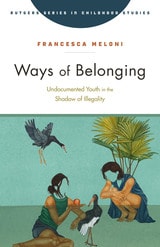
Ways of Belonging
Undocumented Youth in the Shadow of IllegalityFrancesca Meloni
Rutgers University Press, 2024
Ways of Belonging examines the experiences of undocumented young people who are excluded from K–12 schools in Canada and are rendered invisible to the education system. Canadian law doesn’t mention the existence of undocumented children, and thus their access to education rests on discretionary practices and is often denied altogether. This book brings the stories of undocumented young people vividly alive, putting them into conversation with the perspectives of the different actors in schools and courts who fail to include these young people.
Drawing on long-term ethnographic fieldwork, Francesca Meloni shows how ambivalence shapes the lives of young people who are caught between the desire to belong and the impossibility of fully belonging. Meloni pays close attention to these young people’s struggles and hopes, showing us what it means to belong and to endure in contexts of social exclusion. Ways of Belonging reveals the opacities and failures of a system that excludes children from education and puts their lives in invisibility mode.
An interview with the author (https://www.qmul.ac.uk/clpn/news-views/book-interviews/items/interview-with-francesca-meloni-about-her-book-ways-of-belonging-undocumented-youth-in-the-shadow-of-illegality.html)
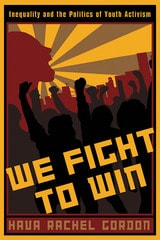
We Fight To Win
Inequality and the Politics of Youth ActivismHava Rachel Gordon
Rutgers University Press, 2009
Hava Rachel Gordon compares the struggles and successes of two very different youth movements: a mostly white, middle-class youth activist network in Portland, Oregon, and a working-class network of minority youth in Oakland, California. She examines how these young activists navigate schools, families, community organizations, and the mainstream media, and employ a variety of strategies to make their voices heard on some of today's most pressing issuesùwar, school funding, the environmental crisis, the prison industrial complex, standardized testing, corporate accountability, and educational reform. We Fight to Win is one of the first books to focus on adolescence and political action and deftly explore the ways that the politics of youth activism are structured by age inequality as well as race, class, and gender.
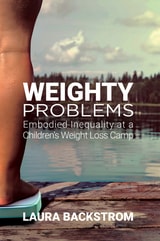
Weighty Problems
Embodied Inequality at a Children’s Weight Loss CampLaura Backstrom
Rutgers University Press, 2019
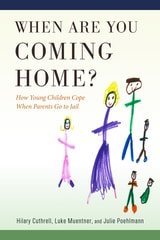
When Are You Coming Home?
How Young Children Cope When Parents Go to JailHilary Cuthrell
Rutgers University Press, 2023

When Kids Get Arrested
What Every Adult Should KnowSandra Simkins, Esq.
Rutgers University Press, 2009
Sandra Simkins provides straight answers to common questions such as:
- Should I let my child talk to the police without a lawyer?
- How can I help my child succeed on probation?
- Should my child admit to the charges or take the case to trial?
- How will this case impact my child's future? Will it prevent him from getting a job or going into the army?
- My child has mental health issues. Can the juvenile justice system help?
- My daughter is out of control. Should I call the police?
- My son got arrested at school and is now suspended. What should I do next?
Simkins takes complicated legal concepts and breaks them down into easy-to-understand guidelines. She includes information on topics such as police interrogation, detention hearings, and bail, along with state-by-state specifics. When Kids Get Arrested is a perfect resource for parents, social workers, guidance counselors, teachers, principals, coaches, and anyone else who works with children.

Why Afterschool Matters
Nelson, Ingrid A.
Rutgers University Press, 2017
Why Afterschool Matters takes a different approach, closely following ten Mexican American students who attended the same extracurricular program in California, then chronicling its long-term effects on their lives, from eighth grade to early adulthood. Discovering that participation in the program was life-changing for some students, yet had only a minimal impact on others, sociologist Ingrid A. Nelson investigates the factors behind these very different outcomes. Her research reveals that while afterschool initiatives are important, they are only one component in a complex network of school, family, community, and peer interactions that influence the educational achievement of disadvantaged students.
Through its detailed case studies of individual students, this book brings to life the challenges marginalized youth en route to college face when navigating the intersections of various home, school, and community spheres. Why Afterschool Matters may focus on a single program, but its findings have major implications for education policy nationwide.
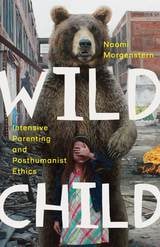
Wild Child
Intensive Parenting and Posthumanist EthicsNaomi Morgenstern
University of Minnesota Press, 2018
Exploring how the figure of the “wild child” in contemporary fiction grapples with contemporary cultural anxieties about reproductive ethics and the future of humanity
In the eighteenth century, Western philosophy positioned the figure of “the child” at the border between untamed nature and rational adulthood. Contemporary cultural anxieties about the ethics and politics of reproductive choice and the crisis of parental responsibility have freighted this liminal figure with new meaning in twenty-first-century narratives.
In Wild Child, Naomi Morgenstern explores depictions of children and their adult caregivers in extreme situations—ranging from the violence of slavery and sexual captivity to accidental death, mass murder, torture, and global apocalypse—in such works as Toni Morrison’s A Mercy, Cormac McCarthy’s The Road, Lionel Shriver’s We Need to Talk about Kevin, Emma Donoghue’s Room, and Denis Villeneuve’s film Prisoners. Morgenstern shows how, in such narratives, “wild” children function as symptoms of new ethical crises and existential fears raised by transformations in the technology and politics of reproduction and by increased ethical questions about the very decision to reproduce. In the face of an uncertain future that no longer confirms the confidence of patriarchal humanism, such narratives displace or project present-day apprehensions about maternal sacrifice and paternal protection onto the wildness of children in a series of hyperbolically violent scenes.
Urgent and engaging, Wild Child offers the only extended consideration of how twenty-first-century fiction has begun to imagine the decision to reproduce and the ethical challenges of posthumanist parenting.
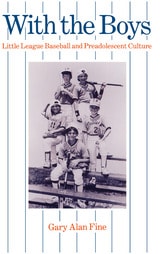
With the Boys
Little League Baseball and Preadolescent CultureGary Alan Fine
University of Chicago Press, 1987
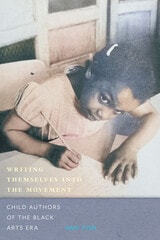
Writing Themselves into the Movement
Child Authors of the Black Arts EraAmy Fish
University of Massachusetts Press, 2024
Between 1967 and 1972, a previously obscure group of authors entered the US cultural spotlight. During this five-year period, at least thirty anthologies of poetry and prose by African American, Latinx, Asian American, and Native American children came out of adult-led workshops, classrooms, and sites of juvenile incarceration. Mass-market publishers, independent imprinters, and local mimeograph machines produced volumes with titles such as I Am Somebody! and The Me Nobody Knows: Children’s Voices from the Ghetto. These young writers actively participated in the Black Arts Movement, and some collaborated with well-known adult authors, most prominently June Jordan. Their anthologies gained national media coverage, occasionally became bestsellers, were quoted by James Baldwin, and even inspired a hit Broadway musical. While writings by children had long attracted adult attention, this flurry of youth writing and publishing was distinguished by the widespread belief that children of color from poor and working-class neighborhoods were uniquely able to speak truth about American racism and inequality.
Focusing on Black and Latinx youth authorship within New York City, and using deep archival research and elegant close readings, Amy Fish examines child-authored texts of this era within the context of their literary production and reception. These young writers were often supervised and edited by white adults, raising concerns about the authenticity and agency of their voices. Fish contends that young authors themselves shared these concerns and that they employed savvy rhetorical strategies of address, temporality, and trope to self-consciously interrogate the perils and possibilities of their adult-influenced work. Young writers thus contributed to the era’s important debates about the nature of authorship and readership within a racist society, while also using their writing as an intimate occasion of self-discovery.
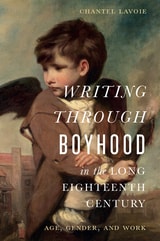
Writing through Boyhood in the Long Eighteenth Century
Age, Gender, and WorkChantel Lavoie
University of Delaware Press, 2024