Results by title
233 books match the query 'Cold War' and 6 start with w
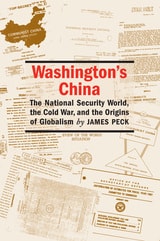
Washington's China
The National Security World, the Cold War, and the Origins of GlobalismJames L. Peck
University of Massachusetts Press, 2006
This book addresses a central question about the Cold War that has never been adequately resolved. Why did the United States go to such lengths not merely to “contain” the People's Republic of China but to isolate it from all diplomatic, cultural, and economic ties to other nations? Why, in other words, was American policy more hostile to China than to the Soviet Union, at least until President Nixon visited China in 1972?
The answer, as set out here, lies in the fear of China's emergence as a power capable of challenging the new Asian order the United States sought to shape in the wake of World War II. To meet this threat, American policymakers fashioned an ideology that was not simply or exclusively anticommunist, but one that aimed at creating an integrated, cooperative world capitalism under U.S. leadership—an ideology, in short, designed to outlive the Cold War.
In building his argument, James Peck draws on a wide variety of little-known documents from the archives of the National Security Council and the CIA. He shows how American officials initially viewed China as a “puppet” of the Soviet Union, then as “independent junior partner” in a Sino-Soviet bloc, and finally as “revolutionary model” and sponsor of social upheaval in the Third World. Each of these constructs revealed more about U.S. perceptions and strategic priorities than about actual shifts in Chinese thought and conduct. All were based on the assumption that China posed a direct threat not just to specific U.S. interests and objectives abroad but to the larger vision of a new global order dominated by American economic and military power. Although the nature of “Washington's China” may have changed over the years, Peck contends that the ideology behind it remains unchanged, even today.
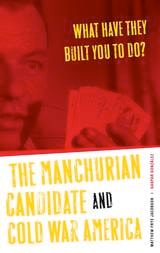
What Have They Built You to Do?
The Manchurian Candidate and Cold War AmericaMatthew Frye Jacobson
University of Minnesota Press, 2006
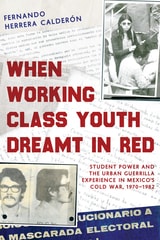
When Working Class Youth Dreamt in Red
Student Power and the Urban Guerrilla Experience in Mexico's Cold War, 1970–1982Fernando Herrera Calderón
University of Arizona Press, 2027
The 1970s in Mexico were turbulent from the start. Insurgent voices converged across cities and rural peripheries. Militant labor, urban popular sectors, and Indigenous collectives erupted in expressions of broad social exhaustion. Rebellion, rooted in the layered betrayals of the postrevolutionary state and the fractures of a deteriorating modernity under the Institutional Revolutionary Party (PRI), fermented and boiled over.
At the core of this moment, Mexican youth found their way to political-military organizations, coalescing around shared ecologies of dissent and embedded in broader currents of revolutionary struggle. When Working Class Youth Dreamt in Red reconstructs these insurgent youth cultures and guerrilla imaginaries, reorienting the historiographical lens to center radical working class youth—especially urban students—as protagonists in a wider saga of revolutionary experimentation and political rupture.
At its conceptual core, this book offers a bold new interpretation of a turbulent moment in Mexican history. It shows how class shaped the epistemic horizons through which proletarian youth understood themselves and makes visible their role as central actors at the vanguard of a revolutionary time.
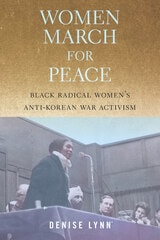
Women March for Peace
Black Radical Women’s Anti-Korean War ActivismDenise Lynn
University of Massachusetts Press, 2025
The Korean War is commonly known as the “forgotten war” because it supposedly had little impact on American culture in comparison to World War II or the American War in Vietnam. Yet from 1950–1953, the conflict produced vigorous anti-war activism, particularly among Black radical women. Informed by their experiences with racism and misogyny within the US, these women were convinced that peace was not just the absence of military aggression, but that it required the liberation of the most oppressed, including the end of capitalist exploitation of women and People of Color and the return of self-determination to colonized peoples—themes that later anti-war activists would echo and develop. Whether or not the Korean War has ever truly been forgotten, the visionary activism of these women has been largely overlooked.
In Women March for Peace, Denise Lynn examines the lives of seven Black women—Louise Thompson Patterson, Claudia Jones, Charlotta Bass, Shirley Graham Du Bois, Eslanda Robeson, Lorraine Hansberry, and Beulah Richardson—and their resistance to domestic and foreign US policies during the height of anticommunist hysteria. While much peace scholarship focuses on the threat of nuclear conflict, Lynn instead explores how these women connected issues of civil rights at home with international military campaigns, highlights the hypocrisy of containment policies that sought to secure the freedom and rights for Koreans when US citizens were still oppressed. Lynn traces their peace advocacy through their personal papers, local and national articles, Progressive Party documents, and global conventions. Women March for Peace recovers the radical activism of these Black women to understand a crucial chapter in the fight against American imperialism and white supremacy.
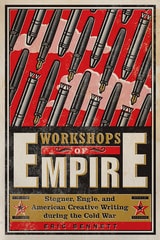
Workshops of Empire
Stegner, Engle, and American Creative Writing during the Cold WarEric Bennett
University of Iowa Press, 2015
Creative writing emerged as a graduate discipline in the United States amid this astonishing swirl of grand conceptions. The early workshops were formed not only at the time of, but in the image of, and under the tremendous urgency of, the postwar imperatives for the humanities. Vivid renderings of personal experience would preserve the liberal democratic soul—a soul menaced by the gathering leftwing totalitarianism of the USSR and the memory of fascism in Italy and Germany.
Workshops of Empire explores this history via the careers of Paul Engle at the University of Iowa and Wallace Stegner at Stanford. In the story of these founding fathers of the discipline, Eric Bennett discovers the cultural, political, literary, intellectual, and institutional underpinnings of creative writing programs within the university. He shows how the model of literary technique championed by the first writing programs—a model that values the interior and private life of the individual, whose experiences are not determined by any community, ideology, or political system—was born out of this Cold War context and continues to influence the way creative writing is taught, studied, read, and written into the twenty-first century.
World War II and the Cold War
The Rhetoric of Hearts and Minds, Volume VIIIMartin J. Medhurst
Michigan State University Press, 2018