Results by title
8 books match the query 'Sexualities'
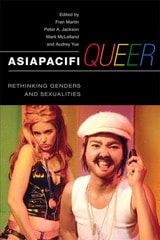
AsiaPacifiQueer
Rethinking Genders and SexualitiesEdited by Fran Martin, Peter A. Jackson, Mark McLelland, and Audrey Yue
University of Illinois Press, 2007
Dissident Genders and Sexualities in the Andes
Truth, Justice, and ReparationsPascha Bueno-Hansen
Rutgers University Press, 2027
Dissident Genders and Sexualities in the Andes: Truth, Justice, and Reparations reveals how people of non-normative genders and sexualities fight for truth, justice, and reparations in the aftermath of armed conflict and authoritarian regimes in Peru, Ecuador and Colombia. A focus on body politics flips the transitional justice model that focuses on nation-states to investigate massive human rights violations. How and why are harms against people of non-normative genders and sexualities included or excluded in Peruvian, Ecuadorian and Colombian transitional justice efforts? What strategies do activists use in the ongoing struggle for the recognition of their humanity through truth, justice and reparations? To answer these questions, Dissident Genders and Sexualities in the Andes focuses on activists and their embodied knowledge.
Getting Medieval
Sexualities and Communities, Pre- and PostmodernCarolyn Dinshaw
Duke University Press, 1999
In her pursuit of historical analyses that embrace the heterogeneity and indeterminacy of sex and sexuality, Dinshaw examines canonical Middle English texts such as the Canterbury Tales and TheBook of Margery Kempe. She examines polemics around the religious dissidents known as the Lollards as well as accounts of prostitutes in London to address questions of how particular sexual practices and identifications were normalized while others were proscribed. By exploring contemporary (mis)appropriations of medieval tropes in texts ranging from Quentin Tarantino’s Pulp Fiction to recent Congressional debates on U.S. cultural production, Dinshaw demonstrates how such modern media can serve to reinforce constrictive heteronormative values and deny the multifarious nature of history. Finally, she works with and against the theories of Michel Foucault, Homi K. Bhabha, Roland Barthes, and John Boswell to show how deconstructionist impulses as well as historical perspectives can further an understanding of community in both pre- and postmodern societies.
This long-anticipated volume will be indispensable to medieval and queer scholars and will be welcomed by a larger cultural studies audience.
Queer Iberia
Sexualities, Cultures, and Crossings from the Middle Ages to the RenaissanceJosiah Blackmore and Gregory S. Hutcheson, eds.
Duke University Press, 1999
To show how sexual otherness is most evident at points of cultural conflict, the contributors use a variety of methodologies and perspectives and consider source materials that originated in Castilian, Latin, Arabic, Catalan, and Galician-Portuguese. Covering topics from the martydom of Pelagius to the exploits of the transgendered Catalina de Erauso, this volume is the first to provide a comprehensive historical examination of the relations among race, gender, sexuality, nation-building, colonialism, and imperial expansion in medieval and early modern Iberia. Some essays consider archival evidence of sexual otherness or evaluate the use of “deviance” as a marker for cultural and racial difference, while others explore both male and female homoeroticism as literary-aesthetic discourse or attempt to open up canonical texts to alternative readings.
Positing a queerness intrinsic to Iberia’s historical process and cultural identity, Queer Iberia will challenge the field of Iberian studies while appealing to scholars of medieval, cultural, Hispanic, gender, and gay and lesbian studies.
Contributors. Josiah Blackmore, Linde M. Brocato, Catherine Brown, Israel Burshatin, Daniel Eisenberg, E. Michael Gerli, Roberto J. González-Casanovas, Gregory S. Hutcheson, Mark D. Jordan, Sara Lipton, Benjamin Liu, Mary Elizabeth Perry, Michael Solomon, Louise O. Vasvári, Barbara Weissberger

Queer Ricans
Cultures and Sexualities in the DiasporaLawrence La Fountain-Stokes
University of Minnesota Press, 2009
Highlighting cultural and political resistance within Puerto Rico’s gay, lesbian, bisexual, and transgender subcultures, La Fountain-Stokes pays close attention to differences of gender, historical moment, and generation, arguing that Puerto Rican queer identity changes over time and is experienced in very different ways. He traces an arc from 1960s Puerto Rico and the writings of Luis Rafael Sánchez to New York City in the 1970s and 1980s (Manuel Ramos Otero), Philadelphia and New Jersey in the 1980s and 1990s (Luz María Umpierre and Frances Negrón-Muntaner), and Chicago (Rose Troche) and San Francisco (Erika López) in the 1990s, culminating with a discussion of Arthur Avilés and Elizabeth Marrero’s recent dance-theater work in the Bronx.
Proposing a radical new conceptualization of Puerto Rican migration, this work reveals how sexuality has shaped and defined the Puerto Rican experience in the United States.

Sites of Desire/Economies of Pleasure
Sexualities in Asia and the PacificEdited by Lenore Manderson and Margaret Jolly
University of Chicago Press, 1997
A unique and important contribution to the study of sexuality, this book also suggests that the history of sexuality in the West was shaped by myths of the legendary Orient and the exotic "Other."
The Feminism of Charlotte Perkins Gilman
Sexualities, Histories, ProgressivismJudith A. Allen
University of Chicago Press, 2009
Famous for her short fiction—most notably “The Yellow Wallpaper”—Charlotte Perkins Gilman also produced a vast body of nonfiction in tandem with her work as a Progressive-era feminist reformer. Rooted in groundbreaking research on Gilman’s extensive correspondence, publications, and speeches, this keenly argued intellectual biography reconstructs her controversial output and the heady context in which she produced it.
Judith Allen provides the first comprehensive assessment of Gilman’s complicated feminism by exploring the renowned writer’s theories of sexuality and evolutionary analyses of androcentric—or male-dominated—culture. These ideas, Allen shows, informed Gilman’s many contributions to the suffrage movement, the fight to abolish regulated prostitution, and efforts to legalize birth control. Restoring a previously overlooked public intellectual to her preeminent place in Progressive-era politics and the history of feminism at home and abroad, Allen’s landmark study provides the fullest account available of Gilman’s consequential life and profoundly influential work.
Theorizing Self in Samoa
Emotions, Genders, and SexualitiesJeannette Marie Mageo
University of Michigan Press, 1998