Results by title
103 books match the query 'Conversations' and 7 start with w
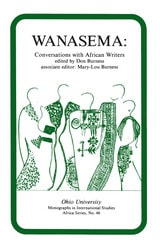
Wanasema
Conversations with African WritersDon Burness
Ohio University Press, 1985
There is a tendency to regard African literature as a homogenous product. Certainly it is true that African writers have created a vibrant, modern literature. Nevertheless, they come from specific societies and reflect vastly differing worlds. Wanasema attempts to show some of the many faces of African literature. Dramatists, poets and novelists speak in these pages. They write in French, English, Portuguese, Arabic and indigenous languages. Some are Christian; others are Muslim. A variety of subjects are discussed, including the status of women, history, religion, politics, dress and education. Taken together, the interviews in Wanasema suggest that Western students of Africa would do well to learn the languages of Africa. They suggest, too, taht there is a need to investigate further the relationship between Islamic North Africa and Sub-Saharan Africa, and finally, that oral literature continues to be a vast marketplace for scholars. This book should interest African Studies specialists, of course, but also those whose concerns include literature, history and contemporary events in the non-Western world generally.
[more]
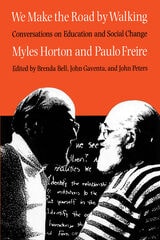
We Make the Road by Walking
Conversations on Education and Social ChangeMyles Horton
Temple University Press, 1990
[more]

Weapon of the Strong
Conversations on US State TerrorismJon Bailes and Cihan Aksan
Pluto Press, 2012
The term ‘terrorism’ is often applied exclusively to non-state groups or specific ‘rogue states’. Far less attention is given to state terrorism carried out or sponsored by democracies, most notably the United States. History shows that this state terrorism has been responsible for the deaths of millions of people.
Weapon of the Strong analyses the forms of US state terrorism through exclusive, never before published interviews with leading commentators and theorists, including Noam Chomsky, Edward S. Herman, Richard A. Falk, Judith Butler, Ted Honderich, Norman Finkelstein and Gilbert Achcar. The interviews explore the different aspects of state terrorism: its functions, institutional supports and the legal and moral arguments surrounding it, and consider specific case studies in Europe, Latin America and the Middle East.
Weapon of the Strong makes an indispensable contribution to contemporary debates on terrorism and constructs a damning critique of US foreign policy from World War Two to the present day.
[more]
Weaving a Fabric of Unity
Conversations on Education and DevelopmentHaleh Arbab
West Virginia University Press, 2024
Weaving a Fabric of Unity shares the story of FUNDAEC (the Foundation for the Application and Teaching of Science), a non-governmental organization found in Cali, Colombia in 1974, and highlights five decades of stories, learning, and insight from key individuals central to shaping its evolution. The book outlines FUNDAEC’s unique conceptual and methodological approach, which is focused on the releasing of human potentialities and the integration of theory and practice so that a population may carry out action and research related to its social, economic, and cultural life. Weaving a Fabric of Unity brings the reader on the journey of how the organization created one of Latin America’s most innovative curricula in rural development. It shares how FUNDAEC’s focus on raising up individuals and communities dedicated to the promotion of community wellbeing supported its efforts to organically scale over the last few decades. The program now reaches hundreds of thousands of students across Colombia, and is being adopted in over a dozen countries to support diverse populations working towards the collective realization of a dignified future.
[more]
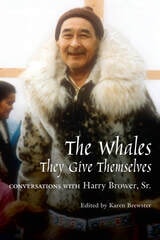
Whales, They Give Themselves
Conversations with Harry Brower, Sr.Karen Brewster
University of Alaska Press, 2004
The Whales, They Give Themselves is an intimate life history of Harry Brower, Sr. (1924-1992), an Inupiaq whaling captain, artisan, and community leader from Barrow, Alaska. In a life that spanned the profound cultural and economic changes of the twentieth century, Brower's vast knowledge of the natural world made him an essential contributor to the Native and scientific communities of the North. His desire to share his insights with future generations resulted in a series of conversations with friend and oral historian Karen Brewster, who weaves Harry's stories with cultural and historical background into this innovative and collaborative oral biography.
Brower was deeply committed to Native culture, and his life history is a moving expression of the Inupiaq way of life. He was also influential in traditionally non-Native arenas in which Native and non-Native values sometimes collided. Acting as a mediator between Inupiaq whalers and non-Native scientists, Brower communicated a vast understanding of bowhead whales and whaling that became the basis for a scientific research program and helped protect Inupiaq subsistence whaling. He was a central architect of the Arctic Slope Regional Corporation boundaries, and served for over twenty years as a consultant to scientists at the Naval Arctic Research Laboratory. Brower's role in this collaborative research serves as one of the earliest and best examples of how scientists and Native experts can work together to advance knowledge. Such approaches are now promoted by researchers around the world.
The Whales, They Give Themselves not only conveys Brower's life story, but also is a cross-cultural journey of wisdom and friendship. Whereas academic oral historians once strove to erase the presence of the interviewer in the name of objectivity, Brewster recognizes the influence her specific relationship with Brower had on the way he narrated his life. This volume is a major contribution to our understanding of northern peoples, and a testament to the immense value of collaborative oral history.
[more]
What We Made
Conversations on Art and Social CooperationTom Finkelpearl
Duke University Press, 2013
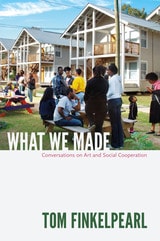
In What We Made, Tom Finkelpearl examines the activist, participatory, coauthored aesthetic experiences being created in contemporary art. He suggests social cooperation as a meaningful way to think about this work and provides a framework for understanding its emergence and acceptance. In a series of fifteen conversations, artists comment on their experiences working cooperatively, joined at times by colleagues from related fields, including social policy, architecture, art history, urban planning, and new media. Issues discussed include the experiences of working in public and of working with museums and libraries, opportunities for social change, the lines between education and art, spirituality, collaborative opportunities made available by new media, and the elusive criteria for evaluating cooperative art. Finkelpearl engages the art historians Grant Kester and Claire Bishop in conversation on the challenges of writing critically about this work and the aesthetic status of the dialogical encounter. He also interviews the often overlooked co-creators of cooperative art, "expert participants" who have worked with artists. In his conclusion, Finkelpearl argues that pragmatism offers a useful critical platform for understanding the experiential nature of social cooperation, and he brings pragmatism to bear in a discussion of Houston's Project Row Houses.
Interviewees. Naomi Beckwith, Claire Bishop, Tania Bruguera, Brett Cook, Teddy Cruz, Jay Dykeman, Wendy Ewald, Sondra Farganis, Harrell Fletcher, David Henry, Gregg Horowitz, Grant Kester, Mierle Laderman Ukeles, Pedro Lasch, Rick Lowe, Daniel Martinez, Lee Mingwei, Jonah Peretti, Ernesto Pujol, Evan Roth, Ethan Seltzer, and Mark Stern
[more]
When These Things Begin
Conversations with Michel TreguerRené Girard (Translated by Trevor Cribben Merrill)
Michigan State University Press, 2014
In this lively series of conversations with writer Michel Treguer, René Girard revisits the major concepts of mimetic theory and explores science, democracy, and the nature of God and freedom. Girard affirms that “our unprecedented present is incomprehensible without Christianity.” Globalization has unified the world, yet civil war and terrorism persist despite free trade and economic growth. Because of mimetic desire and the rivalry it generates, asserts Girard, “whether we’re talking about marriage, friendship, professional relationships, issues with neighbors or matters of national unity, human relations are always under threat.” Literary masters including Marivaux, Dostoevsky, and Joyce understood this, as did archaic religion, which warded off violence with blood sacrifice. Christianity brought a new understanding of sacrifice, giving rise not only to modern rationality and science but also to a fragile system that is, in Girard’s words, “always teetering between a new golden age and a destructive apocalypse.” Treguer, a skeptic of mimetic theory, wonders: “Is what he’s telling me true...or is it just a nice story, a way of looking at things?” In response, Girard makes a compelling case for his theory.
[more]