Results by title

6 books match the query 'Shintoism'

cover of Faking Liberties: Religious Freedom in American-Occupied Japan

Faking Liberties

Religious Freedom in American-Occupied Japan

Jolyon Baraka Thomas

University of Chicago Press, 2019

Religious freedom is a founding tenet of the United States, and it has frequently been used to justify policies towards other nations. Such was the case in 1945 when Americans occupied Japan following World War II. Though the Japanese constitution had guaranteed freedom of religion since 1889, the United States declared that protection faulty, and when the occupation ended in 1952, they claimed to have successfully replaced it with “real” religious freedom.

Through a fresh analysis of pre-war Japanese law, Jolyon Baraka Thomas demonstrates that the occupiers’ triumphant narrative obscured salient Japanese political debates about religious freedom. Indeed, Thomas reveals that American occupiers also vehemently disagreed about the topic. By reconstructing these vibrant debates, Faking Liberties unsettles any notion of American authorship and imposition of religious freedom. Instead, Thomas shows that, during the Occupation, a dialogue about freedom of religion ensued that constructed a new global set of political norms that continue to form policies today.
[more]
cover of Immortal Wishes: Labor and Transcendence on a Japanese Sacred Mountain

Immortal Wishes

Labor and Transcendence on a Japanese Sacred Mountain

Ellen Schattschneider

Duke University Press, 2003

Immortal Wishes is a powerful ethnographic rendering of religious experiences of landscape, healing, and self-fashioning on a northern Japanese sacred mountain. Working at the intersection of anthropology, religion, and Japan studies, Ellen Schattschneider focuses on Akakura Mountain Shrine, a popular Shinto institution founded by a rural woman in the 1920s. For decades, local spirit mediums and worshipers, predominantly women, have undertaken extended periods of shugyo (ascetic discipline) within the shrine and on the mountain's slopes. Schattschneider argues that their elaborate, transforming repertoire of ritual practice and ascetic discipline has been generated by complex social and historical tensions largely emerging out of the uneasy status of the surrounding area within the modern nation's industrial and postindustrial economies.

Schattschneider shows how, through dedicated work at the shrine including demanding ascents up the sacred mountain, the worshipers come to associate the rugged mountain landscape with their personal biographies, the life histories of certain exemplary predecessors and ancestors, and the collective biography of the extended congregation. She contends that this body of ritual practice presents worshipers with fields of imaginative possibilities through which they may dramatize or reflect upon the nature of their relations with loved ones, ancestors, and divinities. In some cases, worshipers significantly redress traumas in their own lives or in those of their families. In other instances, these ritualized processes lead to deepening crises of the self, the accelerated fragmentation of local households, and apprehension of possession by demons or ancestral forces. Immortal Wishes reveals how these varied practices and outcomes have over time been incorporated into the changing organization of ritual, space, and time on the mountainscape.

For more information about this book and to read an excerpt, please click here.

[more]
cover of In the Presence of Gods and Spirits: Hirata Atsutane and His Collaborators

In the Presence of Gods and Spirits

Hirata Atsutane and His Collaborators

Anne Walthall

University of Michigan Press, 2025
In the Presence of Gods and Spirits brings to life the early nineteenth-century Japanese religious leader and scholar Hirata Atsutane, whose fear of Russian incursion onto Japan’s soil led him to redefine what it means to be Japanese. Atsutane advocated the study of the Way of the Gods, commonly known as Shinto, to explain what happens to the soul after death and to cultivate a  Japanese identity centered on gods, spirits, and the emperor. His teachings would later attract thousands of followers and feed the movements that led to the Meiji Restoration. Drawing on the concept of material religion, Walthall demonstrates how Atsutane and his collaborators sought out knowledge of the unseen world and educated others, while seeking to bring themselves closer to the gods and spirits. This work showcases Atsutane and his community’s legacy, which has had a profound influence on Japanese society, religious belief, and culture far beyond his lifetime.
[more]
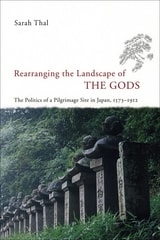
cover of Rearranging the Landscape of the Gods: The Politics of a Pilgrimage Site in Japan, 1573-1912

Rearranging the Landscape of the Gods

The Politics of a Pilgrimage Site in Japan, 1573-1912

Sarah Thal

University of Chicago Press, 2005

When people create new societies, economies, and nations—both now and in the past—they create gods, rituals, and miracles to support them. Even what seem to be some of the most timeless and sacred sites in the world have been shaped, reshaped, and reinterpreted by countless people to produce oases of peace and nature today.

Using miracle tales, votive plaques, diaries, and newspapers, Sarah Thal traces such changes at one of the most popular Japanese pilgrimage sites of the nineteenth and twentieth centuries: the shrine of Konpira on the island of Shikoku. This rich and fascinating history explores how people from all walks of life gave shape to the gods, shrines, and rituals so often attributed to ancient, indigenous Japan. Thal shows how worshippers and priests, rulers and entrepreneurs, repeatedly rebuilt and reinterpreted Konpira to reflect their needs and aspirations in a changing world—and how, in doing so, they helped shape the structures of the modern state, economy, and society in turn.

Rearranging the Landscape of the Gods will be welcomed by all scholars of Japanese history and by students of religion interested in the construction of modernity.

[more]
cover of Textual Sources for the Study of Zoroastrianism

Textual Sources for the Study of Zoroastrianism

Edited by Mary Boyce

University of Chicago Press, 1990

"Boyce is a, perhaps the, world authority on Zoroastrianism. . . . Prefaced by a 27-page introduction, this anthology contains selections which offer a complete picture of Zoroastrian belief, worship and practice. There are historical texts from the sixth century B.C. onwards, and extracts from modern Zoroastrian writings representing traditionalism, occultism and reformist opinion. Anyone wishing to know more about this 'least well known of the world religions' should sample these selections."—The Methodist Church

"Wide-ranging. . . . An indispensable one-volume collection of primary materials."—William R. Darrow, Religious Studies Review

[more]
cover of The Invention of Religion in Japan

The Invention of Religion in Japan

Jason Ananda Josephson Storm

University of Chicago Press, 2012

Throughout its long history, Japan had no concept of what we call “religion.” There was no corresponding Japanese word, nor anything close to its meaning. But when American warships appeared off the coast of Japan in 1853 and forced the Japanese government to sign treaties demanding, among other things, freedom of religion, the country had to contend with this Western idea. In this book, Jason Ananda Josephson reveals how Japanese officials invented religion in Japan and traces the sweeping intellectual, legal, and cultural changes that followed.
 
More than a tale of oppression or hegemony, Josephson’s account demonstrates that the process of articulating religion offered the Japanese state a valuable opportunity. In addition to carving out space for belief in Christianity and certain forms of Buddhism, Japanese officials excluded Shinto from the category. Instead, they enshrined it as a national ideology while relegating the popular practices of indigenous shamans and female mediums to the category of “superstitions”—and thus beyond the sphere of tolerance. Josephson argues that the invention of religion in Japan was a politically charged, boundary-drawing exercise that not only extensively reclassified the inherited materials of Buddhism, Confucianism, and Shinto to lasting effect, but also reshaped, in subtle but significant ways, our own formulation of the concept of religion today. This ambitious and wide-ranging book contributes an important perspective to broader debates on the nature of religion, the secular, science, and superstition.
[more]