Results by title
143 books match the query 'Crisis' and 10 start with w
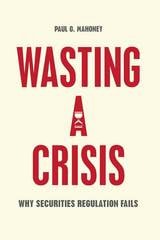
Wasting a Crisis
Why Securities Regulation FailsPaul G. Mahoney
University of Chicago Press, 2015
With Wasting a Crisis, Paul G. Mahoney offers persuasive research to show that this now almost universally accepted narrative of market failure—broadly similar across financial crises—is formulated by political actors hoping to deflect blame from prior policy errors. Drawing on a cache of data, from congressional investigations, litigation, regulatory reports, and filings to stock quotes from the 1920s and ’30s, Mahoney moves beyond the received wisdom about the financial reforms of the New Deal, showing that lax regulation was not a substantial cause of the financial problems of the Great Depression. As new regulations were formed around this narrative of market failure, not only were the majority largely ineffective, they were also often counterproductive, consolidating market share in the hands of leading financial firms. An overview of twenty-first-century securities reforms from the same analytic perspective, including Dodd-Frank and the Sarbanes-Oxley Act of 2002, shows a similar pattern and suggests that they too may offer little benefit to investors and some measurable harm.
We Need To Talk About Climate
How Citizens' Assemblies Can Help Us Solve The Climate CrisisGraham Smith
University of Westminster Press, 2024
Citizens’ assemblies bring the shared wisdom of ordinary people into political decision making on the climate and ecological crisis. They are increasingly being used at local, national and even global levels. But with what impact? Can they take us beyond the shortcomings of electoral and partisan politics? Can they make a real difference? This book explains why climate assemblies have captured the imagination of governments and activists alike, exploring the ways they can have a meaningful impact on climate politics.
This book charts the development of climate assemblies across Europe and beyond. It explores what ordinary people want, highlighting the ways in which assembly recommendations take us beyond current government policies and offer new visions and directions for change. It shows that not all assemblies are the same and that the context and design of climate assemblies have differed quite profoundly – as have their impacts on policy and public discourse. The book also lays out the key elements needed for climate assemblies to have sustained impact, providing essential insights for anyone wanting to run or advocate for them, and concludes with reflections on what we can expect from assemblies as they evolve.
The transition to net zero and climate resilient societies requires deep social and economic transformations that will have significant impacts on citizens’ choices and behaviours. Such a transition needs to engage the public directly and this book shows how climate assemblies can achieve this, allowing us to address the issues we all face together.
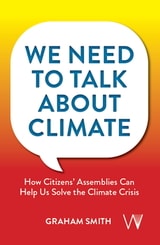
We Need To Talk About Climate
How Citizens' Assemblies Can Help Us Solve The Climate CrisisGraham Smith
University of Westminster Press, 2024
Citizens’ assemblies bring the shared wisdom of ordinary people into political decision making on the climate and ecological crisis. They are increasingly being used at local, national and even global levels. But with what impact? Can they take us beyond the shortcomings of electoral and partisan politics? Can they make a real difference? This book explains why climate assemblies have captured the imagination of governments and activists alike, exploring the ways they can have a meaningful impact on climate politics.
This book charts the development of climate assemblies across Europe and beyond. It explores what ordinary people want, highlighting the ways in which assembly recommendations take us beyond current government policies and offer new visions and directions for change. It shows that not all assemblies are the same and that the context and design of climate assemblies have differed quite profoundly – as have their impacts on policy and public discourse. The book also lays out the key elements needed for climate assemblies to have sustained impact, providing essential insights for anyone wanting to run or advocate for them, and concludes with reflections on what we can expect from assemblies as they evolve.
The transition to net zero and climate resilient societies requires deep social and economic transformations that will have significant impacts on citizens’ choices and behaviours. Such a transition needs to engage the public directly and this book shows how climate assemblies can achieve this, allowing us to address the issues we all face together.
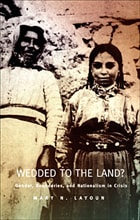
Wedded to the Land?
Gender, Boundaries, and Nationalism in CrisisMary N. Layoun
Duke University Press, 2001
Drawing on readings of literature and of official documents and decrees, songs, poetry, cinema, public monuments, journalism, and conversations with exiles, refugees, and public officials, Layoun uses each historical incident as a means of highlighting a recurring trope within constructs of nationalism. The displacement of the Greek refugees in the 1920s calls into question the very idea of home, as well as the desire for ethnic homogeneity within nations. She reads the Cypriot coup and invasion as an illustration of the gendering of nation and how the notion of the inviolable woman came to represent sovereignity. In her third example she shows how the Palestinian and PLO expulsion from Beirut highlights the ambiguity of the borders upon which many manifestations of nationalism putatively depend. These chapters are preceded and introduced by a discussion of “culturing the nation” and closed by a consideration of citizenship and silence in which Layoun discusses rights ostensibly possessed by all members of a political community.
This book will be of interest to scholars engaged in cultural and critical theory, Middle Eastern and Mediterranean history, literary studies, political science, postcolonial studies, and gender studies.
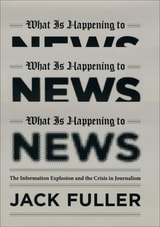
What Is Happening to News
The Information Explosion and the Crisis in JournalismJack Fuller
University of Chicago Press, 2010
Across America, newspapers that have defined their cities for over a century are rapidly failing, their circulations plummeting even as opinion-soaked web outlets like the Huffington Post thrive. Meanwhile, nightly news programs shock viewers with stories of horrific crime and celebrity scandal, while the smug sarcasm and shouting of pundits like Glenn Beck and Keith Olbermann dominate cable television. Is it any wonder that young people are turning away from the news entirely, trusting comedians like Jon Stewart as their primary source of information on current events?
In the face of all the problems plaguing serious news, What Is Happening to News explores the crucial question of how journalism lost its way—and who is responsible for the ragged retreat from its great traditions. Veteran editor and newspaperman Jack Fuller locates the surprising sources of change where no one has thought to look before: in the collision between a revolutionary new information age and a human brain that is still wired for the threats faced by our prehistoric ancestors. Drawing on the dramatic recent discoveries of neuroscience, Fuller explains why the information overload of contemporary life makes us dramatically more receptive to sensational news, while rendering the staid, objective voice of standard journalism ineffective. Throw in a growing distrust of experts and authority, ably capitalized on by blogs and other interactive media, and the result is a toxic mix that threatens to prove fatal to journalism as we know it.
For every reader troubled by what has become of news—and worried about what the future may hold—What Is Happening to News not only offers unprecedented insight into the causes of change but also clear guidance, strongly rooted in the precepts of ethical journalism, on how journalists can adapt to this new environment while still providing the information necessary to a functioning democracy.

What is to Be Done About Law and Order?
Crisis in the NinetiesJohn Lea and Jock Young
Pluto Press, 1993
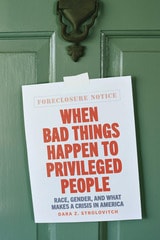
When Bad Things Happen to Privileged People
Race, Gender, and What Makes a Crisis in AmericaDara Z. Strolovitch
University of Chicago Press, 2023
A deep and thought-provoking examination of crisis politics and their implications for power and marginalization in the United States.
From the climate crisis to the opioid crisis to the Coronavirus crisis, the language of crisis is everywhere around us and ubiquitous in contemporary American politics and policymaking. But for every problem that political actors describe as a crisis, there are myriad other equally serious ones that are not described in this way. Why has the term crisis been associated with some problems but not others? What has crisis come to mean, and what work does it do?
In When Bad Things Happen to Privileged People, Dara Z. Strolovitch brings a critical eye to the taken-for-granted political vernacular of crisis. Using systematic analyses to trace the evolution of the use of the term crisis by both political elites and outsiders, Strolovitch unpacks the idea of “crisis” in contemporary politics and demonstrates that crisis is itself an operation of politics. She shows that racial justice activists innovated the language of crisis in an effort to transform racism from something understood as natural and intractable and to cast it instead as a policy problem that could be remedied. Dominant political actors later seized on the language of crisis to compel the use of state power, but often in ways that compounded rather than alleviated inequality and injustice. In this eye-opening and important book, Strolovitch demonstrates that understanding crisis politics is key to understanding the politics of racial, gender, and class inequalities in the early twenty-first century.
When Bad Things Happen to Privileged People
Race, Gender, and What Makes a Crisis in AmericaDara Z. Strolovitch
University of Chicago Press, 2023
A deep and thought-provoking examination of crisis politics and their implications for power and marginalization in the United States.
From the climate crisis to the opioid crisis to the Coronavirus crisis, the language of crisis is everywhere around us and ubiquitous in contemporary American politics and policymaking. But for every problem that political actors describe as a crisis, there are myriad other equally serious ones that are not described in this way. Why has the term crisis been associated with some problems but not others? What has crisis come to mean, and what work does it do?
In When Bad Things Happen to Privileged People, Dara Z. Strolovitch brings a critical eye to the taken-for-granted political vernacular of crisis. Using systematic analyses to trace the evolution of the use of the term crisis by both political elites and outsiders, Strolovitch unpacks the idea of “crisis” in contemporary politics and demonstrates that crisis is itself an operation of politics. She shows that racial justice activists innovated the language of crisis in an effort to transform racism from something understood as natural and intractable and to cast it instead as a policy problem that could be remedied. Dominant political actors later seized on the language of crisis to compel the use of state power, but often in ways that compounded rather than alleviated inequality and injustice. In this eye-opening and important book, Strolovitch demonstrates that understanding crisis politics is key to understanding the politics of racial, gender, and class inequalities in the early twenty-first century.
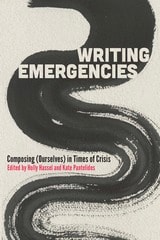
Writing Emergencies
Composing (Ourselves) in Times of CrisisHolly Hassel
Utah State University Press, 2026
Despite the adage “there are no writing emergencies,” at times situations invite or require immediate written response. In a modern era of social media and with the constancy of “crisis,” knowing when, how, and why to respond quickly is increasingly important. In Writing Emergencies, a diverse group of authors contribute scholarly, narrative-based discussions of writing emergencies, descriptions of more and less successful strategies, and a reflective conclusion that offers implications for writing studies praxis and theory.
In this collection, contributors demonstrate the reality of writing emergencies—in their own writing lives, classrooms, and programs—and they offer both self- and community-focused approaches for response. Chapters focus on discernment and prioritization, recognizing that all stressors are not necessarily emergencies. Instead, expanding our vocabulary for (and subsequent understanding) of the kinds of difficulties we come across can build our professional capacity and support greater career sustainability. The volume also illustrates the role of coalitions in navigating writing emergencies and how purposefully building and activating these coalitions subverts some challenges before they become emergencies, particularly those that are recurrent or manufactured.
Writing Emergencies both names and grapples with writing emergencies and offers insights for capacity-building in the acts of filtering and prioritizing competing urgent demands. The findings are meaningful for all leaders, students, and teachers who center care in their relationships with others.
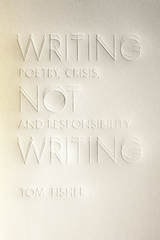
Writing Not Writing
Poetry, Crisis, and ResponsibilityTom Fisher
University of Iowa Press, 2017
Writing Not Writing both confirms this question into which crisis puts poetry and explores alternative modes of “response” and “responsibility” that poetry makes possible. Reading the silences of Oppen, Carl Rakosi, and Bob Kaufman, the renunciation of Laura Riding, and other more contemporary instances of poetic abnegation, Tom Fisher explores silence, refusal, and disavowal as political and ethical modes of response in a time of continuous crisis. Through a turn away from writing, these poets offer strategies of refusal and departure that leave anagrammatical hollows behind, activating the negational capacities of writing and aesthetics to disrupt the empire of sense, speech, and agency.
Fisher’s work is both an engaging and detailed analysis of four individual poets who left poetry behind and a theoretically provocative exploration of the political and ethical possibilities of silence, not-doing, and disavowal. In lucid but nuanced terms, Fisher makes the case that, from at least modernism forward, poetry is marked by refusals of speech and sense in order to open possibilities of response outside conventional forms of responsibility.