Results by title
27 books match the query 'Burma'

Burma
The Curse of IndependenceShelby Tucker
Pluto Press, 2001
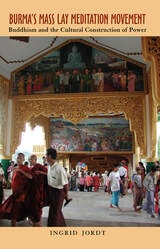
Burma’s Mass Lay Meditation Movement
Buddhism and the Cultural Construction of PowerIngrid Jordt
Ohio University Press, 2007
Burma's Mass Lay Meditation Movement: Buddhism and the Cultural Construction of Power describes a transformation in Buddhist practice in contemporary Burma. This revitalization movement has had real consequences for how the oppressive military junta, in power since the early 1960s, governs the country.
Drawing on more than ten years of extensive fieldwork in Burma, Ingrid Jordt explains how vipassanā meditation has brought about a change of worldview for millions of individuals, enabling them to think and act independently of the totalitarian regime. She addresses human rights as well as the relationship between politics and religion in a country in which neither the government nor the people clearly separates the two. Jordt explains how the movement has been successful in its challenge to the Burmese military dictatorship where democratically inspired resistance movements have failed.
Jordt's unsurpassed access to the centers of political and religious power in Burma becomes the reader's opportunity to witness the political workings of one of the world's most secretive and tyrannically ruled countries. Burma's Mass Lay Meditation Movement is a valuable contribution to Buddhist studies as well as anthropology, religious studies, and political science.
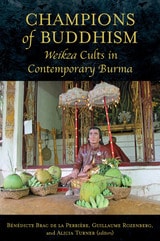
Champions of Buddhism
Weikza Cults in Contemporary BurmaEdited by Bénédicte Brac de la Perrière, Guillaume Rozenberg, and Alicia Turner
National University of Singapore Press, 2014
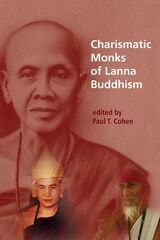
Charismatic Monks of Lanna Buddhism
Edited by Paul T. Cohen
National University of Singapore Press, 2017
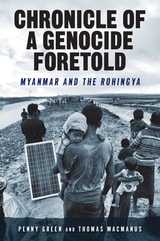
Chronicle of a Genocide Foretold
Myanmar and the RohingyaPenny Green
Rutgers University Press, 2027
Chronicle of a Genocide Foretold is a powerful account of one of the most devastating human crises of the 21st century. Drawing on firsthand research conducted in Burma (Myanmar) and neighboring countries, the book uncovers how the Rohingya Muslims have been systematically isolated, impoverished, and targeted in a state-led genocidal campaign. Through more than 150 interviews with survivors, local officials, religious leaders, and international actors, the authors reveal how discrimination, mass displacement, and organized brutality have created conditions that meet the legal, criminological, and moral definition of genocide. The book also challenges the silence and complicity of the international community. Accessible and grounded in rigorous research, this book speaks to scholars, activists, policymakers, and anyone concerned with justice, human rights, and the global failure to prevent genocide.
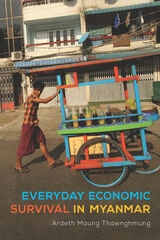
Everyday Economic Survival in Myanmar
Ardeth Maung Thawnghmung
University of Wisconsin Press, 2022
Thawnghmung conducted in-depth interviews and surveys of 372 individuals from all walks of life and across geographical locations in Myanmar between 2008 and 2015. To frame her analysis, she provides context from countries with comparable political and economic situations. Her findings will be welcomed by political scientists and policy analysts, as well by journalists and humanitarian activists looking for substantive, reliable information about everyday life in a country that remains largely in the shadows.
Exploring Ethnic Diversity in Burma
Edited by Mikael Gravers
National University of Singapore Press, 2007
Fiery Dragons
Banks, Moneylenders and Microfinance in BurmaSean Turnell
National University of Singapore Press, 2009
Free Burma
Transnational Legal Action and Corporate AccountabilityJohn G. Dale
University of Minnesota Press, 2010
Through the experience of the Free Burma movement, John G. Dale demonstrates how social movements create and appropriate legal mechanisms for generating new transnational political opportunities. He presents three corporate accountability campaigns waged by the Free Burma movement. The cases focus on the legislation of “Free Burma” laws in local governments throughout the United States; the effort to force the state of California to de-charter Unocal Oil Corporation for its flagrant abuse of human rights; and the first-ever use of the U.S. Alien Tort Claims Act to sue a corporation in a U.S. court for human rights abuses committed abroad. Dale’s work also raises the issue of how foreign policies of so-called constructive engagement actually pose a threat to the hope of Burma’s activists—and others worldwide—for more democratic economic development.
Industrialization in Late-Developing ASEAN Countries
Cambodia, Laos, Myanmar and VietnamNaoko Amakawa
National University of Singapore Press, 2010
The outcomes differed significantly owing to geographical location, government policies, and internal economic conditions. Industrialization in Late-Developing ASEAN Countries explores these differences through case studies based on an extended research program conducted by the Institute of Developing Economies in Tokyo, which offered insights into models of economic growth, and into the trajectories followed by the four countries examined.
Master of the Air
William Tunner and the Success of Military AirliftRobert A. Slayton
University of Alabama Press, 2010
Into this difficult situation the US placed General William Henry Tunner. He was given a task that seemed doomed to failure—to supply a major city by air with everything it needed to survive from food to a winter’s supply of coal—and made it a brilliant success, astonishing the world in a major public relations defeat for the Soviets, and demonstrating the unexpected capacity of air fleets in a postwar world.
Metamorphosis
Studies in Social and Political Change in MyanmarEdited by Renaud Egreteau and François Robinne
National University of Singapore Press, 2015
But underlying recent political transitions are other wrenching social changes and shocks, a set of transformations less clearly mapped out. Relations between ethnic and religious groups, in the context of Burma’s political model of a state composed of ethnic groups, are a particularly important “unsolved equation”.
The editors use the notion of metamorphosis to look at Myanmar today and tomorrow—a term that accommodates linear change, stubborn persistence and the possibility of dramatic transformation. Divided into four sections, on politics, identity and ethnic relations, social change in fields like education and medicine, and the evolutions of religious institutions, the volume takes a broad view, combining an anthropological approach with views from political scientists and historians. This volume is an essential guide to the political and social challenges ahead for Myanmar.

Myth and History in the Historiography of Early Burma
Paradigms, Primary Sources, and PrejudicesMichael A. Aung-Thwin
Ohio University Press, 1998
After careful re-reading and analysis of original Old Burmese and other primary sources, the author discovered that four out of the five events considered to be the most important in the history of early Burma, and believed to have been historically accurate, are actually late-nineteenth and twentieth-century inventions of colonial historians caught in their own intellectual and political world.
Only one of these is a genuine indigenous Burmese myth, but it too has been embellished by modern historians.
The author discusses each of these five myths and concludes with an assessment of the current situation in Burma in the context of the new myths springing up today, thereby bringing the thirteenth century into the twentieth.

Not Out of Hate
A Novel of BurmaMa Ma Lay
Ohio University Press, 1991

Project 9
The Birth of the Air Commandos in World War IIDennis R. Okerstrom
University of Missouri Press, 2026
Pursuing Morality
Buddhism and Everyday Ethics in Southeastern MyanmarJustine Chambers
National University of Singapore Press, 2024
Pursuing Morality is an in-depth and fascinating study of ordinary life in Myanmar’s southeast through a unique ethnographic focus on Buddhist Plong (Pwo) Karen. Based on extensive in-depth fieldwork in the small city of Hpa-an, the capital of Karen State, Justine Chambers shines a new light on Plong Buddhists’ lives and the many ways they broker, traverse, enact, cultivate, defend, and pursue moral lives.
This is the first ethnographic study of Myanmar to add to a growing body of anthropological scholarship that is referred to as the “moral turn.” Each chapter examines the lives of Plong Buddhists from different vantage points, calling into question many assumptions about Southeast Asian values and the nature of Buddhist Theravada practice. Critiquing the notion that moral coherence is necessary for ethical selfhood, Chambers demonstrates how the pursuit of morality is varied, performative, and embedded in an affective notion of the self as a moral agent in a relationship with wider structural political forces. This vivid account of everyday life in Myanmar complements existing scholarship on the region and offers a deeper understanding of Buddhism, moral anthropology, and ethics in Southeast Asia.

Repossessing Shanland
Myanmar, Thailand, and a Nation-State DeferredJane M. Ferguson
University of Wisconsin Press, 2022
Based on close readings of Shan-language media and years of ethnographic research in a community of soldiers and their families, Jane M. Ferguson details the origins of these movements and tells the story of the Shan in their own voices. She shows how the Shan have forged a homeland and identity during great upheaval by using state building as an ongoing project of resistance, resilience, and accommodation within both countries. In avoiding a good/bad moral binary and illuminating cultural complexities, Repossessing Shanland offers a fresh perspective on identity formation, transformation, and how people understand and experience borderlands today.
Rethinking Community in Myanmar
Practices of We-Formation among Muslims and Hindus in Urban YangonJudith Beyer
National University of Singapore Press, 2023

Sovereignty and Survival
Power, Conflict and Climate Change in BurmaAshley South
National University of Singapore Press, 2027
Evaluates Burma at a pivotal tipping point after the 2021 military coup.
The 2021 military coup in Burma/Myanmar triggered popular resistance and a spreading civil war, reigniting long-standing struggles for ethnic self-determination. The chaos has enabled a huge rise in transnational criminal activities, including drug trafficking and the emergence of scam centers. The country's geopolitical importance, not least as a source of rare earths, is also heightening the struggle for power. At the same time, accelerating climate change is destabilizing local ecologies and livelihoods, driving food production, socio-economic systems, and civil society towards collapse or massive change. Together, these forces have undermined the coherence of Burma as a centralized state. However, new forms of resistance and political organization have emerged in liberated areas across the country. At this critical juncture, rather than “state failure,” Burma demonstrates novel forms of complex, asymmetrical, and sometimes messy state-building, a “bottom-up” federalism based on the agency and resilience of Indigenous communities and anti-junta forces.

Stilwell and Mountbatten in Burma
Allies at War, 1943-1944Jonathan Templin Ritter
University of North Texas Press, 2017
Strong Soldiers, Failed Revolution
The State and Military in Burma, 1962-88Yoshihiro Nakanishi
National University of Singapore Press, 2013
The tatmadaw’s anti-communist propaganda during the 1950s was a key element in state ideology under the Ne Win regime, and the direct participation of tatmadaw officers in the Burma Socialist Programme Party and government ministries at the national and local level transformed the political party system and civilian bureaucracy. Personal relationships — between Ne Win and the tatmadaw officer corps, and within the military — were central to the growing influence of the military, and to the outcome of the political crisis and subsequent military coup d’état in 1988.
Nakanishi’s discussion of these processes reveals many heretofore-unknown facts about this “dark age” in the country’s political history, and highlights its institutional legacy for the post-1988 military regime and the reformist government that succeeded it. His thought-provoking conclusions are significant for Southeast Asia specialists and for students of politics generally, and his insights will be useful for anyone seeking to engage with Myanmar as it comes to terms with an outside world it once kept at arm’s length.
Survival
Dislocation and Repair in BurmaFrançois Robinne
National University of Singapore Press, 2027
Captures the tenuous reality of daily life for those in and outside Burma.
In the wake of the military coup of February 2021, a new and unsettling reality has emerged in Burma. Unlike previous uprisings, this time the junta's reach extends beyond marginalized groups and ethnic territories to target the entire spectrum of civil society—urban and rural, young and old, across all groups, faiths, and social classes. The "Spring Revolution" sees Generation Z not only resisting authoritarian rule but also striving to forge a new societal vision.
In the face of totalitarian desocialization, a complex dance of dislocation and repair unfolds, within, outside, and along Burma's international borders. Survival takes a multi-sited approach to explore these dynamics: we hear from asylum seekers in France, the undocumented in Thailand, resistance leaders in constant motion, and, through the medium of the handphone, from within Burma. The result that emerges is a compelling picture of the individual struggle in an unforgiving situation, of interest to anyone who seeks a grounded understanding of the conflict—and what might emerge from it. Highly engaged yet academically rigorous, this compelling book also opens new spaces for understanding the complications of migration in today’s world.
Surviving the State
Land and Democracy in MyanmarHilary Oliva Faxon
Duke University Press, 2026

The Coffin Tree
Wendy Law-Yone
Northwestern University Press, 2003
The Commonwealth of Empire
A History of the Burma Corporation and the Bawdwin Mining Complex in British Colonial BurmaDavid Baillargeon
University of Nevada Press, 2026
The Commonwealth of Empire explores the overlooked history of the Bawdwin mining complex in Burma's Northern Shan States, focusing on its development during the British colonial period. Drawing on global and imperial history, author David Baillargeon showcases how industrial-scale mining transformed Bawdwin into a hub of commerce and migration, especially under the Burma Corporation in the early twentieth century. By the 1920s, Bawdwin had become one of the largest industrial sites in the world, staffed by a multinational workforce from South, Southeast, and East Asia, and managed by foreign engineers from the United States and Australia. Known as the “Commonwealth of Namtu” for its diverse workforce, the site exemplifies how colonial and corporate interests overlapped, and how such commercial spaces were shaped, contested, and reimagined locally. In telling the stories of the diverse agents and workers who developed the site and made it their home, The Commonwealth of Empire uncovers how and why a space like Bawdwin has been forgotten over time, interrogating its marginalization in national and regional histories and linking such forgetting to the nature of Britain's colonial project.
Baillargeon argues that recovering such forgotten histories requires moving beyond nation-based frameworks and embracing methods that illuminate the global forces behind colonial enterprises. In doing so, the book offers opportunities to decolonize histories and spaces of occupation that fit uneasily into existing frameworks of empire and nation.
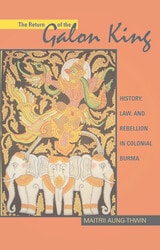
The Return of the Galon King
History, Law, and Rebellion in Colonial BurmaMaitrii Aung-Thwin
Ohio University Press, 2010
In late 1930, on a secluded mountain overlooking the rural paddy fields of British Burma, a peasant leader named Saya San crowned himself King and inaugurated a series of uprisings that would later erupt into one of the largest anti-colonial rebellions in Southeast Asian history. Considered an imposter by the British, a hero by nationalists, and a prophet-king by area-studies specialists, Saya San came to embody traditional Southeast Asia’s encounter with European colonialism in his attempt to resurrect the lost throne of Burma.
The Return of the Galon King analyzes the legal origins of the Saya San story and reconsiders the facts upon which the basic narrative and interpretations of the rebellion are based. Aung-Thwin reveals how counter-insurgency law produced and criminalized Burmese culture, contributing to the way peasant resistance was recorded in the archives and understood by Southeast Asian scholars.
This interdisciplinary study reveals how colonial anthropologists, lawyers, and scholar-administrators produced interpretations of Burmese culture that influenced contemporary notions of Southeast Asian resistance and protest. It provides a fascinating case study of how history is treated by the law, how history emerges in legal decisions, and how the authority of the past is used to validate legal findings.
Wartime in Burma
A Diary, January to June 1942Theippan Maung Wa
Ohio University Press, 2009
This diary, begun after the Japanese attack on Pearl Harbor and covering the invasion of Burma up to June 1942, is a moving account of the dilemmas faced by the well-loved and prolific Burmese author Theippan Maung Wa (a pseudonym of U Sein Tin) and his family. At the time of the Japanese invasion, U Sein Tin was deputy secretary in the Ministry of Home and Defense Affairs. An Oxford-trained member of the Indian Civil Service, working for the British administration on the eve of the invasion, he lived with his wife and three small children in Rangoon.
Wartime in Burma is a stirring memoir that presents a personal account of U Sein Tin’s feelings about the war, his anxiety for the safety of his family, the bombing of Rangoon, and what happened to them during the next six chaotic months of the British retreat. The author and his family leave Rangoon to live in a remote forest in Upper Burma with several other Burmese civil servants, their staff, and valuable possessions—rich pickings for robbers. His diary ends abruptly on June 5, his forty-second birthday; U Sein Tin was murdered on June 6 by a gang of Burmese bandits. The diary pages, scattered on the floor of the house, were rescued by his wife and eventually published in Burma in 1966. What survives is a unique account that shines new light on the military retreat from Burma.