Results by title
628 books match the query 'Democracy' and 25 start with w

Walter Benjamin
Overpowering ConformismEsther Leslie
Pluto Press, 2000

Waves of Discontent
Electoral Volatility, Public Policymaking, and the Health of American DemocracyJacob F.H. Smith
University of Michigan Press, 2025
Conducting statistical analyses of a wide array of surveys, Smith found that these feelings of displeasure translate to lower turnout among voters from the president’s party and a higher percentage of independents voting for the other party. Subsequently, he conducted a content analysis of New York Times articles to look at the connection between unrest in American society and seat swings in congressional elections, even before the existence of polling. Examining the consequences of volatility in congressional elections reveals that political amateurs are more likely to win in wave years than in normal years. Based on this data, Smith presents a new theory about the policy process—the policy doom loop—in which frustration among voters at both the inability of Congress to pass policy and anger at policies that actually do pass results in even more churn in congressional elections. Waves of Discontent offers some suggestions to promote constructive policymaking efforts in Washington to reduce frustration in the electorate.
We Decide!
Theories and Cases in Participatory DemocracyMichael Menser
Temple University Press, 2017
Participatory democracy calls for the creation and proliferation of practices and institutions that enable individuals and groups to better determine the conditions in which they act and relate to others. Michael Menser’s timely book We Decide! is arguably the most comprehensive treatment of participatory democracy. He explains the three waves of participatory democracy theory to show that this movement is attentive to the mechanics of contemporary political practices. Menser also outlines “maximal democracy,” his own view of participatory democracy that expands people’s abilities to shape their own lives, reduce inequality, and promote solidarity.
We Decide! draws on liberal, feminist, anarchist, and environmental justice philosophies as well as in-depth case studies of Spanish factory workers, Japanese housewives, and Brazilian socialists to show that participatory democracy actually works. Menser concludes his study by presenting a reconstructed version of the state that is shaped not by corporations but by inclusive communities driven by municipal workers, elected officials, and ordinary citizens working together. In this era of Bernie Sanders and Donald Trump, the participatory democracy proposed in We Decide! is more significant than ever.
We Need To Talk About Climate
How Citizens' Assemblies Can Help Us Solve The Climate CrisisGraham Smith
University of Westminster Press, 2024
Citizens’ assemblies bring the shared wisdom of ordinary people into political decision making on the climate and ecological crisis. They are increasingly being used at local, national and even global levels. But with what impact? Can they take us beyond the shortcomings of electoral and partisan politics? Can they make a real difference? This book explains why climate assemblies have captured the imagination of governments and activists alike, exploring the ways they can have a meaningful impact on climate politics.
This book charts the development of climate assemblies across Europe and beyond. It explores what ordinary people want, highlighting the ways in which assembly recommendations take us beyond current government policies and offer new visions and directions for change. It shows that not all assemblies are the same and that the context and design of climate assemblies have differed quite profoundly – as have their impacts on policy and public discourse. The book also lays out the key elements needed for climate assemblies to have sustained impact, providing essential insights for anyone wanting to run or advocate for them, and concludes with reflections on what we can expect from assemblies as they evolve.
The transition to net zero and climate resilient societies requires deep social and economic transformations that will have significant impacts on citizens’ choices and behaviours. Such a transition needs to engage the public directly and this book shows how climate assemblies can achieve this, allowing us to address the issues we all face together.

We Need To Talk About Climate
How Citizens' Assemblies Can Help Us Solve The Climate CrisisGraham Smith
University of Westminster Press, 2024
Citizens’ assemblies bring the shared wisdom of ordinary people into political decision making on the climate and ecological crisis. They are increasingly being used at local, national and even global levels. But with what impact? Can they take us beyond the shortcomings of electoral and partisan politics? Can they make a real difference? This book explains why climate assemblies have captured the imagination of governments and activists alike, exploring the ways they can have a meaningful impact on climate politics.
This book charts the development of climate assemblies across Europe and beyond. It explores what ordinary people want, highlighting the ways in which assembly recommendations take us beyond current government policies and offer new visions and directions for change. It shows that not all assemblies are the same and that the context and design of climate assemblies have differed quite profoundly – as have their impacts on policy and public discourse. The book also lays out the key elements needed for climate assemblies to have sustained impact, providing essential insights for anyone wanting to run or advocate for them, and concludes with reflections on what we can expect from assemblies as they evolve.
The transition to net zero and climate resilient societies requires deep social and economic transformations that will have significant impacts on citizens’ choices and behaviours. Such a transition needs to engage the public directly and this book shows how climate assemblies can achieve this, allowing us to address the issues we all face together.

We are the People
The Rise of the AfD in GermanyPenny Bochum
Haus Publishing, 2020
We are the People analyzes the sudden growth and radicalization of the AfD, from its Euroskeptic beginnings in 2013 to its increasing extremism. Penny Bochum shows us how the leaders’ use of inflammatory, xenophobic, and even Nazi-era language mirrors that of emerging far-right forces across much of the Western world. At the same time, through a lucid examination of the group’s ideology, Bochum shows how their brand of populism is distinct and based on German experiences and history.

We the Elites
Why the US Constitution Serves the FewRobert
Pluto Press, 2022
An adroit collection of essays exposing the constitution for what it really is – a rulebook to protect capitalism for the elites.
Written by 55 of the richest white men of early America, and signed by only 39 of them, the constitution is the sacred text of American nationalism. Popular perceptions of it are mired in idolatry, myth, and misinformation - many Americans have opinions on the constitution but have no idea what’s in it.
The misplaced faith of social movements in the constitution as a framework for achieving justice actually obstructs social change - incessant lengthy election cycles, staggered terms, and legislative sessions have kept social movements trapped in a redundant loop. This stymies progress on issues like labor rights, public health, and climate change, projecting the American people and the rest of the world towards destruction.
Robert Ovetz’s reading of the constitution shows that the system isn’t broken. Far from it. It works as it was designed.
What Democracy Looks Like
A New Critical Realism for a Post-Seattle WorldLang, Amy
Rutgers University Press, 2006
The convergence of activists in Seattle during the World Trade Organization meetings captured the headlines in 1999. These demonstrations marked the first major expression on U.S. soil of worldwide opposition to inequality, privatization, and political and intellectual repression. This turning point in world politics coincided with an ongoing quandary in academia-particularly in the humanities where the so-called "death of theory" has left the field on tenuous footing.
In What Democracy Looks Like, the editors and twenty-seven contributors argue that these crises-in the world and the academy-are not unrelated. The essays insist that, in the wake of "Seattle," teachers and scholars of American literature and culture are faced with the challenge of addressing new points of intersection between American studies and literary studies. The narrative, the poem, the essay, and the drama need to be reexamined in ways that are relevant to the urgent social and political issues of our time.
Collectively urging scholars and educators to pay fresh attention to the material conditions out of which literature arises, this path-breaking book inaugurates a new critical realism in American literary studies. It provides a crucial link in the growing need to merge theory and practice with the goal of reconnecting the ivory tower elite to the activists on the street.
What Democracy Looks Like
The Rhetoric of Social Movements and CounterpublicsEdited by Christina R. Foust, Amy Pason, and Kate Zittlow Rogness
University of Alabama Press, 2017
Examining How Social Movements and Counterpublics Shape Democratic Change.
Recent protests around the world (such as the Arab Spring uprisings and Occupy Wall Street movements) have drawn renewed interest to the study of social change and, especially, to the manner in which words, images, events, and ideas associated with protestors can “move the social.” What Democracy Looks Like is an attempt to foster a more coherent understanding of social change among scholars of rhetoric and communication studies by juxtaposing the ideas of social movements and counterpublics—historically two key factors significant in the study of social change. Foust, Pason, and Zittlow Rogness’s volume compiles the voices of leading and new scholars who are contributing to the history, application, and new directions of these two concepts, all in conversation with a number of acts of resistance or social change.
The theories of social movements and counterpublics are related, but distinct. Social movement theories tend to be concerned with enacting policy and legislative changes. Scholars flying this flag have concentrated on the organization and language (for example, rallies and speeches) that are meant to enact social change. Counterpublic theory, on the other hand, focuses less on policy changes and more on the unequal distribution of power and resources among different protest groups, which is sometimes synonymous with subordinated identity groups such as race, gender, sexuality, and class.
Nonetheless, contributors argue that in recent years the distinctions between these two methods have become less evident. By putting the literatures of the two theories in conversation with one another, these scholars seek to promote and imagine social change outside the typical binaries.

What Makes or Breaks a Democracy
Lessons from HungaryAndras Schweitzer
Central European University Press, 2026
Hungary is unique in that it democratized quickly and thoroughly in 1989–1990, then, after two decades, it turned into an electoral autocracy. A new democratic era could be in the making after the April 2026 election. This book evaluates potential factors involved in these turnarounds by analyzing the post-1989 Hungarian trajectory and comparing it to other countries of the region.
If the dramatic backsliding is connected to social cultural aspects, how could democracy take root after 1989? If constitutional arrangements helped the subsequent autocratization, how was the Hungarian setup different from that in neighboring countries? Did Budapest mismanage the economy? Is Viktor Orbán unique? The findings in this book lead to universal lessons on how to build and protect democracy.

Where Did the Party Go?
William Jennings Bryan, Hubert Humphrey, and the Jeffersonian LegacyJeff Taylor
University of Missouri Press, 2006
Who Deliberates?
Mass Media in Modern DemocracyBenjamin I. Page
University of Chicago Press, 1996
Page shows how the New York Times presented a restricted set of opinions on whether to go to war with Iraq, shutting out discussion of compromises favored by many Americans. He then examines the media's negative reaction to the Bush administration's claim that riots in Los Angeles were caused by welfare programs. Finally, he shows how talk shows overcame the elite media's indifference to widespread concern about Zoe Baird's hiring of illegal aliens. Page's provocative conclusion identifies the conditions under which media outlets become political actors and actively shape and limit the ideas and information available to the public.
Arguing persuasively that a diversity of viewpoints is essential to true public deliberation, this book will interest students of American politics, communications, and media studies.
Who Gets Represented?
Peter K. Enns
Russell Sage Foundation, 2011
Who Governs?
Presidents, Public Opinion, and ManipulationJames N. Druckman and Lawrence R. Jacobs
University of Chicago Press, 2015
Melding big debates about democratic theory with existing research on American politics and innovative use of the archives of three modern presidents—Johnson, Nixon, and Reagan—Druckman and Jacobs deploy lively and insightful analysis to show that the conventional model of representative democracy bears little resemblance to the actual practice of American politics. The authors conclude by arguing that polyarchy and the promotion of accelerated citizen mobilization and elite competition can improve democratic responsiveness. An incisive study of American politics and the flaws of representative government, this book will be warmly welcomed by readers interested in US politics, public opinion, democratic theory, and the fecklessness of American leadership and decision-making.
Who Guards the Guardians and How
Democratic Civil-Military RelationsEdited by Thomas C. Bruneau and Scott D. Tollefson
University of Texas Press, 2006
The continued spread of democracy into the twenty-first century has seen two-thirds of the almost two hundred independent countries of the world adopting this model. In these newer democracies, one of the biggest challenges has been to establish the proper balance between the civilian and military sectors. A fundamental question of power must be addressed—who guards the guardians and how?
In this volume of essays, contributors associated with the Center for Civil-Military Relations in Monterey, California, offer firsthand observations about civil-military relations in a broad range of regions including Latin America, Africa, Asia, and Eastern Europe. Despite diversity among the consolidating democracies of the world, their civil-military problems and solutions are similar—soldiers and statesmen must achieve a deeper understanding of one another, and be motivated to interact in a mutually beneficial way. The unifying theme of this collection is the creation and development of the institutions whereby democratically elected civilians achieve and exercise power over those who hold a monopoly on the use of force within a society, while ensuring that the state has sufficient and qualified armed forces to defend itself against internal and external aggressors. Although these essays address a wide variety of institutions and situations, they each stress a necessity for balance between democratic civilian control and military effectiveness.
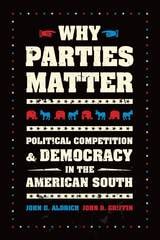
Why Parties Matter
Political Competition and Democracy in the American SouthJohn H. Aldrich and John D. Griffin
University of Chicago Press, 2017
With Why Parties Matter, John H. Aldrich and John D. Griffin make a compelling case that competition between political parties is an essential component of a democracy that is responsive to its citizens and thus able to address their concerns. Tracing the history of the parties through four eras—the Democratic-Whig party era that preceded the Civil War; the post-Reconstruction period; the Jim Crow era, when competition between the parties virtually disappeared; and the modern era—Aldrich and Griffin show how and when competition emerged between the parties and the conditions under which it succeeded and failed. In the modern era, as party competition in the South has come to be widely regarded as matching that of the North, the authors conclude by exploring the question of whether the South is poised to become a one-party system once again with the Republican party now dominant.
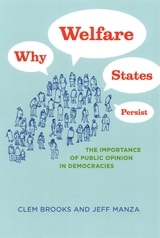
Why Welfare States Persist
The Importance of Public Opinion in DemocraciesClem Brooks and Jeff Manza
University of Chicago Press, 2007
The world’s richer democracies all provide such public benefits as pensions and health care, but why are some far more generous than others? And why, in the face of globalization and fiscal pressures, has the welfare state not been replaced by another model? Reconsidering the myriad issues raised by such pressing questions, Clem Brooks and Jeff Manza contend here that public opinion has been an important, yet neglected, factor in shaping welfare states in recent decades.
Analyzing data on sixteen countries, Brooks and Manza find that the preferences of citizens profoundly influence the welfare policies of their governments and the behavior of politicians in office. Shaped by slow-moving forces such as social institutions and collective memories, these preferences have counteracted global pressures that many commentators assumed would lead to the welfare state’s demise. Moreover, Brooks and Manza show that cross-national differences in popular support help explain why Scandinavian social democracies offer so much more than liberal democracies such as the United States and the United Kingdom.
Significantly expanding our understanding of both public opinion and social policy in the world’s most developed countries, this landmark study will be essential reading for scholars of political economy, public opinion, and democratic theory.

Winds of Will
Emily Dickinson and the Sovereignty of Democratic ThoughtPaul Crumbley
University of Alabama Press, 2010
A sophisticated literary analysis positioning Emily Dickinson’s poetry within the framework of democratic thought and individual sovereignty.
In this study, Paul Crumbley asserts that, contrary to popular opinion, Emily Dickinson consistently communicated political views through her poetry. Dickinson’s life of self-isolation—today her most notable personal characteristic—by no means extended into the political sphere, he argues. While she rarely addressed political issues directly and was curiously disengaged from the liberal causes and female reform movements of her time, Dickinson’s poems are deeply rooted both in matters of personal sovereignty and reader choice. The significant choices Dickinson extends to the reader underscore the democratic dimensions of reading her work, and of reading itself as a political act.
Crumbley employs close readings of Dickinson’s poems and letters, highlighting the many changing—and often contradictory—voices in her work, both throughout her oeuvre and in individual poems themselves. In Dickinson’s letters Crumbley finds just as many unique and conflicting voices; thus, both her personal correspondence and the poems make political demands by placing the burden of interpretation on the reader.
Rather than reflecting explicit political values, Dickinson’s work chronicles an ongoing decision-making process that magnifies the role of individual choice, not the advocacy of specific outcomes. In the end, Dickinson’s readers must either accept an isolated lyric subjectivity or invest that subjectivity with the substance necessary for engagement with the larger world.

Witchcraft, Violence, and Democracy in South Africa
Adam Ashforth
University of Chicago Press, 2004
In Witchcraft, Violence, and Democracy in South Africa, Adam Ashforth examines how people in Soweto and other parts of post-apartheid South Africa manage their fear of 'evil forces' such as witchcraft. Ashforth examines the dynamics of insecurity in the everyday life of Soweto at the turn of the twenty-first century. He develops a new framework for understanding occult violence as a form of spiritual insecurity and documents new patterns of interpretation attributing agency to evil forces. Finally, he analyzes the response of post-apartheid governments to issues of spiritual insecurity and suggests how these matters pose severe long-term challenges to the legitimacy of the democratic state.
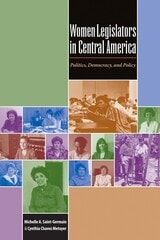
Women Legislators in Central America
Politics, Democracy, and PolicyBy Michelle A. Saint-Germain and Cynthia Chavez Metoyer
University of Texas Press, 2008
During the years between 1980 and 1999, in the midst of war and economic crisis, a record number of women were elected to national legislatures in Central American republics. Can quantitative increases in the presence of elected women in Central America produce qualitative political changes?
In this detailed study, Michelle A. Saint-Germain and Cynthia Chavez Metoyer explore the reasons for this unprecedented political rise of women, and what effect it has had on the region. Focusing on Costa Rica, El Salvador, Guatemala, Honduras, and Nicaragua, the authors analyze national and regional indicators to evaluate various hypotheses concerning the reasons for women's electoral success in the region, as well as to make comparisons with findings from other world regions. They find that the election of more women depends on three things: the presence of a crisis, a pool of politically experienced women, and a culture of gender consciousness. They also compare the characteristics of Central American women legislators to women in other national legislatures around the world.
The authors document how elected women have used their policy-making power to begin to change the lives of all Central Americans, women and men alike. In more than seventy-five in-depth, personal interviews, these women legislators reflect on their lives, political careers, and gender identities in their own words, providing deep insights into recent events in this region.
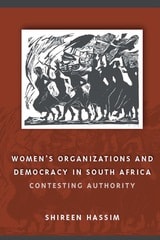
Women's Organizations and Democracy in South Africa
Contesting AuthorityShireen Hassim
University of Wisconsin Press, 2006
The transition to democracy in South Africa was one of the defining events in twentieth-century political history. The South African women’s movement is one of the most celebrated on the African continent. Shireen Hassim examines interactions between the two as she explores the gendered nature of liberation and regime change. Her work reveals how women’s political organizations both shaped and were shaped by the broader democratic movement. Alternately asserting their political independence and giving precedence to the democratic movement as a whole, women activists proved flexible and remarkably successful in influencing policy. At the same time, their feminism was profoundly shaped by the context of democratic and nationalist ideologies. In reading the last twenty-five years of South African history through a feminist framework, Hassim offers fresh insights into the interactions between civil society, political parties, and the state.
Hassim boldly confronts sensitive issues such as the tensions between autonomy and political dependency in feminists’ engagement with the African National Congress (ANC) and other democratic movements, and black-white relations within women’s organizations. She offers a historically informed discussion of the challenges facing feminist activists during a time of nationalist struggle and democratization.
Winner, Victoria Schuck Award for best book on women and politics, American Political Science Association
“An exceptional study, based on extensive research. . . . Highly recommended.”—Choice
“A rich history of women’s organizations in South African . . . . [Hassim] had observed at first hand, and often participated in, much of what she described. She had access to the informants and private archives that so enliven the narrative and enrich the analysis. She provides a finely balanced assessment.”—Gretchen Bauer, African Studies Review

Working for Democracy
American Workers from the Revolution to the PresentEdited by Paul Buhle and Alan Dawley
University of Illinois Press, 1985
Working, Shirking, and Sabotage
Bureaucratic Response to a Democratic PublicJohn Brehm and Scott Gates
University of Michigan Press, 1999
Worldly Ethics
Democratic Politics and Care for the WorldElla Myers
Duke University Press, 2013
Wrong Turnings
How the Left Got LostGeoffrey M. Hodgson
University of Chicago Press, 2017
With Wrong-Turnings, Geoffrey M. Hodgson tracks changes in the meaning of the Left and offers suggestions for how the Left might reclaim some of its core values. The term Left originated during the French Revolution, when revolutionaries sought to abolish the monarchy and privilege and to introduce a new society based on liberty, equality, fraternity, and universal rights. Over time, however, the meaning radically changed, especially through the influence of socialism and collectivism. Hodgson argues that the Left must rediscover its roots in the Enlightenment and readopt Enlightenment values it has abandoned, such as those concerning democracy and universal human rights. Only then will it be prepared to address contemporary problems of inequality and the survival of democracy. Possible measures could include enhanced educational provisions, a guaranteed basic income, and a viable mechanism for fair distribution of wealth.
Wrong-Turnings is a truly pathbreaking work from one of our most prolific and respected institutional theorists. It will change our understanding of how the left got lost.