Results by title
87 books match the query 'Developing & Emerging Countries' and 5 start with w
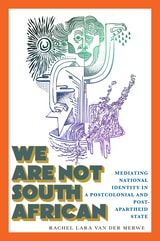
We Are Not South African
Mediating National Identity in a Postcolonial and Postapartheid StateRachel Lara van der Merwe
Rutgers University Press, 2026
We Are Not South African explores how national identity functions as a colonial tool of communication, control, and power. Author Rachel Lara van der Merwe examines how humans and the planet are integrally shaped by the idea of the nation and speculates on how different sociopolitical imaginaries, instead of the nation, could inform ways of being-together in the world.
Linking national identity to colonialism, the book broadens the idea of the nation to include its impact on all forms of life, human and more-than-human. Van der Merwe builds her argument on three central observations: that nations are made up of conflicting and fractured imaginaries, not unified, cohesive ones; the nation is divisive by nature, tracing back to its colonial origins; and the nation, along with the state, exploits both humans and more-than-humans. In order to build a more just and sustainable planetary society, she argues, liberation from such colonial formations is vital. In response, the book asks, How could we reimagine how we organize our societies through values of relationality and mutual care rather than rigid borders? What sociopolitical imaginaries do we need, or already possess, that might inform new configurations of community?
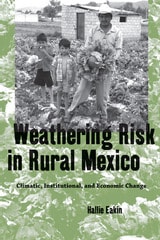
Weathering Risk in Rural Mexico
Climatic, Institutional, and Economic ChangeHallie Eakin
University of Arizona Press, 2006
In Weathering Risk in Rural Mexico, Hallie Eakin draws on ethnographic data collected in three agricultural communities in rural Mexico to show how economic and climatic change are not only linked in cause and effect at the planetary scale but also interact in unpredictable and complex ways in the context of regional political and trade relationships, national economic and social programs, and the decision making of institutions, enterprises, and individuals.She shows how the parallel processes of globalization and climatic change result in populations that are “doubly exposed” and thus particularly vulnerable.
Chapters trace the effects of El Niño in central Mexico in the late 1990s alongside some of the principal changes in the country’s agricultural policy. Eakin argues that in order to develop policies that effectively address rural poverty and agricultural development, we need an improved understanding of how households cope simultaneously with various sources of uncertainty and adjust their livelihoods to accommodate newly evolving environmental, political, and economic realities.
Weaving a Fabric of Unity
Conversations on Education and DevelopmentHaleh Arbab
West Virginia University Press, 2024
Wellbeing Economics
How and Why Economics Needs to ChangeNicky Pouw
Amsterdam University Press, 2020
In 'Wellbeing Economics' Nicky Pouw puts forward a new framework that places human wellbeing at the centre, instead of economic growth. She postulates ten reasons why economics should change to remain a relevant discipline and develops a Wellbeing Economic Matrix (WEM) to implement this approach. In doing so, it is one of the first economics books that 'rethinks the economy' from head to tail.
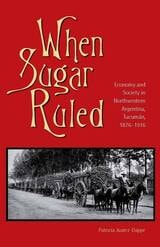
When Sugar Ruled
Economy and Society in Northwestern Argentina, Tucumán, 1876–1916Patricia Juarez-Dappe
Ohio University Press, 2010
Two tropical commodities—coffee and sugar—dominated Latin American export economies in the nineteenth and early twentieth centuries. When Sugar Ruled: Economy and Society in Northwestern Argentina, Tucumán, 1876–1916 presents a distinctive case that does not quite fit into the pattern of many Latin American sugar economies.
During the last quarter of the nineteenth century, the province of Tucumán emerged as Argentina’s main sugar producer, its industry catering almost exclusively to the needs of the national market and financed mostly by domestic capital. The expansion of the sugar industry provoked profound changes in Tucumán’s economy as sugar specialization replaced the province’s diversified productive structure. Since ingenios relied on outside growers for the supply of a large share of the sugarcane, sugar production did not produce massive land dispossession and resulted in the emergence of a heterogeneous planter group. The arrival of thousands of workers from neighboring provinces during the harvest season transformed rural society dramatically. As the most dynamic sector in Tucumán’s economy, revenues from sugar enabled the provincial government to participate in the modernizing movement sweeping turn-of-the-century Argentina.
Patricia Juarez-Dappe uncovers the unique features that characterized sugar production in Tucumán as well as the changes experienced by the province’s economy and society between 1876 and 1916, the period of most dramatic sugar expansion. When Sugar Ruled is an important addition to the literature on sugar economies in Latin America and Argentina.