Results by title
81 books match the query 'Disasters & Disaster Relief' and 5 start with w
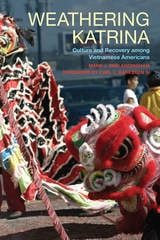
Weathering Katrina
Culture and Recovery among Vietnamese AmericansMark J. VanLandingham
Russell Sage Foundation, 2017
In 2005, Hurricane Katrina devastated New Orleans. The principal Vietnamese-American enclave was a remote, low-income area that flooded badly. Many residents arrived decades earlier as refugees from the Vietnam War and were marginally fluent in English. Yet, despite these poor odds of success, the Vietnamese made a surprisingly strong comeback in the wake of the flood. In Weathering Katrina, public health scholar Mark VanLandingham analyzes their path to recovery, and examines the extent to which culture helped them cope during this crisis.
Contrasting his longitudinal survey data and qualitative interviews of Vietnamese residents with the work of other research teams, VanLandingham finds that on the principal measures of disaster recovery—housing stability, economic stability, health, and social adaptation—the Vietnamese community fared better than other communities. By Katrina’s one-year anniversary, almost 90 percent of the Vietnamese had returned to their neighborhood, higher than the rate of return for either blacks or whites. They also showed much lower rates of post-traumatic stress disorder than other groups. And by the second year after the flood, the employment rate for the Vietnamese had returned to its pre-Katrina level.
While some commentators initially attributed this resilience to fairly simple explanations such as strong leadership or to a set of vague cultural strengths characteristic of the Vietnamese and other “model minorities”, VanLandingham shows that in fact it was a broad set of factors that fostered their rapid recovery. Many of these factors had little to do with culture. First, these immigrants were highly selected—those who settled in New Orleans enjoyed higher human capital than those who stayed in Vietnam. Also, as a small, tightly knit community, the New Orleans Vietnamese could efficiently pass on information about job leads, business prospects, and other opportunities to one another. Finally, they had access to a number of special programs that were intended to facilitate recovery among immigrants, and enjoyed a positive social image both in New Orleans and across the U.S., which motivated many people and charities to offer the community additional resources. But culture—which VanLandingham is careful to define and delimit—was important, too. A shared history of overcoming previous challenges—and a powerful set of narratives that describe these successes; a shared set of perspectives or frames for interpreting events; and a shared sense of symbolic boundaries that distinguish them from broader society are important elements of culture that provided the Vietnamese with some strong advantages in the post-Katrina environment.
By carefully defining and disentangling the elements that enabled the swift recovery of the Vietnamese in New Orleans, Weathering Katrina enriches our understanding of this understudied immigrant community and of why some groups fare better than others after a major catastrophe like Katrina.
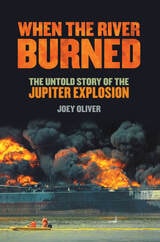
When the River Burned
The Untold Story of the Jupiter ExplosionJoey Oliver
Michigan State University Press, 2026
On September 16, 1990, the tanker ship Jupiter exploded while unloading gasoline at a Bay City pier on the Saginaw River. The blast killed one worker, injured eleven others, and triggered what the U.S. Coast Guard later described as an unprecedented crisis on the Great Lakes. For weeks, the disaster commanded national attention as officials worked to contain the damage and investigate the cause. Then, like so many industrial accidents, the story faded from public memory.
When the River Burned tells the story of this overlooked chapter in Great Lakes maritime history. Drawing on newspaper archives, Coast Guard investigations, and eyewitness accounts, Joey Oliver reconstructs how a series of small oversights—in equipment, procedure, and human judgment—aligned to produce catastrophe.
The book places the Jupiter explosion within a broader history of the Saginaw River, tracing its evolution into a vital artery of Michigan industry. Oliver examines the fragile interdependence of ships, piers, and river traffic, revealing how disasters emerge not from single causes but from the breakdown of complex systems. When the River Burned is not only the account of a deadly tanker explosion; it is a reflection on what caused it, on the safety changes that followed, and on changes that never came.
Worst Cases
Terror and Catastrophe in the Popular ImaginationLee Clarke
University of Chicago Press, 2005
We consider the few who live in fear of such scenarios to be alarmist or even paranoid. But Worst Cases shows that such individuals—like Cassandra foreseeing the fall of Troy—are more reasonable and prescient than you might think. In this book, Lee Clarke surveys the full range of possible catastrophes that animate and dominate the popular imagination, from toxic spills and terrorism to plane crashes and pandemics. Along the way, he explores how the ubiquity of worst cases in everyday life has rendered them ordinary and mundane. Fear and dread, Clarke argues, have actually become too rare: only when the public has more substantial information and more credible warnings will it take worst cases as seriously as it should.
A timely and necessary look into how we think about the unthinkable, Worst Cases will be must reading for anyone attuned to our current climate of threat and fear.
Worst Cases
Terror and Catastrophe in the Popular ImaginationLee Clarke
University of Chicago Press, 2005
Al Qaeda detonates a nuclear weapon in Times Square during rush hour, wiping out half of Manhattan and killing 500,000 people. A virulent strain of bird flu jumps to humans in Thailand, sweeps across Asia, and claims more than fifty million lives. A single freight car of chlorine derails on the outskirts of Los Angeles, spilling its contents and killing seven million. An asteroid ten kilometers wide slams into the Atlantic Ocean, unleashing a tsunami that renders life on the planet as we know it extinct.
We consider the few who live in fear of such scenarios to be alarmist or even paranoid. But Worst Cases shows that such individuals—like Cassandra foreseeing the fall of Troy—are more reasonable and prescient than you might think. In this book, Lee Clarke surveys the full range of possible catastrophes that animate and dominate the popular imagination, from toxic spills and terrorism to plane crashes and pandemics. Along the way, he explores how the ubiquity of worst cases in everyday life has rendered them ordinary and mundane. Fear and dread, Clarke argues, have actually become too rare: only when the public has more substantial information and more credible warnings will it take worst cases as seriously as it should.
A timely and necessary look into how we think about the unthinkable, Worst Cases will be must reading for anyone attuned to our current climate of threat and fear.
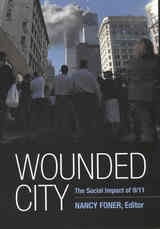
Wounded City
The Social Impact of 9/11 on New York CityNancy Foner
Russell Sage Foundation, 2005