Results by title
577 books match the query 'Earth Sciences' and 24 start with w
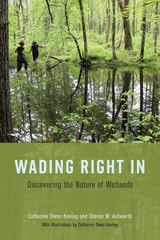
Wading Right In
Discovering the Nature of WetlandsCatherine Owen Koning and Sharon M. Ashworth
University of Chicago Press, 2019
In Wading Right In, Catherine Owen Koning and Sharon M. Ashworth take us on a journey into wetlands through stories from the people who wade in the muck. Traveling alongside scientists, explorers, and kids with waders and nets, the authors uncover the inextricably entwined relationships between the water flows, natural chemistry, soils, flora, and fauna of our floodplain forests, fens, bogs, marshes, and mires. Tales of mighty efforts to protect rare orchids, restore salt marshes, and preserve sedge meadows become portals through which we visit major wetland types and discover their secrets, while also learning critical ecological lessons.
The United States still loses wetlands at a rate of 13,800 acres per year. Such loss diminishes the water quality of our rivers and lakes, depletes our capacity for flood control, reduces our ability to mitigate climate change, and further impoverishes our biodiversity. Koning and Ashworth’s stories captivate the imagination and inspire the emotional and intellectual connections we need to commit to protecting these magical and mysterious places.
Wasted World
How Our Consumption Challenges the PlanetRob Hengeveld
University of Chicago Press, 2012
Watching Vesuvius
A History of Science and Culture in Early Modern ItalySean Cocco
University of Chicago Press, 2012
Water Always Wins
Thriving in an Age of Drought and DelugeErica Gies
University of Chicago Press, 2022
Nearly every human endeavor on the planet was conceived and constructed with a relatively stable climate in mind. But as new climate disasters remind us every day, our world is not stable—and it is changing in ways that expose the deep dysfunction of our relationship with water. Increasingly severe and frequent floods and droughts inevitably spur calls for higher levees, bigger drains, and longer aqueducts. But as we grapple with extreme weather, a hard truth is emerging: our development, including concrete infrastructure designed to control water, is actually exacerbating our problems. Because sooner or later, water always wins.
In this quietly radical book, science journalist Erica Gies introduces us to innovators in what she calls the Slow Water movement who start by asking a revolutionary question: What does water want? Using close observation, historical research, and cutting-edge science, these experts in hydrology, restoration ecology, engineering, and urban planning are already transforming our relationship with water.
Modern civilizations tend to speed water away, erasing its slow phases on the land. Gies reminds us that water’s true nature is to flex with the rhythms of the earth: the slow phases absorb floods, store water for droughts, and feed natural systems. Figuring out what water wants—and accommodating its desires within our human landscapes—is now a crucial survival strategy. By putting these new approaches to the test, innovators in the Slow Water movement are reshaping the future.
Water and Climate in the Western United States
W Lewis
University Press of Colorado, 2003
Water's Edge
Writing on WaterEdited by Lenore Manderson and Forrest Gander
Northwestern University Press, 2023
A wide-ranging consideration of water’s plenitude and paucity—and of our relationship to its many forms
Water is quotidian, ubiquitous, precious, and precarious. With their roots in this element, the authors of Water’s Edge reflect on our natural environment: its forms, textures, and stewardship. Born from a colloquium organized by the editors at the Institute at Brown for Environment and Society, the anthology features a diverse group of writers and artists from half a dozen countries, from different fields of scholarship and practice: artists, biologists, geologists, poets, ecocritics, actors, and anthropologists. The contributors explore and celebrate water while reflecting on its disturbances and pollution, and their texts and art play with the boundaries by which we differentiate literary forms.
In the creative nonfiction, poetry, and visual art collected here, water moves from backdrop to subject. Ashley Dawson examines the effects of industrial farming on the health of local ecosystems and economies. Painter Kulvinder Kaur Dhew captures water’s brilliance and multifaceted reflections through a series of charcoal pieces that interlace the collection. Poet Arthur Sze describes the responsibility involved in the careful management of irrigation ditches in New Mexico. Rather than concentrating their thoughts into a singular, overwhelming argument, the authors circulate moments of apprehension, intimation, and felt experience. They are like tributaries, each carrying, in a distinctive style, exigent and often intimate reports concerning a substance upon which all living organisms depend.
Waters of the World
The Story of the Scientists Who Unraveled the Mysteries of Our Oceans, Atmosphere, and Ice Sheets and Made the Planet WholeSarah Dry
University of Chicago Press, 2019
From the glaciers of the Alps to the towering cumulonimbus clouds of the Caribbean and the unexpectedly chaotic flows of the North Atlantic, Waters of the World is a tour through 150 years of the history of a significant but underappreciated idea: that the Earth has a global climate system made up of interconnected parts, constantly changing on all scales of both time and space. A prerequisite for the discovery of global warming and climate change, this idea was forged by scientists studying water in its myriad forms. This is their story.
Linking the history of the planet with the lives of those who studied it, Sarah Dry follows the remarkable scientists who summited volcanic peaks to peer through an atmosphere’s worth of water vapor, cored mile-thick ice sheets to uncover the Earth’s ancient climate history, and flew inside storm clouds to understand how small changes in energy can produce both massive storms and the general circulation of the Earth’s atmosphere. Each toiled on his or her own corner of the planetary puzzle. Gradually, their cumulative discoveries coalesced into a unified working theory of our planet’s climate.
We now call this field climate science, and in recent years it has provoked great passions, anxieties, and warnings. But no less than the object of its study, the science of water and climate is—and always has been—evolving. By revealing the complexity of this history, Waters of the World delivers a better understanding of our planet’s climate at a time when we need it the most.
Weather Forecaster to Research Scientist
My Career in MeteorologyRobert M. Atlas
American Meteorological Society, 2022
As a young child, Robert M. Atlas would often look up at the sky, observe the clouds, and ask his parents questions about the weather. That early interest sparked a career in meteorology that took place during a period of rapid development in the field. Weather Forecaster to Research Scientist follows his decades-long career and his innovative research, which led to improvements in the understanding and prediction of extreme weather.
Atlas’s journey begins with his start as an apprentice forecaster for the US Weather Bureau during a time when satellite meteorology and operational numerical weather prediction were just in their infancy. Weather Forecaster to Research Scientist also traces his experiences as an operational forecaster in the US Air Force, discusses his pioneering work on ocean surface winds using satellites, and describes his leadership of scientific organizations within NASA and NOAA as well as his experiences teaching at several universities. An engaging account of a distinguished career, this book will appeal to students, educators, weather forecasters, scientists, and weather enthusiasts alike.
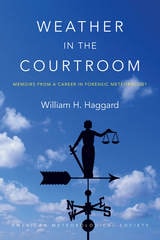
Weather in the Courtroom
Memoirs from a Career in Forensic MeteorologyWilliam H. Haggard
American Meteorological Society, 2016
For a society enthralled by courtroom drama, forensics, and natural disasters, Weather in the Courtroom is a perfect storm: an exciting inside scoop on legendary court cases where the weather may—or may not—have played a crucial role. Haggard explores both the meteorological facts and human stories of a variety of high-profile cases among the hundreds in which, after retiring from the government, he served as an expert witness. Were the disappearance of Alaskan Congressman Nick Begich’s plane on October 16, 1972; the collapse of Tampa Bay’s Skyway Bridge on May 9, 1980; and the crash of Delta Flight 191 in Dallas/Fort Worth on August 2, 1985, natural or human-caused disasters? Haggard’s recounting of these and other litigations reveals just how critical the interpretation of weather and climate data in the courtroom is to our understanding of what happened—and who, if anyone, is at fault.
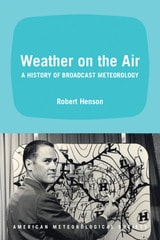
Weather on the Air
A History of Broadcast MeteorologyRobert Henson
American Meteorological Society, 2010
From low humor to high drama, TV weather reporting has encompassed an enormous range of styles and approaches, triggering chuckles, infuriating the masses, and at times even saving lives. In Weather on the Air,meteorologist and science journalist Robert Henson covers it all—the people, technology, science, and show business that combine to deliver the weather to the public each day.
The first comprehensive history of its kind, Weather on the Air explores the many forces that have shaped weather broadcasts over the years, including the long-term drive to professionalize weathercasting, the complex relations between government and private forecasters, and the effects of climate-change science and the Internet on today’s broadcasts. Dozens of photos and anecdotes accompany Henson’s more than two decades of research to document the evolution of weathercasts, from their primitive beginnings on the radio to the high-gloss, graphics-laden segments we watch on television every morning.
This engaging study will be an invaluable tool for students of broadcast meteorology and mass communication and an entertaining read for anyone fascinated by the public face of weather.
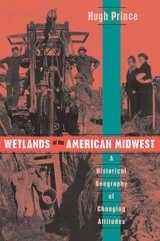
Wetlands of the American Midwest
A Historical Geography of Changing AttitudesHugh Prince
University of Chicago Press, 1997
As attitudes changed, so did scientific research agendas, government policies, and farmers' strategies for managing their land. Originally viewed as bountiful sources of wildlife by indigenous peoples, wet areas called "wet prairies," "swamps," or "bogs" in the late nineteenth and early twentieth centuries were considered productive only when drained for agricultural use. Beginning in the 1950s, many came to see these renamed "wetlands" as valuable for wildlife and soil conservation.
Prince's book will appeal to a wide readership, ranging from geographers and environmental historians to the many government and private agencies and individuals concerned with wetland research, management, and preservation.
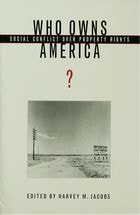
Who Owns America?
Social Conflict over Property RightsEdited by Harvey M. Jacobs
University of Wisconsin Press, 1998
Land ownership by individual citizens is a cornerstone of American heritage and a centerpiece of the American dream. Thomas Jefferson called it the key to our success as a democracy. Yet the question of who owns America not only remains unanswered but is central to a fundamental conflict that can pit private property rights advocates against government policymakers and environmentalists.
Land use authority Harvey M. Jacobs has gathered a provocative collection of perspectives from eighteen contributors in the fields of law, history, anthropology, economics, sociology, forestry, and environmental studies. Who Owns America? begins with the popular view of land ownership as seen though the television show Bonanza! It examines public regulation of private land; public land management; the roles culture and ethnic values play in land use; and concludes with Jacobs’ title essay.
Who Owns America? is a powerful and illuminating exploration of the very terrain that makes us Americans. Its broad set of theoretical and historical perspectives will fascinate historians, environmental activists, policy makers, and all who care deeply about the land we share.

Who Rules the Waves?
Piracy, Overfishing and Mining the OceansDenise Russell
Pluto Press, 2010
With piracy raging in the Indian Ocean, international disputes over undersea oil and gas, and chronic overfishing, the oceans have rarely been subject to such varied and environmentally damaging conflict outside a world war. In Who Rules the Waves? Denise Russell gives us a rare insight into these issues and how they could be resolved.
International law states that a coastal country has territorial rights for 12 miles into the sea beyond its coastline, and economic rights for 200 miles, but in practice many countries have virtually no control over their own waters, and there is no international agency powerful enough to settle disputes. Russell provides a thorough examination of the politics of the sea, showing that without a radical change in ocean governance, accelerating climate change and overuse of the sea's resources is likely to have catastrophic effects.
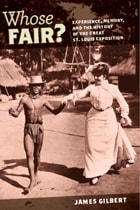
Whose Fair?
Experience, Memory, and the History of the Great St. Louis ExpositionJames Gilbert
University of Chicago Press, 2009
The 1904 St. Louis World’s Fair was a major event in early-twentieth-century America. Attracting millions of tourists, it exemplified the Victorian predilection for public spectacle. The Fair has long served as a touchstone for historians interested in American culture prior to World War I and has endured in the memories of generations of St. Louis residents and visitors. In Whose Fair? James Gilbert asks: what can we learn about the lived experience of fairgoers when we compare historical accounts, individual and collective memories, and artifacts from the event?
Exploring these differing, at times competing, versions of history and memory prompts Gilbert to dig through a rich trove of archival material. He examines the papers of David Francis, the Fair’s president and subsequent chief archivist; guidebooks and other official publications; the 1944 film Meet Me in St. Louis; diaries, oral histories, and other personal accounts; and a collection of striking photographs. From this dazzling array of sources, Gilbert paints a lively picture of how fairgoers spent their time, while also probing the ways history and memory can complement each other.
Wild Hope
On the Front Lines of Conservation SuccessAndrew Balmford
University of Chicago Press, 2012
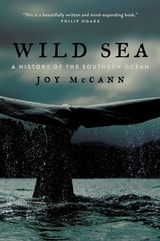
Wild Sea
A History of the Southern OceanJoy McCann
University of Chicago Press, 2019
So begins Joy McCann’s Wild Sea, the remarkable story of the world’s remote Southern, or Antarctic, Ocean. Unlike the Pacific, Atlantic, Indian, and Arctic Oceans with their long maritime histories, little is known about the Southern Ocean. This book takes readers beyond the familiar heroic narratives of polar exploration to explore the nature of this stormy circumpolar ocean and its place in Western and Indigenous histories. Drawing from a vast archive of charts and maps, sea captains’ journals, whalers’ log books, missionaries’ correspondence, voyagers’ letters, scientific reports, stories, myths, and her own experiences, McCann embarks on a voyage of discovery across its surfaces and into its depths, revealing its distinctive physical and biological processes as well as the people, species, events, and ideas that have shaped our perceptions of it. The result is both a global story of changing scientific knowledge about oceans and their vulnerability to human actions and a local one, showing how the Southern Ocean has defined and sustained southern environments and people over time.
Beautifully and powerfully written, Wild Sea will raise a broader awareness and appreciation of the natural and cultural history of this little-known ocean and its emerging importance as a barometer of planetary climate change.
Wildlife in the Anthropocene
Conservation after NatureJamie Lorimer
University of Minnesota Press, 2015
Elephants rarely breed in captivity and are not considered domesticated, yet they interact with people regularly and adapt to various environments. Too social and sagacious to be objects, too strange to be human, too captive to truly be wild, but too wild to be domesticated—where do elephants fall in our understanding of nature?
In Wildlife in the Anthropocene, Jamie Lorimer argues that the idea of nature as a pure and timeless place characterized by the absence of humans has come to an end. But life goes on. Wildlife inhabits everywhere and is on the move; Lorimer proposes the concept of wildlife as a replacement for nature. Offering a thorough appraisal of the Anthropocene—an era in which human actions affect and influence all life and all systems on our planet— Lorimer unpacks its implications for changing definitions of nature and the politics of wildlife conservation. Wildlife in the Anthropocene examines rewilding, the impacts of wildlife films, human relationships with charismatic species, and urban wildlife. Analyzing scientific papers, policy documents, and popular media, as well as a decade of fieldwork, Lorimer explores the new interconnections between science, politics, and neoliberal capitalism that the Anthropocene demands of wildlife conservation.
Imagining conservation in a world where humans are geological actors entangled within and responsible for powerful, unstable, and unpredictable planetary forces, this work nurtures a future environmentalism that is more hopeful and democratic.
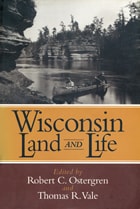
Wisconsin Land and Life
A Portrait of the StateRobert C. Ostergren
University of Wisconsin Press, 1997
These are images of Wisconsin's land and life, images that evoke a strong sense of place. This book, Wisconsin Land and Life, is an exploration of place, a series of original essays by Wisconsin geographers that offers an introduction to the state's natural environment, the historical processes of its human habitation, and the ways that nature and people interact to create distinct regional landscapes. To read it is to come away with a sweeping view of Wisconsin's geography and history: the glaciers that carved lakes and moraines; the soils and climate that fostered the prairies and great northern pine forests; the early Native Americans who began to shape the landscape and who established forest trails and river portages; the successive waves of Europeans who came to trade in furs, mine for lead and iron, cut the white pines, establish farms, work in the lumber and paper mills, and transform spent wheatfields into pasture for dairy cattle.
Readers will learn, too, about the platting and naming of Wisconsin's towns, the establishment of county and township governments, the growth of urban neighborhoods and parishes, the role of rivers, railroads, and religion in shaping the state's growth, and the controversial reforestation of the cutover lands that eventually transformed hardscrabble farms and swamps into a sportsman's paradise.
Abundantly illustrated with photos and maps, this book will richly reward anyone who wishes to learn more about the land and life of the place we know as Wisconsin.
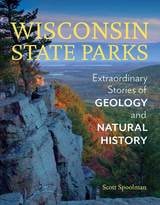
Wisconsin State Parks
Extraordinary Stories of Geology and Natural HistoryScott Spoolman
Wisconsin Historical Society Press, 2018
The impressive bluffs, valleys, waterfalls, and lakes of Wisconsin’s state parks provide more than beautiful scenery and recreational opportunities. They are windows into the distant past, offering clues to the dramatic events that have shaped the land over billions of years.
Author and former DNR journalist Scott Spoolman takes readers with him to twenty-eight parks, forests, and natural areas where evidence of the state’s striking geologic and natural history are on display. In an accessible storytelling style, Spoolman sheds light on the volcanoes that poured deep layers of lava rock over a vast area in the northwest, the glacial masses that flattened and molded the landscape of northern and eastern Wisconsin, mountain ranges that rose up and wore away over hundreds of millions of years, and many other bedrock-shaping phenomena. These stories connect geologic processes to the current landscape, as well as to the evolution of flora and fauna and development of human settlement and activities, for a deeper understanding of our state’s natural history.
The book includes a selection of detailed trail guides for each park, which hikers can take with them on the trail to view evidence of Wisconsin’s geologic and natural history for themselves.
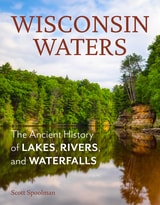
Wisconsin Waters
The Ancient History of Lakes, Rivers, and WaterfallsScott Spoolman
Wisconsin Historical Society Press, 2022
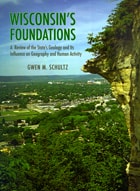
Wisconsin's Foundations
A Review of the State's Geology and Its Influence on Geography and Human ActivityGwen Schultz
University of Wisconsin Press, 2004
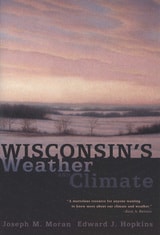
Wisconsin's Weather and Climate
Joseph M. Moran
University of Wisconsin Press, 2003
Wisconsin's Weather and Climate is written for weather buffs, teachers, students, outdoor enthusiasts, and those working in fields, lakes, and forests for whom the weather is a daily force to be reckoned with. It examines the physical features of Wisconsin that shape the state’s climate—topography, mid-latitude location, and proximity to Lakes Superior and Michigan—and meteorological phenomena that affect climate, such as atmospheric circulation and air mass frequency. Authors Joseph M. Moran and Edward J. Hopkins trace the evolution of methods of weather observation and forecasting that are so important for agriculture and Great Lakes commerce, and they explain how Wisconsin scientists use weather balloons, radar, and satellites to improve forecasting and track climate changes. They take readers through the seasonal changes in weather in Wisconsin and give an overview of what past climate changes might tell us about the future.
Appendices provide climatic data for Wisconsin, including extremes of temperature, snowfall, and precipitation at selected stations in the state. The authors also list sources for further information.
Vignettes throughout the book provide fascinating weather lore:
o Why there are cacti in Wisconsin
o The famous Green Bay Packers–Dallas Cowboys "Ice Bowl" game of 1967
o The Army Signal Corps’ ban on the word tornado
o Advances in snow-making technology
o The decline of the Great Lakes ice industry
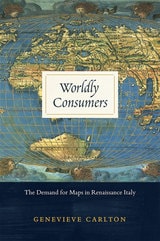
Worldly Consumers
The Demand for Maps in Renaissance ItalyGenevieve Carlton
University of Chicago Press, 2015
Drawing on a variety of sixteenth-century sources, including household inventories, epigrams, dedications, catalogs, travel books, and advice manuals, Worldly Consumers studies how individuals displayed different maps in their homes as deliberate acts of self-fashioning. One citizen decorated with maps of Bruges, Holland, Flanders, and Amsterdam to remind visitors of his military prowess, for example, while another hung maps of cities where his ancestors fought or governed, in homage to his auspicious family history. Renaissance Italians turned domestic spaces into a microcosm of larger geographical places to craft cosmopolitan, erudite identities for themselves, creating a new class of consumers who drew cultural capital from maps of the time.
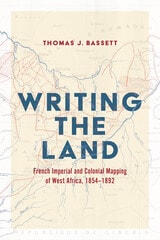
Writing the Land
French Imperial and Colonial Mapping of West Africa, 1854–1892Thomas J. Bassett
University of Chicago Press, 2027
Reveals the intertwined nature of imperial mapping and map history through the making of the colony of French Soudan in nineteenth-century West Africa.
Thomas J. Bassett’s Writing the Land argues that mapping played a key role in France’s territorial conquest of Africa, and that the process of imperial expansion and colonization shaped map history by influencing how maps were constructed, circulated, and used. Analyzing military and surveying campaigns over half a century in an area that became the colony of French Soudan, Bassett focuses on the social and spatial problems that surveyors and mapmakers tried to solve in the process of territorial conquest, as well as the conflicts that arose as they pursued their goals.
In their efforts to obtain this territory, French military leaders, cartographers, and expedition members came into continual contact with local Africans, with whom they negotiated and clashed. Often, imperial officers relied on intermediaries to navigate West African geography, drawing on the knowledge of political authorities, interpreters, guides, and long-distance traders; the maps they produced are inextricable from these interactions. Ultimately, Bassett claims, examining the processes of mapping in the context of these encounters leads us to understand these maps anew as Euro-African constructions, ones that emerge from a complex process of exchange and domination.