198 books match the query 'Educational Policy & Reform' and 8 start with w
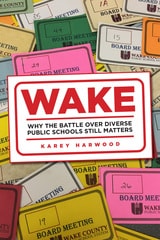
cover of Wake: Why the Battle over Diverse Public Schools Still Matters

Wake

Why the Battle over Diverse Public Schools Still Matters

Karey Alison Harwood

Rutgers University Press, 2024
The Wake County Public School System was once described as a beacon of hope for American school districts. It was both academically successful and successfully integrated. It accomplished these goals through the hard work of teachers and administrators, and through a student assignment policy that made sure no school in the countywide district became a high poverty school. Although most students attended their closest school, the “diversity policy” modified where some students were assigned to make sure no school had more than 40% of its students qualifying for free or reduced-price lunch or more than 25% performing below grade level. When the school board election of 2009 swept into office a majority who favored “neighborhood schools,” the diversity policy that had governed student assignment for years was eliminated. Wake: Why the Battle Over Diverse Public Schools Still Matters tells the story of the aftermath of that election, including the fierce public debate that ensued during school board meetings and in the pages of the local newspaper, and the groundswell of community support that voted in a pro-diversity school board in 2011. What was at stake in those years was the fundamental direction of the largest school district in North Carolina and the 14th largest in the U.S. Would it maintain a commitment to diverse schools, and if so, how would it balance that commitment with various competing interests and demands? Through hundreds of published opinion articles and several in depth interviews with community leaders, Wake examines the substance of that debate and explores the community’s vision for public education. Wake also explores the importance of knowing the history of a place, including the history of school segregation. Wake County’s example still resonates, and the battle over diverse public schools still matters, because owning responsibility for the problem of segregated schools (or not) will shape the direction of America’s future.
 
[more]
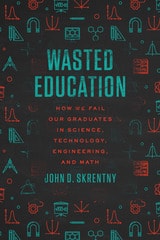
cover of Wasted Education: How We Fail Our Graduates in Science, Technology, Engineering, and Math

Wasted Education

How We Fail Our Graduates in Science, Technology, Engineering, and Math

John D. Skrentny

University of Chicago Press, 2023

An urgent reality check for America’s blinkered fixation on STEM education.

We live in an era of STEM obsession. Not only do tech companies dominate American enterprise and economic growth while complaining of STEM shortages, but we also need scientific solutions to impending crises. As a society, we have poured enormous resources—including billions of dollars—into cultivating young minds for well-paid STEM careers. Yet despite it all, we are facing a worker exodus, with as many as 70% of STEM graduates opting out of STEM work. Sociologist John D. Skrentny investigates why, and the answer, he shows, is simple: the failure of STEM jobs.

Wasted Education reveals how STEM work drives away bright graduates as a result of  “burn and churn” management practices, lack of job security, constant training for a neverending stream of new—and often socially harmful—technologies, and the exclusion of women, people of color, and older workers. Wasted Education shows that if we have any hope of improving the return on our STEM education investments, we have to change the way we’re treating the workers on whom our future depends.
[more]
cover of Wasted Education: How We Fail Our Graduates in Science, Technology, Engineering, and Math

Wasted Education

How We Fail Our Graduates in Science, Technology, Engineering, and Math

John D. Skrentny

University of Chicago Press, 2023

This is an auto-narrated audiobook version of this book.

An urgent reality check for America’s blinkered fixation on STEM education.

We live in an era of STEM obsession. Not only do tech companies dominate American enterprise and economic growth while complaining of STEM shortages, but we also need scientific solutions to impending crises. As a society, we have poured enormous resources—including billions of dollars—into cultivating young minds for well-paid STEM careers. Yet despite it all, we are facing a worker exodus, with as many as 70% of STEM graduates opting out of STEM work. Sociologist John D. Skrentny investigates why, and the answer, he shows, is simple: the failure of STEM jobs.

Wasted Education reveals how STEM work drives away bright graduates as a result of  “burn and churn” management practices, lack of job security, constant training for a neverending stream of new—and often socially harmful—technologies, and the exclusion of women, people of color, and older workers. Wasted Education shows that if we have any hope of improving the return on our STEM education investments, we have to change the way we’re treating the workers on whom our future depends.
[more]
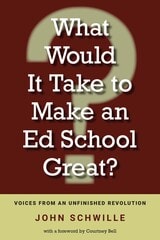
cover of What Would It Take to Make an Ed School Great?: Voices from an Unfinished Revolution

What Would It Take to Make an Ed School Great?

Voices from an Unfinished Revolution

John Schwille

Michigan State University Press, 2023
This book brings new life to the long-standing debate in the United States over whether teacher education, K–12 teaching, and the role that universities play in this work can be revolutionized so that they are less subject to self-defeating conventions and orthodoxy, to the benefit of all the nation’s children. Author John Schwille reexamines the ambitious reform agenda that Michigan State University teacher education leaders brought to the national table in the 1980s and 1990s. This attempted revolution mobilized unprecedented resources to the struggle to transform teaching and learning of subject matter. Conveying this history through the words of the teachers and scholars responsible for it, Schwille shows that a great deal was achieved, but many of the lessons learned continue to be ignored.
 
[more]
cover of Whither Opportunity?: Rising Inequality, Schools, and Children's Life Chances

Whither Opportunity?

Rising Inequality, Schools, and Children's Life Chances

Greg J. Duncan

Russell Sage Foundation, 2012
As the incomes of affluent and poor families have diverged over the past three decades, so too has the educational performance of their children. But how exactly do the forces of rising inequality affect the educational attainment and life chances of low-income children? In Whither Opportunity? a distinguished team of economists, sociologists, and experts in social and education policy examines the corrosive effects of unequal family resources, disadvantaged neighborhoods, insecure labor markets, and worsening school conditions on K-12 education. This groundbreaking book illuminates the ways rising inequality is undermining one of the most important goals of public education—the ability of schools to provide children with an equal chance at academic and economic success. The most ambitious study of educational inequality to date, Whither Opportunity? analyzes how social and economic conditions surrounding schools affect school performance and children’s educational achievement. The book shows that from earliest childhood, parental investments in children’s learning affect reading, math, and other attainments later in life. Contributor Meredith Phillip finds that between birth and age six, wealthier children will have spent as many as 1,300 more hours than poor children on child enrichment activities such as music lessons, travel, and summer camp. Greg Duncan, George Farkas, and Katherine Magnuson demonstrate that a child from a poor family is two to four times as likely as a child from an affluent family to have classmates with low skills and behavior problems – attributes which have a negative effect on the learning of their fellow students. As a result of such disparities, contributor Sean Reardon finds that the gap between rich and poor children’s math and reading achievement scores is now much larger than it was fifty years ago. And such income-based gaps persist across the school years, as Martha Bailey and Sue Dynarski document in their chapter on the growing income-based gap in college completion. Whither Opportunity? also reveals the profound impact of environmental factors on children’s educational progress and schools’ functioning. Elizabeth Ananat, Anna Gassman-Pines, and Christina Gibson-Davis show that local job losses such as those caused by plant closings can lower the test scores of students with low socioeconomic status, even students whose parents have not lost their jobs. They find that community-wide stress is most likely the culprit. Analyzing the math achievement of elementary school children, Stephen Raudenbush, Marshall Jean, and Emily Art find that students learn less if they attend schools with high student turnover during the school year – a common occurrence in poor schools. And David Kirk and Robert Sampson show that teacher commitment, parental involvement, and student achievement in schools in high-crime neighborhoods all tend to be low. For generations of Americans, public education provided the springboard to upward mobility. This pioneering volume casts a stark light on the ways rising inequality may now be compromising schools’ functioning, and with it the promise of equal opportunity in America.
[more]
cover of Who Owns This Text?: Plagiarism, Authorship, and Disciplinary Cultures

Who Owns This Text?

Plagiarism, Authorship, and Disciplinary Cultures

Carol Peterson Haviland and Joan A. Mullin

Utah State University Press, 2008

Carol Haviland, Joan Mullin, and their collaborators report on a three-year interdisciplinary interview project on the subject of plagiarism, authorship, and “property,” and how these are conceived across different fields. The study investigated seven different academic fields to discover disciplinary conceptions of what types of scholarly production count as “owned.”

Less a research report than a conversation, the book offers a wide range of ideas, and the chapters here will provoke discussion on scholarly practice relating to intellectual property, plagiarism, and authorship---and to how these matters are conveyed to students. Although these authors find a good deal of consensus in regard to the ethical issues of plagiarism, they document a surprising variety of practice on the subject of what ownership looks like from one discipline to another. And they discover that students are not often instructed in the conventions of their major field.
[more]
cover of Who Should Pay?: Higher Education, Responsibility, and the Public

Who Should Pay?

Higher Education, Responsibility, and the Public

Natasha Quadlin

Russell Sage Foundation, 2022

Americans now obtain college degrees at a higher rate than at any time in recent decades in the hopes of improving their career prospects. At the same time, the rising costs of an undergraduate education have increased dramatically, forcing students and families to take out often unmanageable levels of student debt. The cumulative amount of student debt reached nearly $1.5 trillion in 2017, and calls for student loan forgiveness have gained momentum. Yet public policy to address college affordability has been mixed. While some policymakers support  more public funding to broaden educational access, others oppose this expansion. Noting that public opinion often shapes public policy, sociologists Natasha Quadlin and Brian Powell examine public opinion on who should shoulder the increasing costs of higher education and why.
 
Who Should Pay? draws on a decade’s worth of public opinion surveys analyzing public attitudes about whether parents, students, or the government should be primarily responsible for funding higher education. Quadlin and Powell find that between 2010 and 2019, public opinion has shifted dramatically in favor of more government funding. In 2010, Americans overwhelming believed that parents and students were responsible for the costs of higher education. Less than a decade later, the percentage of Americans who believed that federal or state/local government should be the primary financial contributor has more than doubled. The authors contend that the rapidity of this change may be due to the effects of the 2008 financial crisis and the growing awareness of the social and economic costs of high levels of student debt. Quadlin and Powell also find increased public endorsement of shared responsibility between individuals and the government in paying for higher education. The authors additionally examine attitudes on the accessibility of college for all, whether higher education at public universities should be free, and whether college is worth the costs. 
 
Quadlin and Powell also explore why Americans hold these beliefs. They identify individualistic and collectivist world views that shape public perspectives on the questions of funding, accessibility, and worthiness of college. Those with more individualistic orientations believed parents and students should pay for college, and that if students want to attend college, then they should work hard and find ways to achieve their goals. Those with collectivist orientations believed in a model of shared responsibility – one in which the government takes a greater level of responsibility for funding education while acknowledging the social and economic barriers to obtaining a college degree for many students. The authors find that these belief systems differ among socio-demographic groups and that bias – sometimes unconscious and sometimes deliberate – regarding race and class affects responses from both individualistic and collectivist-oriented participants. 
 
Public opinion is typically very slow to change. Yet Who Should Pay? provides an illuminating account of just how quickly public opinion has shifted regarding the responsibility of paying for a college education and its implications for future generations of students.


[more]
cover of Wrecked: Deinstitutionalization and Partial Defenses in State Higher Education Policy

Wrecked

Deinstitutionalization and Partial Defenses in State Higher Education Policy

Barrett J. Taylor

Rutgers University Press, 2022

Higher education is a central institution in U.S. democracy. In the 2010s, however, many states that spent previous decades building up their higher education systems began to tear them down. Growing hostility toward higher education reflected changing social forces that remade the politics of U.S. higher education. The political Right became increasingly reliant on angry white voters as higher education became more racially diverse. The Republican party became more closely connected to extremely wealthy donors as higher education became more costly. In Wrecked, Barrett J. Taylor shows how these social changes set a collision course for the Right and higher education. These attacks fed a policy agenda of deinstitutionalization, which encompassed stark divestment from higher education but was primarily characterized by an attack on the institution’s social foundation of public trust. In response to these attacks, higher education officials have offered a series of partial defenses that helped higher education to cope in the short-term but did nothing to defend the institution itself against the long-term threat of declining public trust. The failure to address underlying issues of mistrust allowed conflict to escalate to the point at which many states are now wrecking their public higher education systems. Wrecked offers a unique and compelling perspective linking higher education policymaking to broader social and political forces acting in the twenty-first century. 
[more]