Results by title
475 books match the query 'Environmental' and 20 start with w
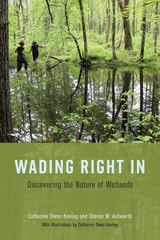
Wading Right In
Discovering the Nature of WetlandsCatherine Owen Koning and Sharon M. Ashworth
University of Chicago Press, 2019
In Wading Right In, Catherine Owen Koning and Sharon M. Ashworth take us on a journey into wetlands through stories from the people who wade in the muck. Traveling alongside scientists, explorers, and kids with waders and nets, the authors uncover the inextricably entwined relationships between the water flows, natural chemistry, soils, flora, and fauna of our floodplain forests, fens, bogs, marshes, and mires. Tales of mighty efforts to protect rare orchids, restore salt marshes, and preserve sedge meadows become portals through which we visit major wetland types and discover their secrets, while also learning critical ecological lessons.
The United States still loses wetlands at a rate of 13,800 acres per year. Such loss diminishes the water quality of our rivers and lakes, depletes our capacity for flood control, reduces our ability to mitigate climate change, and further impoverishes our biodiversity. Koning and Ashworth’s stories captivate the imagination and inspire the emotional and intellectual connections we need to commit to protecting these magical and mysterious places.

Walls
Enclosure and Ethics in the Modern LandscapeThomas Oles
University of Chicago Press, 2014
In Walls, Oles shows how our minds and our politics are shaped by–and shape–our divisions in the landscape. He traces the rich array of practices and meanings connected to the making and marking of boundaries across history and prehistory, and he describes how these practices have declined in recent centuries. The consequence, he argues, is all around us in the contemporary landscape, riven by walls shoddy in material and mean in spirit. Yet even today, Oles demonstrates, every wall remains potentially an opening, a stage, that critical place in the landscape where people present themselves and define their obligations to one another. In an evocative epilogue, Oles brings to life a society of productive, intentional, and ethical enclosure—one that will leave readers more hopeful about the divided landscapes of the future.
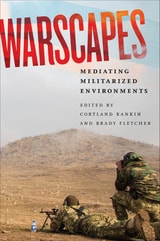
Warscapes
Mediating Militarized EnvironmentsCortland Rankin
Rutgers University Press, 2026
What do we see when we look at a battlefield? How do we come to understand environments as battlefields in the first place? What happens to our perception of war when we focus on the physical spaces of conflict? Warscapes is the first collection to pursue answers to such questions by considering the relationship between war, environment, and media along three lines: imagined geographies of control that prefigure environments as spaces of war; representations of resistance to occupation and ecocidal violence; and elemental reframings of archives and cultural memories of war. This book offers novel perspectives on historical conflict environments while also examining how hypothetical spaces of conflict are imagined. Deploying theoretical perspectives gleaned from film and media studies, ecocriticism, environmental history, urban studies, and postcolonial/decolonial studies, among others, authors highlight an international spectrum of 21st-century fiction films and television series, documentaries, and video installations that challenge how we look at war.
Waste is a Terrible Thing to Mind
Risk, Radiation, and Distrust of GovernmentWeingart, John
Rutgers University Press, 2007
It is an unenviable task, but one that all state governments face: finding a final “resting place” for low-level nuclear waste from power plants, hospitals, university laboratories, and other industries. John Weingart was the official in New Jersey who for many years led this onerous charge. This book is the story of how he and a commission appointed by the governor, instead of imposing a top-down solution, designed an approach that would confront public fears by seeking a community that would volunteer to host a disposal facility. Initially, this novel approach was surprisingly successful, as leaders in a dozen municipalities stepped forward to say they might be interested. Once their interest became known, however, the process in each town derailed. Residents demanded assurances of zero-percent risk and expressed profound distrust of government assertions and promises.
Waste Is a Terrible Thing to Mind is a compelling, suspenseful, and amusing insider’s account of New Jersey policy and politics, but it is also a larger saga of the challenges facing society in the post–9/11 era when the public’s distrust of government is increasing at the same time that its sensitivity to health and safety threats is heightened.
For more information, see: http://wasteisaterriblethingtomind.com/
"Written with a wry sense of humor, it is a pleasure to read and could provide the blueprint for future efforts to find locations for controversial land uses."
- Marie Curtis, Executive Director, New Jersey Environmental Lobby
"A penetrating look at one state's struggle with radioactive waste ... offering some tantalizing reflections on the public understanding of science and how we, in a democratic society, deal with complexity and uncertainty."
- Jay Kaufman, State Senator, Massachusetts State Legislature
"A provocative story, laced with humor, demonstrates how public distrust of government can make it impotent. It should be read by anyone working on public policy issues, especially planning, growth, and the environment."
- Harriet Keyserling, Former Energy Committee Chair, South Carolina State Legislature
"Readers interested in environmental policy, land use and how governments make decisions will learn much from this fine reflective insider's account. It's also a primer on how to survive and thrive in state government."
- David N. Kinsey, Visiting Professor, Woodrow Wilson School Princeton University
"... a fascinating case study of how a government agency creatively tried to solve an intractable public issue. Although the agency failed in its quest to recruit a town to host a low-level radioactive waste site, Weingart's detailed and often humorous narrative of the agency's efforts is a clear winner."
- Jack Sabatino, Judge, New Jersey Superior Court
"... a very engaging and sometimes discouraging case study about the pitfalls and perils of trying to site a controversial facility the right way."
- Gregg Larson, Administrator, Center for Biometric Research, University of Minnesota
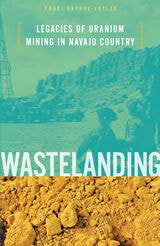
Wastelanding
Legacies of Uranium Mining in Navajo CountryTraci Brynne Voyles
University of Minnesota Press, 2015
Wastelanding tells the history of the uranium industry on Navajo land in the U.S. Southwest, asking why certain landscapes and the peoples who inhabit them come to be targeted for disproportionate exposure to environmental harm. Uranium mines and mills on the Navajo Nation land have long supplied U.S. nuclear weapons and energy programs. By 1942, mines on the reservation were the main source of uranium for the top-secret Manhattan Project. Today, the Navajo Nation is home to more than a thousand abandoned uranium sites. Radiation-related diseases are endemic, claiming the health and lives of former miners and nonminers alike.
Traci Brynne Voyles argues that the presence of uranium mining on Diné (Navajo) land constitutes a clear case of environmental racism. Looking at discursive constructions of landscapes, she explores how environmental racism develops over time. For Voyles, the “wasteland,” where toxic materials are excavated, exploited, and dumped, is both a racial and a spatial signifier that renders an environment and the bodies that inhabit it pollutable. Because environmental inequality is inherent in the way industrialism operates, the wasteland is the “other” through which modern industrialism is established.
In examining the history of wastelanding in Navajo country, Voyles provides “an environmental justice history” of uranium mining, revealing how just as “civilization” has been defined on and through “savagery,” environmental privilege is produced by portraying other landscapes as marginal, worthless, and pollutable.
Water Management in the Yellow River Basin of China
By Charles Greer
University of Texas Press, 1979
Throughout history the Yellow River, or Huang Ho, has repeatedly broken through its levees to rampage over the densely populated North China Plain. In spite of its importance as the major river of China, little has been written on the Yellow River and its management. Charles Greer fills this gap with his comprehensive and thoroughly researched book.
This work deals with the technological problems faced by the Chinese in taming the destructive river and also focuses on cultural attitudes that have governed the Chinese response to nature. For example, water control was not highly regarded by the Taoists, who preferred to let nature take its course; but the Buddhists sought to harness the river against devastating floods and also to benefit their crops.
Greer traces water use and management in the Yellow River Basin through Chinese history and discusses early Western interest in the flood problem and Soviet assistance in Yellow River development. He analyzes traditional methods of control as well as newer strategies and their implications.
The author of this book is one of a small number of social scientists able to master the original Chinese-language historical materials necessary to this undertaking. He has also examined Chinese water management methods first-hand as part of a delegation of water management specialists in 1976.
In addition to geographers and conservationists, China scholars will find this book valuable because of the axial role the control of the Yellow River plays in the fundamental economic health of the People’s Republic of China. Water management engineers will find much useful comparative material.
Water and Agriculture in Colorado and the American West
First in Line for the Rio GrandeDavid Stiller
University of Nevada Press, 2021
David Stiller’s thoughtful study focuses on the history of agricultural water use of the Rio Grande in Colorado’s San Luis Valley. After surveying the practices of early farmers in the region, he focuses on the impacts of Euro-American settlement and the ways these new agrarians endeavored to control the river. Using the Rio Grande as a case study, Stiller offers an informed and accessible history of the development of practices and technologies to store, distribute, and exploit water in Colorado and other western states, as well as an account of the creation of water rights and laws that govern this essential commodity throughout the West to this day. Stiller’s work ranges from meticulously monitored fields of irrigated alfalfa and potatoes to the local and state water agencies and halls of Congress. He also includes perceptive comments on the future of western water as these arid states become increasingly urbanized during a period of worsening drought and climate change.
An excellent read for anyone curious about important issues in the West, Water and Agriculture in Colorado and the American West offers a succinct summary and analysis of Colorado’s use of water by agricultural interests, in addition to a valuable discussion of the past, present, and future of struggles over this necessary and endangered resource.
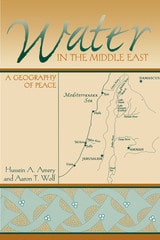
Water in the Middle East
A Geography of PeaceEdited by Hussein A. Amery and Aaron Wolf
University of Texas Press, 2000
Finding "streams in the desert" has never been more urgent for the peoples of the Middle East. Rapid population growth and a rising standard of living are driving water demand inexorably upward, while the natural supply has not increased since Biblical times. Ensuring a fair and adequate distribution of water in the region is vitally important for building a lasting peace among the nations of the Middle East.
Addressing water needs from a geographical perspective, the contributors to this book analyze and assess the impact of scarce water resources in the Jordan River basin countries and territories (Israel, Jordan, Lebanon, Palestine, and Syria) as these long-time antagonists work toward peace. After geographical and historical overviews, the authors envision the future-what the water issues may be when Israel and Syria begin negotiating, the "hydro-security" needs of each nation, and the difficulties of planning for uncertainty. Without proposing any one ideal scheme, they discuss the possibilities for cooperative sharing of water resources, while honestly acknowledging the political constraints that may limit such projects. The final essay speaks to the needs of the one party so rarely represented at the negotiating table—the Jordan River itself.
Watering the Revolution
An Environmental and Technological History of Agrarian Reform in MexicoMikael D. Wolfe
Duke University Press, 2017
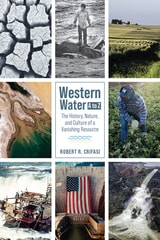
Western Water A to Z
The History, Nature, and Culture of a Vanishing Resourceby Robert R. Crifasi
University Press of Colorado, 2022
Organized as a collection of terms, the book addresses the most salient water issues and provides helpful background information regarding their origins and implications. Photographs serve a vital role in the cultural dialogue on water and stand as an equal partner to the text. Each subject is covered in about one page and is accompanied by one or two striking images from famous photographers like Margaret Bourke-White, Carleton E. Watkins, Arthur Rothstein, William Henry Jackson, and Dorothea Lang as well as Crifasi’s own work. Water often finds itself at the center of our cultural discourse in art, cinema, and literature, which play essential roles in shaping our understanding and experience of Western water. Crifasi also engages personalities that are nearly synonymous with Western water—John Wesley Powell, Elwood Mead, and Floyd Dominy, among others—to show how their lives intertwined with and often influenced the course of water development across the region.
Travelers, adventurers, students, and anyone interested in water will find Western Water A to Z a handy and entertaining reference guide.
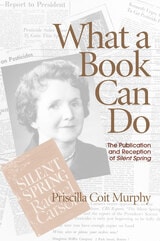
What a Book Can Do
The Publication and Reception of "Silent Spring"Priscilla Coit Murphy
University of Massachusetts Press, 2005
Murphy reviews the publishing history of the Houghton Mifflin edition and the prior New Yorker serialization, describing Carson's approach to her project as well as the views and expectations of her editors. She also documents the response of opponents to Carson's message, notably the powerful chemical industry, including efforts to undermine, delay, or stop publication altogether.
Murphy then investigates the media's role, showing that it went well beyond providing a forum for debate. In addition, she analyzes the perceptions and expectations of the public at large regarding the book, the debate, and the media. By probing all of these perspectives, Murphy sheds new light on the dynamic between newsmaking books, the media, and the public. In the process, she addresses a host of broader questions about the place of books in American culture, past, present, and future.
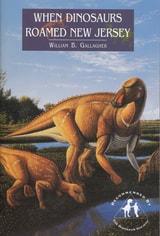
When Dinosaurs Roamed New Jersey
William B. Gallagher
Rutgers University Press, 1997
Did you know that Benjamin Franklin examined the first dinosaur bone in America from Woodbury, Gloucester County, in 1787--decades before the word dinosaur was even coined? Or that when the first reasonably complete dinosaur skeleton in the world was unearthed in Haddonfield, Camden County, in 1858, it was a major scientific breakthrough which forced paleontologists to completely revise their picture of dinosaur anatomy? Few people know that New Jersey is the nursery of American vertebrate paleontology!
When Dinosaurs Roamed New Jersey provides a succinct and readable history of the geology and paleontology of New Jersey from the time the region was covered by Cambrian seas, 543 million years ago, to the Pleistocene Ice Age only 10-15,000 years ago. William Gallagher tells the stories of professional and amateur fossil hunters, their discoveries, and their impact on the history of paleontological thought. He points out places in New Jersey and nearby where specimens characteristic of each era were found. He shows how fossil evidence found in the state is helping paleontologists uncover the ecological interactions and behavior of dinosaurs, and discusses such ongoing scientific controversies as the reason for the extinction of the dinosaurs.
From tracking dinosaur footprints across the Newark basin, to digging for the last dinosaurs in the greensands of South Jersey, to finding a mushroom in ancient amber in East Brunswick, this book is the ideal introduction to the Garden State's fossils and prehistory.
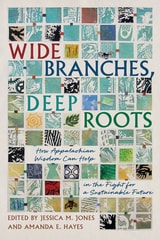
Wide Branches, Deep Roots
How Appalachian Wisdom Can Help in the Fight for a Sustainable FutureJessica M Jones
West Virginia University Press, 2026
To be Appalachian is to define oneself in terms of a place. Where we’re from plays a tremendous role in who we are, through storytelling about our homeplaces and the people who have loved them. However, what goes largely unaddressed is how this love of place can contribute to sustainability within the region, which has notoriously faced on-going environmental threats from extraction industries. The reality is that our relationship with the environment is thorny and intertwined with our identities, histories, and economic realities. The authors in the collection get down among the thorns to explore what sustainability means in Appalachia and how we can utilize the power of traditional folkways to achieve it.
This collection of over thirty pieces explores the connections between Appalachia’s stories, traditions, and modern events and the pathway to regional sustainability. The contributors — writers and scholars — examine how our definitions of sustainability have been formed, the power of education to encourage or inhibit it, and what moves are being made toward efficacy in the future. They also offer specific actions readers can take to better understand and build sustainability where they live.
Contributors: Greg Bealer, Luc Biscan-White, David Blackmore, Aysha Bodenhamer, Ivy Brashear, Matthew Calloway, Nicole Drewitz-Crockett, Christina Fisanick, Deborah Fleming, Amanda V. Garner, Karie Gunter-Seymour, Richard Hague, Amanda E. Hayes, Lockie Hunter, Jessica M. Jones, Kristen LeFevers, Sarah Long, Meghan Moore-Hubbard, Barbara Marie Minney, Jessica Radicic, Elizabeth Emmerth Rexroad, Barbara Sabol, Larry Smith, Patrice Stank, Taylor Nasim Stone, Paul Thomas, Elizabeth Tussey, and Betsy Weems.
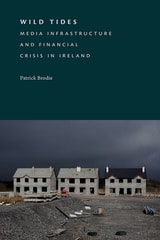
Wild Tides
Media Infrastructure and Financial Crisis in IrelandPatrick Brodie
Duke University Press, 2026
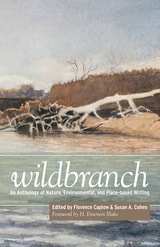
Wildbranch
An Anthology of Nature, Environmental, and Place-based WritingEdited by Florence Caplow and Susan A. Cohen. Foreword by H. Emerson Blake
University of Utah Press, 2010
Wildbranch: An Anthology of Nature, Environmental, and Place-based Writing is a powerful collection of mostly unpublished essays and poetry by both prominent American environmental writers and exciting new voices. The poetry and essays by more than fifty contributors offer the reader glimpses into places as diverse as a forest in West Africa, the moors of Ireland, the canyons of the Sonoran desert mountains, and the fields of New England, and they reflect the varied perspectives of field biologists, hunters, farmers, environmental educators, wilderness guides, academics, writers, and artists.
The collection is an intimate portrait of the natural world drawn through the wisdom, ecological consciousness, and open hearts of these exceptional contributors. The Wildbranch Writing Workshop, cosponsored by Orion magazine and Sterling College, has encouraged thoughtful natural history, outdoor, and environmental writing for more than twenty years. The Wildbranch faculty has included its founder E. Anne Proulx, the essayists Edward Hoagland, Janisse Ray, and Scott Russell Sanders, the poet Alison Hawthorne Deming, and many other notable authors. Many have work included in the anthology.
Winner of the New Mexico Book Association's Southwest Book Design & Production Awards for Excellence in the category Trade Books: Non-illustrated.
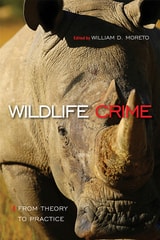
Wildlife Crime
From Theory to PracticeWilliam D.Moreto
Temple University Press, 2018
The editors and contributors to Wildlife Crime examine topical issues from extinction to trafficking in order to understand the ecological, economic, political, and social costs and consequences of these crimes. Drawing from diverse theoretical perspectives, empirical and methodological developments, and on-the-ground experiences of practitioners, this comprehensive volume looks at how conservationists and law enforcement grapple with and combat environmental crimes and the profitable market for illegal trade.
Chapters cover criminological perspectives on species poaching, unregulated fishing, the trading of ivory and rhino horns, the adoption of conservation technologies, and ranger workplaces and conditions. The book includes firsthand experiences and research from China, Indonesia, Kenya, Madagascar, Morocco, Peru, Russia, South Africa, Tanzania, and the United States. The result is a significant book about the causes of and response to wildlife crime.
Contributors include: Johan Bergenas, Avi Brisman, Craig Forsyth, Meredith Gore, Georg Jaster, Alex Killion, Kasey Kinnard, Antony C. Leberatto, Barney Long, Nerea Marteache, Gohar Petrossian, Jonah Ratsimbazafy, Gary Roloff, Viviane Seyranian, Louise Shelley, Rohit Singh, Nicole Sintov, Nigel South, Milind Tambe, Daan van Uhm, Greg Warchol, Rodger Watson, Rob White, Madelon Willemsen, and the editor.

Wind Power and Other Energy Options
David Rittenhouse Inglis
University of Michigan Press, 1978

Wind and Power in the Anthropocene
Dominic Boyer and Cymene Howe
Duke University Press, 2019
In his volume, Energopolitics, Boyer examines the politics of wind power and how it is shaped by myriad factors, from the legacies of settler colonialism and indigenous resistance to state bureaucracy and corporate investment. Drawing on interviews with activists, campesinos, engineers, bureaucrats, politicians, and bankers, Boyer outlines the fundamental impact of energy and fuel on political power. Boyer also demonstrates how large conceptual frameworks cannot adequately explain the fraught and uniquely complicated conditions on the Isthmus, illustrating the need to resist narratives of Anthropocenic universalism and to attend to local particularities.
In her volume, Ecologics, Howe narrates how an antidote to the Anthropocene became both failure and success. Tracking the development of what would have been Latin America's largest wind park, Howe documents indigenous people's resistance to the project and the political and corporate climate that derailed its renewable energy potential. Using feminist and more-than-human theories, Howe demonstrates how the dynamics of energy and environment cannot be captured without understanding how human aspirations for energy articulate with nonhuman beings, technomaterial objects, and the geophysical forces that are at the heart of wind and power.
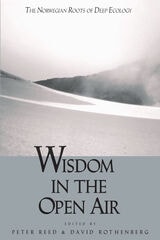
Wisdom In The Open Air
The Norwegian Roots of Deep EcologyPeter Reed
University of Minnesota Press, 1992
Wisdom in the Open Air traces the Norwegian roots of the strain of thinking called “deep ecology”—the search for the solutions to environmental problems by examining the fundamental tenets of our culture. Although Arne Naess coined the term in the 1970s, the insights of deep ecology actually reflect a tradition of thought that can be seen in the history of Norwegian culture, from ancient mountain myths to the radical ecoactivism of today.
Beginning with an introduction to Norway’s emphasis on nature and the wild, Reed and Rothenberg explore the birth of the environmental movement in the 1960s and 1970s. What follows is a collection of writings by prominent Norwegian thinkers on humanity and nature, most never before published in English. From Peter Wessel Zapffe, a twentieth-century Kierkegaardian figure, the list goes on to include Norwegian philosopher Arne Naess, activist-critic-artist Sigmund Kvaloy, wilderness educator Nils Faarland, novelist Finn Alneas, sociologist Johan Galtung, and social reformer Erik Dammann. Their fascinating points of view offer thoughts on the significance of modern life and what it means to be human in the face of the deteriorating global environment of the twentieth century. Wisdom in the Open Air asks and answers a fundamental question concerning the ecomovement: what is the role of deep, often abstract, thinking in the attempt to avert a very real ecological crisis?World Deforestation in the Twentieth Century
John F. Richards and Richard P. Tucker
Duke University Press, 1988