Results by title
148 books match the query 'Evaluation' and 8 start with w
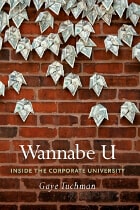
Wannabe U
Inside the Corporate UniversityGaye Tuchman
University of Chicago Press, 2009
Based on years of observation at a large state university, Wannabe U tracks the dispiriting consequences of trading in traditional educational values for loyalty to the market. Aping their boardroom idols, the new corporate administrators at such universities wander from job to job and reductively view the students there as future workers in need of training. Obsessed with measurable successes, they stress auditing and accountability, which leads to policies of surveillance and control dubiously cloaked in the guise of scientific administration. In this eye-opening exposé of the modern university, Tuchman paints a candid portrait of the corporatization of higher education and its impact on students and faculty.
Like the best campus novelists, Tuchman entertains with her acidly witty observations of backstage power dynamics and faculty politics, but ultimately Wannabe U is a hard-hitting account of how higher education’s misguided pursuit of success fails us all.
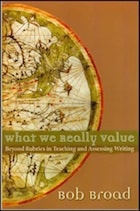
What We Really Value
Beyond Rubrics in Teaching and Assessing WritingBob Broad
Utah State University Press, 2003
What We Really Value traces the origins of traditional rubrics within the theoretical and historical circumstances out of which they emerged, then holds rubrics up for critical scrutiny in the context of contemporary developments in the field. As an alternative to the generic character and decontextualized function of scoring guides, he offers dynamic criteria mapping, a form of qualitative inquiry by which writing programs (as well as individual instructors) can portray their rhetorical values with more ethical integrity and more pedagogical utility than rubrics allow.
To illustrate the complex and indispensable insights this method can provide, Broad details findings from his study of eighty-nine distinct and substantial criteria for evaluation at work in the introductory composition program at "City University." These chapters are filled with the voices of composition instructors debating and reflecting on the nature, interplay, and relative importance of the many criteria by which they judged students' texts. Broad concludes his book with specific strategies that can help writing instructors and programs to discover, negotiate, map, and express a more robust truth about what they value in their students' rhetorical performances.
Working Together for Change
Collaborative Change Research, Evaluation, and Design, Volume 5Edited by Lisa M. Vaughn, Sara Neyer, and Kathie Maynard
University of Minnesota Press, 2023
Strategies for engaging key stakeholders—evaluators, researchers, and designers—to discuss frameworks for promoting collaborative change.
Collaborative Change Research, Evaluation, and Design (CCRED) is a framework and collection of participatory practices that engage people and the systems around them to drive community outcomes. This framework emerged out of the recognition that deep participation (or engagement) is frequently missing in collaborative impact approaches. When collaborative change is implemented effectively, community members are viewed as valuable owners and experts instead of being seen as disinterested or unqualified partners.
CCRED is a social action process with dual goals of collective empowerment and the deepening of social knowledge. Executed successfully, CCRED has the potential to increase the rigor, reach, and relevance of research, evaluation, and design translated to meaningful action. Written in an easily accessible, narrative style, Working Together for Change, the fourth volume in the Interdisciplinary Community Engaged Research for Health series edited by Farrah Jacquez and Lela Svedin brings together evaluators, researchers, and designers to describe collaborative change by describing their own work in the space.
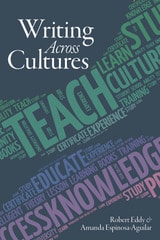
Writing Across Cultures
Robert Eddy
Utah State University Press, 2019
Robert Eddy and Amanda Espinosa-Aguilar offer a new framework for teaching that acknowledges the changing demographics of US college classrooms as the field of writing studies moves toward real equity and expanding diversity. Writing Across Cultures utilizes a streamlined cross-racial and interculturally tested method of introducing students to academic writing via sequenced assignments that are not confined by traditional and static approaches. They focus on helping students become engaged members of a new culture—namely, the rapidly changing collegiate discourse community. The book is based on a multi-racial rhetoric that assumes that writing is inherently a social activity. Students benefit most from seeing composing as an act of engaged communication, and this text uses student samples, not professionally authored ones, to demonstrate this framework in action.
Writing Across Cultures will be a significant contribution to the field, aiding teachers, students, and administrators in navigating the real challenges and wonderful opportunities of multi-racial learning spaces.
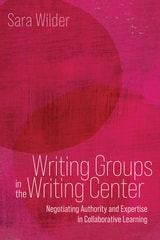
Writing Groups in the Writing Center
Negotiating Authority and Expertise in Collaborative LearningSara Wilder
Utah State University Press, 2025
As many higher education institutions strive to create spaces and systems that increase equity, accessibility, and diversity, they recognize the need for improved mentorship across academic levels. This book analyzes the significant benefits as well as the challenges faced by writing groups in providing such support. Wilder presents a nuanced account of how facilitators scaffold group practice, how members use and build genre knowledge across disciplines, and how institutional contexts shape emotional labor requirements.
For educators and tutors, the book provides an in-depth examination of the facilitator role, describing essential logistical, emotional, and intellectual practices, and addresses common conflicts and challenges. Administrators can find valuable material for training tutor-facilitators and frameworks for conceptualizing writing group functions on campus. For researchers, the book extends scholarship on writing groups, writing transfer, and collaborative learning, bridging writing center and broader writing studies research.
In an era of concern about generative AI’s role in writing education, Writing Groups in the Writing Center extends research on group facilitation, collaborative learning, and authority negotiation in writing center communities of practice and emphasizes the human connections that make collaborative writing meaningful and valuable for student writers.
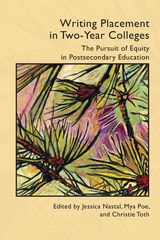
Writing Placement in Two-Year Colleges
The Pursuit of Equity in Postsecondary EducationJessica Nastal
University Press of Colorado, 2023
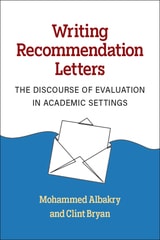
Writing Recommendation Letters
The Discourse of Evaluation in Academic SettingsMohammed Albakry and Clint Bryan
University of Michigan Press, 2024
Key Features
- Readers will learn the theoretical context that defines the genre of letters of recommendation.
- The book highlights the similarities and differences between the three different types of letters of recommendation: letters written for graduate admission, letters written in support of fellowship applications, and letters written to support obtaining a faculty position.
- Chapters on different aspects of linguistic and rhetorical features discuss presenting the applicants' credentials, highlighting the strengths of their character, accentuating and downplaying certain traits, as well as the pros and cons of boilerplate language and the use of customary frames for opening and closing.
- Readers will see real-world examples of actual letters of recommendation to see how seasoned faculty build the case for the applicant.
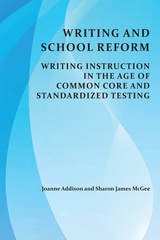
Writing and School Reform
Writing Instruction in the Age of Common Core and Standardized TestingJoanne Addison
University Press of Colorado, 2017