Results by title
72 books match the query 'Field Guide' and 2 start with w

Where the Wild Books Are
A Field Guide to EcofictionJim Dwyer
University of Nevada Press, 2010
As interest in environmental issues grows, many writers of fiction have embraced themes that explore the connections between humans and the natural world. Ecologically themed fiction ranges from profound philosophical meditations to action-packed entertainments. Where the Wild Books Are offers an overview of nearly 2,000 works of nature-oriented fiction. The author includes a discussion of the precursors and history of the genre, and of its expansion since the 1970s. He also considers its forms and themes, as well as the subgenres into which it has evolved, such as speculative fiction, ecodefense, animal stories, mysteries, ecofeminist novels, cautionary tales, and others. A brief summary and critical commentary of each title is included. Dwyer’s scope is broad and covers fiction by Native American writers as well as ecofiction from writers around the world. Far more than a mere listing of books, Where the Wild Books Are is a lively introduction to a vast universe of engaging, provocative writing. It can be used to develop book collections or curricula. It also serves as an introduction to one of the most fertile areas of contemporary fiction, presenting books that will offer enjoyable reading and new insights into the vexing environmental questions of our time.
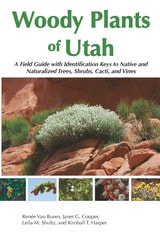
Woody Plants of Utah
A Field Guide with Identification Keys to Native and Naturalized Trees, Shrubs, Cacti, and VinesRenée Van Buren, Janet G. Cooper, Leila M. Shultz, and Kimball T. Harper
Utah State University Press, 2011
A comprehensive guide that includes a vast range of species and plant communities and employs thorough, original keys. Based primarily on vegetative characteristics, the keys don't require that flowers or other reproductive features be present, like many plant guides. And this guide's attention to woody plants as a whole allows one to identify a much greater variety of plants. That especially suits an arid region such as Utah with less diverse native trees. Woody plants are those that have stems that persist above ground even through seasons that don't favor growth, due to low precipitation or temperatures.
Woody Plants of Utah employs dichotomous identification keys that are comparable to a game of twenty questions. They work through a process of elimination by choosing sequential alternatives.
Detailed, illustrated plant descriptions complement the keys and provide additional botanical and environmental information in relation to a useful introductory categorization of Utah plant communities. Supplementary tools include photos, distribution maps, and an illustrated glossary.