Results by title
329 books match the query 'Folklore & Mythology' and 19 start with w
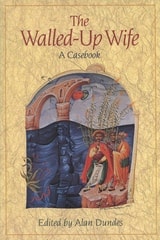
Walled-Up Wife
A CasebookAlan Dundes
University of Wisconsin Press, 1996
For centuries, many Indo-European peoples have sung a poignant ballad about the tragic sacrifice of a female victim to ensure the successful completion of an important undertaking, such as the construction of a building, bridge, or well. The legend, and its many regional and stylistic variations throughout Eastern Europe and India, provides material for an original and engaging casebook of interpretations by folklorists, anthropologists, scholars of comparative religion, and literary critics.
Alan Dundes brings together eighteen essays on this classic ballad, each introduced by his headnotes. Some contributors offer competing nationalistic claims concerning the ballad’s origin, claims now in dispute because of previously overlooked South Asian versions; Ruth Mandel examines gender and power issues in the ballad; Lyubomira Parpulova-Gribble presents a structuralist reading; Krstivoj Kotur proposes a Christian interpretation; Mircea Eliade advocates a myth-ritual reading of blood sacrifices with cosmogonic connections in the Romanian text; and other readings explore female victimization and heroism by seeing the ballad’s theme as a metaphor for marriage, a male-constructed trap seriously restricting women’s freedom and mobility. Dundes concludes the collection with his own feminist and psychoanalytic interpretations of the ballad, followed by suggestions for further reading.
By emphasizing the ballad’s variant forms in diverse cultural contexts, analyzed from different disciplinary perspectives, this volume asks students of folklore to be aware of the multiplicity of approaches available to them in researching folk narrative.
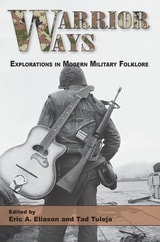
Warrior Ways
Explorations in Modern Military FolkloreEric Eliason and Tad Tuleja
Utah State University Press, 2012
Warrior Ways is one of the first book-length explorations of military folklife, and focuses on the lore produced by modern American warriors, illuminating the ways in which members of the armed services creatively express the complex experience of military life. In short, lively essays, contributors to the volume, all of whom have close personal or professional relationships to the military, examine battlefield talismans, personal narrative (storytelling), “Jody calls” (marching and running cadences), slang, homophobia and transgressive humor, music, and photography, among other cultural expressions.
Military folklore does not remain in an isolated subculture; it reveals our common humanity by delighting, disturbing, infuriating, and inspiring both those deeply invested in and those peripherally touched by military life. Highlighting the contemporary and historical importance of the military in American life, Warrior Ways will be of interest to scholars and students of folklore, anthropology, and popular culture; those involved in veteran services and education; and general readers interested in military culture.
Water Witching U.S.A.
Evon Z. Vogt and Ray Hyman
University of Chicago Press, 2000
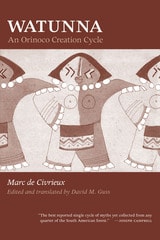
Watunna
An Orinoco Creation CycleBy Marc de Civrieux
University of Texas Press, 1997
Originally published in Spanish in 1970, Watunna is the epic history and creation stories of the Makiritare, or Yekuana, people living along the northern bank of the Upper Orinoco River of Venezuela, a region of mountains and virgin forest virtually unexplored even to the present. The first English edition of this book was published in 1980 to rave reviews. This edition contains a new foreword by David Guss, as well as Mediata, a detailed myth that recounts the origins of shamanism.
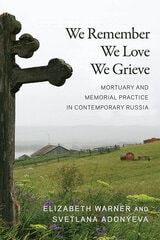
We Remember, We Love, We Grieve
Mortuary and Memorial Practice in Contemporary RussiaElizabeth Warner and Svetlana Adonyeva
University of Wisconsin Press, 2021
“We remember, we love, we grieve” is a common epitaph in this part of the world. As contemporary Russia contends with the Soviet Union’s legacy of dismantling older ways of life, the phrase ripples beyond individual loss—it encapsulates communities’ determination to preserve their customs when faced with oppression. This volume offers insight into a core cultural practice, exploring the dynamism of tradition.
What Goes Around Comes Around
edited by Kimberly J. Lau, Peter Tokofsky, and Stephen Winick
Utah State University Press, 2004
When Our Words Return
Writing, Hearing, and Remembering Oral Traditions from Alasak and the Yukonedited by Phyllis Morrow & William Schneider
Utah State University Press, 1995
The title to this interdisciplinary collection draws on the Yupik Eskimo belief that seals, fish, and other game are precious gifts that, when treated with respect and care, will return to be hunted again. Just so, if oral traditions are told faithfully and respectfully, they will return to benefit future generations. The contributors to this volume are concerned with the interpretation and representation of oral narrative and how it is shaped by its audience and the time, place, and cultural context of the narration. Thus, oral traditions are understood as a series of dialogues between tradition bearers and their listeners, including those who record, write, and interpret.
Whispers in the Echo Chamber
Folklore and the Role of Conspiracy Theory in Contemporary SocietyEdited by Jesse A. Fivecoate and Andrea Kitta
University of Wisconsin Press, 2025
This timely volume complements studies from political science, sociology, psychology, history, and more, while also crucially calling for the field of folklore studies to engage more assertively with conspiracy theories as a genre. Focusing on modern iterations of sometimes quite ancient conspiracy motifs and themes, the editors and contributors forcibly illustrate the crucial relevance of this prevalent and influential form of folklore in today’s interconnected world.
Contributors: Matthew D. Atkinson, John Bodner, Ian Brodie, Darin DeWitt, Bill Ellis, Jesse A. Fivecoate, Sandra Grady, David Guignion, Pavan Holur, Andrea Kitta, Afsane Rezaei, Vwani Roychowdhury, Lisa M. Ruch, Shadi Shahsavari, Timothy R. Tangherlini, Jeannie Banks Thomas, Anika Wilson
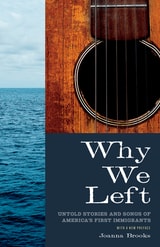
Why We Left
Untold Stories and Songs of America's First ImmigrantsJoanna Brooks
University of Minnesota Press, 2024
A grounded, tender, and mournful reckoning with the catastrophes that launched poor, white Anglos into their role as itinerant foot soldiers for modern imperialism—now in paperback with a new preface
Joanna Brooks’s ancestors were among the early waves of emigrants to leave England for North America. For generations, they lived hardscrabble lives, eking out subsistence in one place after another as they continually moved west in search of a better life. Why, Brooks wondered, did her people and countless other poor English subjects abandon their homeland for such unremitting hardship? The question leads her on a journey through an obscure dimension of American history.
Why We Left reveals the violence and dislocation that propelled seventeenth- and eighteenth-century working-class English emigration, presenting a powerful restorying of how we arrived at our present moment of precarity and rootlessness. Following American folk ballads back across the Atlantic to find histories of economic displacement, environmental destruction, and social betrayal at the heart of the early Anglo-American migrant experience, Brooks offers a scholarly and personal account of the intergenerational traumas that shape the history of white Anglos on Turtle Island.
She shares folk ballads such as “Edward,” which reveals the influence of deforestation on the dislocation of early Anglo-American peasant immigrants, and “The House Carpenter’s Wife,” which emphasizes the impact of economic instability and the colonial enterprise on women. From these ballads, tragic and heartrending, Brooks uncovers an archaeology of the worldviews of America’s earliest immigrants. This tenth-anniversary edition includes a new preface and develops a haunting historical perspective on the ancestors we thought we knew.
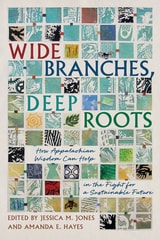
Wide Branches, Deep Roots
How Appalachian Wisdom Can Help in the Fight for a Sustainable FutureJessica M Jones
West Virginia University Press, 2026
To be Appalachian is to define oneself in terms of a place. Where we’re from plays a tremendous role in who we are, through storytelling about our homeplaces and the people who have loved them. However, what goes largely unaddressed is how this love of place can contribute to sustainability within the region, which has notoriously faced on-going environmental threats from extraction industries. The reality is that our relationship with the environment is thorny and intertwined with our identities, histories, and economic realities. The authors in the collection get down among the thorns to explore what sustainability means in Appalachia and how we can utilize the power of traditional folkways to achieve it.
This collection of over thirty pieces explores the connections between Appalachia’s stories, traditions, and modern events and the pathway to regional sustainability. The contributors — writers and scholars — examine how our definitions of sustainability have been formed, the power of education to encourage or inhibit it, and what moves are being made toward efficacy in the future. They also offer specific actions readers can take to better understand and build sustainability where they live.
Contributors: Greg Bealer, Luc Biscan-White, David Blackmore, Aysha Bodenhamer, Ivy Brashear, Matthew Calloway, Nicole Drewitz-Crockett, Christina Fisanick, Deborah Fleming, Amanda V. Garner, Karie Gunter-Seymour, Richard Hague, Amanda E. Hayes, Lockie Hunter, Jessica M. Jones, Kristen LeFevers, Sarah Long, Meghan Moore-Hubbard, Barbara Marie Minney, Jessica Radicic, Elizabeth Emmerth Rexroad, Barbara Sabol, Larry Smith, Patrice Stank, Taylor Nasim Stone, Paul Thomas, Elizabeth Tussey, and Betsy Weems.
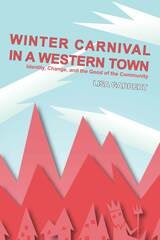
Winter Carnival in a Western Town
Identity, Change and the Good of the CommunityLisa Gabbert
Utah State University Press, 2011
Held annually, the McCall, Idaho, winter carnival has become a modern tradition. A festival and celebration, it is also a source of community income and opportunity for shared community effort; a chance to display the town attractively to outsiders and to define and assert McCall's identity; and consequently, a source of disagreement among citizens over what their community is, how it should be presented, and what the carnival means.
Though rooted in the broad traditions of community festival, annual civic events, often sponsored by chambers of commerce, such as that in McCall, are as much expressions of popular culture and local commerce as of older traditions. Yet they become dynamic, newer community traditions, with artistic, informal, and social meanings and practices that make them forms of folklore as well as commoditized culture. Winter Carnival is the first volume in a new Utah State University Press series titled Ritual, Festival, and Celebration and edited by folklorist Jack Santino.
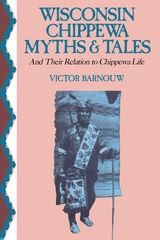
Wisconsin Chippewa Myths & Tales
And Their Relation to Chippewa LifeVictor Barnouw
University of Wisconsin Press, 1979
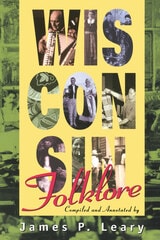
Wisconsin Folklore
Edited by James P. Leary
University of Wisconsin Press, 1999
Highly entertaining and richly informative, Wisconsin Folklore offers the first comprehensive collection of writings about the surprisingly varied folklore of Wisconsin. Beginning with a historical introduction to Wisconsin's folklore and concluding with an up-to-date bibliography, this anthology offers more than fifty annotated and illustrated entries in five sections: "Terms and Talk," "Storytelling," "Music, Song, and Dance," "Beliefs and Customs," and "Material Traditions and Folklife."
The various contributors, from 1884 to 1997, are anthropologists, ethnomusicologists, historians, journalists, museologists, ordinary citizens reminiscing, sociologists, students, writers of fiction, practitioners of folklore, and folklorists. Their interests cover an enormous range of topics: from Woodland Indian place names and German dialect expressions to Welsh nicknames and the jargon of apple-pickers, brewers, and farmers; from Ho-Chunk and Ojibwa mythological tricksters and Paul Bunyan legends to stories of Polish strongmen and Ole and Lena jokes; from Menominee dances and Norwegian fiddling and polka music to African-American gospel groups and Hmong musicians; from faith healers and wedding and funeral customs to seasonal ethnic festivities and tavern amusements; and from spearing decoys and needlework to church dinners, sacred shrines, and the traditional work practices of commercial fishers, tobacco growers, and pickle packers.
For general readers, teachers, librarians, and scholars alike, Wisconsin Folklore exemplifies and illuminates Wisconsin's cultural traditions, and establishes the state's significant but long neglected contributions to American folklore.
Witchcraft Mythologies and Persecutions
Gábor Klaniczay
Central European University Press, 2008
Witches, Ghosts, and Signs
Folklore of the Southern AppalachiansPatrick W. Gainer
West Virginia University Press, 2008
Witches, Ghosts, and Signs: Folklore of the Southern Appalachians by the renowned West Virginia folklorist and former West Virginia University English professor Patrick W. Gainer not only highlights stories that both amuse and raise goosebumps, but also begins with a description of the people and culture of the state. Based on material Gainer collected from over fifty years of field research in West Virginia and the region, Witches, Ghosts, and Signs presents the rich heritage of the southern Appalachians in a way that has never been equaled. Strange and supernatural tales of ghosts, witches, hauntings, disappearances, and unexplained murders that have been passed down from generation to generation from as far back as the earliest settlers in the region are included in this collection that will send chills down the spine.
Words of the Real People
Alaska Native Literature in TranslationEdited by Ann Fienup-Riordan and Lawrence D. Kaplan
University of Alaska Press, 2007
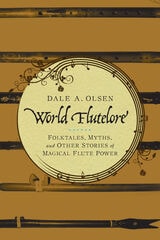
World Flutelore
Folktales, Myths, and Other Stories of Magical Flute PowerDale A. Olsen
University of Illinois Press, 2013
Describing and interpreting many examples of flutes as they are found in mythology, poetry, lyrics, and other narrative and literary sources from around the world, veteran ethnomusicologist Dale Olsen seeks to determine what is singularly distinct or unique about flutes, flute playing, and flute players in a global context. He shows how and why flutes are important for personal, communal, religious, spiritual, and secular expression and even, perhaps, existence. This is a book for students, scholars, and any reader interested in the cultural power of flutes.
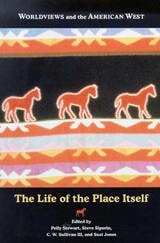
Worldviews And The American West
The Life of the Place ItselfPolly Stewart, Steve Siporin, C. W. Sullivan III, and Suzi Jones
Utah State University Press, 2003
A diverse group of writers and scholars follow the lead of noted folklorist Barre Toelken and consider, from the inside, the ways in which varied cultures in the American West understand and express their relations to the world around them. As Barre Toelken puts it in The Dynamics of Folklore, "'Worldview' refers to the manner in which a culture sees and expresses its relation to the world around it." In Worldviews and the American West, seventeen notable authors and scholars, employing diverse approaches and styles, apply Toelken's ideas about worldview to the American West. While the contributors represent a range of voices, methods, and visions, they are integrated through their focus on the theme of worldview in one region. Worldviews and the American West includes essays by Margaret K. Brady, Hal Cannon, Nora Marks Dauenhauer and Richard Dauenhauer, James S. Griffith, Barry Lopez, Robert McCarl, Elliott Oring, Twilo Scofield, Steve Siporin, Kim Stafford, C. W. Sullivan III, Jeannie B. Thomas, George Venn, George B. Wasson, and William A. Wilson. Each of the authors in this collection attempts to get inside one or more of the worldviews of the many cultures that have come to share and interpret the American West. The result is a lively mix of styles and voices as the authors' own worldviews interact with the multiple perspectives of the diverse peoples (and, in Barry Lopez's "The Language of Animals," other species) of the West. This diversity matches the geography of the region they all call home and gives varied life and meaning to its physical and cultural landscape.
Worship, Women and War
Essays in Honor of Susan NiditchJohn J. Collins
SBL Press, 2015
Celebrate the career of an inspirational scholar and teacher concerned with revealing voices from the margins
This volume of essays honors Susan Niditch, author of War in the Hebrew Bible: A Study in the Ethics of Violence (1993), “My Brother Esau Is a Hairy Man”: Hair and Identity in Ancient Israel (2008), and most recently, The Responsive Self: Personal Religion in Biblical Literature of the Neo-Babylonian and Persian Periods (forthcoming), among other influential publications. Essays touch on topics such as folklore, mythology, and oral history, Israelite religion, ancient Judaism, warfare, violence, and gender.
Features:
- Essays from nineteen scholars, all experts in their fields
- Exploration of texts from Mesopotamia, the Hebrew Bible, and the New Testament
- Bibliography of Niditch's scholarly contributions