Results by title
97 books match the query 'Geopolitics' and 3 start with w
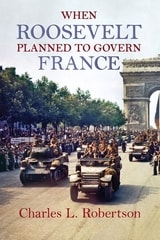
When Roosevelt Planned to Govern France
Charles L. Robertson
University of Massachusetts Press, 2011
This book tells the story of a plan put forth by President Franklin Roosevelt during World War II for an Allied military occupation of France in the aftermath of liberation, and of General Charles de Gaulle's efforts as self-appointed leader of the Free French Movement to thwart FDR's intentions. Charles L. Robertson frames the narrative as a mystery in which he plays the role of detective. He begins at a dinner party thirty years ago, where he first learned of the alleged plan from an elderly former aide to de Gaulle. Yet it wasn't until 2004, when he heard the same story repeated during the 60th commemoration of D-Day, that he set out to investigate whether it was true.
Many French are aware of this episode and believe, on the basis of later Gaullist officials' writings, that until the last moment a military occupation of their country was imminent. This view, across the years, has helped darken relations between France and the United States. Yet few if any Americans have ever heard of this plan, and in the event, no Allied military government of France was ever established.
How and why it never came to be, and why the French still believe it almost did, is the subject of this book. Robertson recounts how the president of the most powerful nation in the world was outmaneuvered in both his earlier plans for an occupation of France and his subsequent attempts to keep General de Gaulle from “seizing” power—in a France that ultimately, despite Roosevelt's intentions and expectations, regained its place among the victorious powers under de Gaulle's leadership.

Women March for Peace
Black Radical Women’s Anti-Korean War ActivismDenise Lynn
University of Massachusetts Press, 2025
The Korean War is commonly known as the “forgotten war” because it supposedly had little impact on American culture in comparison to World War II or the American War in Vietnam. Yet from 1950–1953, the conflict produced vigorous anti-war activism, particularly among Black radical women. Informed by their experiences with racism and misogyny within the US, these women were convinced that peace was not just the absence of military aggression, but that it required the liberation of the most oppressed, including the end of capitalist exploitation of women and People of Color and the return of self-determination to colonized peoples—themes that later anti-war activists would echo and develop. Whether or not the Korean War has ever truly been forgotten, the visionary activism of these women has been largely overlooked.
In Women March for Peace, Denise Lynn examines the lives of seven Black women—Louise Thompson Patterson, Claudia Jones, Charlotta Bass, Shirley Graham Du Bois, Eslanda Robeson, Lorraine Hansberry, and Beulah Richardson—and their resistance to domestic and foreign US policies during the height of anticommunist hysteria. While much peace scholarship focuses on the threat of nuclear conflict, Lynn instead explores how these women connected issues of civil rights at home with international military campaigns, highlights the hypocrisy of containment policies that sought to secure the freedom and rights for Koreans when US citizens were still oppressed. Lynn traces their peace advocacy through their personal papers, local and national articles, Progressive Party documents, and global conventions. Women March for Peace recovers the radical activism of these Black women to understand a crucial chapter in the fight against American imperialism and white supremacy.
Written Here, Published There
How Underground Literature Crossed the Iron CurtainFriederike Kind-Kovács
Central European University Press, 2015
Written Here, Published There offers a new perspective on the role of underground literature in the Cold War and challenges us to recognize gaps in the Iron Curtain. The book identifies a transnational undertaking that reinforced détente, dialogue, and cultural transfer, and thus counterbalanced the persistent belief in Europe's irreversible division.
It analyzes a cultural practice that attracted extensive attention during the Cold War but has largely been ignored in recent scholarship: tamizdat, or the unauthorized migration of underground literature across the Iron Curtain. Through this cultural practice, I offer a new reading of Cold War Europe's history. Investigating the transfer of underground literature from the 'Other Europe' to Western Europe, the United States, and back illuminates the intertwined fabrics of Cold War literary cultures. Perceiving tamizdat as both a literary and a social phenomenon, the book focuses on how individuals participated in this border-crossing activity and used secretive channels to guarantee the free flow of literature.