73 books match the query 'German literature' and 3 start with w

cover of What Makes a Man?: Sex Talk in Beirut and Berlin

What Makes a Man?

Sex Talk in Beirut and Berlin

Rashid al-Daif and Joachim Helfer. Translated by Ken Seigneurie and Gary Schmidt

University of Texas Press, 2015

In 2003, Lebanese writer Rashid al-Daif spent several weeks in Germany as part of the “West-East Divan” program, a cultural exchange effort meant to improve mutual awareness of German and Middle Eastern cultures. He was paired with German author Joachim Helfer, who then returned the visit to al-Daif in Lebanon. Following their time together, al-Daif published in Arabic a literary reportage of his encounter with Helfer in which he focuses on the German writer’s homosexuality. His frank observations have been variously read as trenchant, naïve, or offensive. In response, Helfer provided an equally frank point-by-point riposte to al-Daif’s text. Together these writers offer a rare exploration of attitudes toward sex, love, and gender across cultural lines. By stretching the limits of both fiction and essay, they highlight the importance of literary sensitivity in understanding the Other.

Rashid al-Daif’s “novelized biography” and Joachim Helfer’s commentary appear for the first time in English translation in What Makes a Man? Sex Talk in Beirut and Berlin. Also included in this volume are essays by specialists in Arabic and German literature that shed light on the discourse around sex between these two authors from different cultural contexts.
[more]
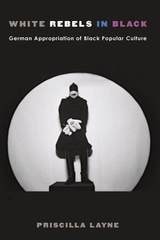
cover of White Rebels in Black: German Appropriation of Black Popular Culture

White Rebels in Black

German Appropriation of Black Popular Culture

Priscilla Layne

University of Michigan Press, 2018
Analyzing literary texts and films, White Rebels in Black shows how German authors have since the 1950s appropriated black popular culture, particularly music, to distance themselves from the legacy of Nazi Germany, authoritarianism, and racism, and how such appropriation changes over time. Priscilla Layne offers a critique of how blackness came to symbolize a positive escape from the hegemonic masculinity of postwar Germany, and how black identities have been represented as separate from, and in opposition to, German identity, foreclosing the possibility of being both black and German. Citing four autobiographies published by black German authors Hans Jürgen Massaquo, Theodor Michael, Günter Kaufmann, and Charly Graf, Layne considers how black German men have related to hegemonic masculinity since Nazi Germany, and concludes with a discussion on the work of black German poet, Philipp Khabo Köpsell.
[more]
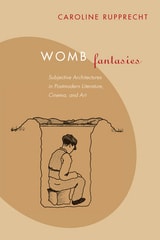
cover of Womb Fantasies: Subjective Architectures in Postmodern Literature, Cinema, and Art

Womb Fantasies

Subjective Architectures in Postmodern Literature, Cinema, and Art

Caroline Rupprecht

Northwestern University Press, 2013

Womb Fantasies examines the womb, an invisible and mysterious space invested with allegorical significance, as a metaphorical space in postwar cinematic and literary texts grappling with the trauma of post-holocaust, postmodern existence. In addition, it examines the representation of visible spaces in the texts in terms of their attribution with womb-like qualities.  The framing of the study historically within the postwar era begins with a discussion of Eero Saarinen’s Womb Chair in the context of the Cold War’s need for safety in light of the threat of nuclear destruction, and ranges over films such as Marguerite Duras’ and Alan Resnais’ film Hiroshima mon amour and Duras’ novel The Vice-Consul, exploring the ways that such cultural texts fantasize the womb as a response to trauma, defined as the compulsive need to return to the site of loss, a place envisioned as both a secure space and a prison. The womb fantasy is linked to the desire to recreate an identity that is new and original but ahistorical.
[more]