Results by title
775 books match the query 'Germany' and 28 start with w

WERNER VON SIEMENS
INVENTOR AND INTERNATIONAL ENTREPRENEURWILFRIED FELDENKIRCHEN
The Ohio State University Press, 1994
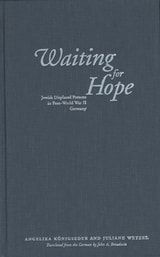
Waiting for Hope
Jewish Displaced Persons in Post-World War II GermanyAngelika Konigseder
Northwestern University Press, 2001
Starting with the discovery of death camps by Allied forces, Königseder and Wetzel describe the inadequate preparations made for the survivors. The soldiers were ill equipped to deal with the physical wreckage and mental anguish of their charges, but American rabbis soon arrived to perform invaluable work helping the survivors cope. The historians also devote attention to autonomous Jewish life in and near the camps: theater groups and orchestras prospered, schools were founded, a tuberculosis hospital and clinic for DPs was established, and underground organizations handled illegal immigration to Israel and trained soldiers to fight in Palestine.
Drawing on original documents and the work of other historians, Waiting for Hope sheds light on a largely unknown period in postwar Jewish history and shows that the suffering of the survivors did not end with the war.
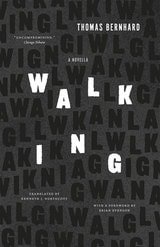
Walking
A NovellaThomas Bernhard
University of Chicago Press, 2003
Thomas Bernhard is “one of the masters of contemporary European fiction” (George Steiner); “one of the century’s most gifted writers” (Newsday); “a virtuoso of rancor and rage” (Bookforum). And although he is favorably compared with Franz Kafka, Samuel Beckett, and Robert Musil, it is only in recent years that he has gained a devoted cult following in America.
A powerful, compact novella, Walking provides a perfect introduction to the absurd, dark, and uncommonly comic world of Bernhard, showing a preoccupation with themes—illness and madness, isolation, tragic friendships—that would obsess Bernhard throughout his career. Walking records the conversations of the unnamed narrator and his friend Oehler while they walk, discussing anything that comes to mind but always circling back to their mutual friend Karrer, who has gone irrevocably mad. Perhaps the most overtly philosophical work in Bernhard’s highly philosophical oeuvre, Walking provides a penetrating meditation on the impossibility of truly thinking.
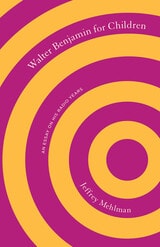
Walter Benjamin for Children
An Essay on His Radio YearsJeffrey Mehlman
University of Chicago Press, 1993
Now in paperback, an insightful analysis of the great theorist's most unusual work: a diverse collection of radio broadcasts for children.
In light of the legendary difficulty of Walter Benjamin's works, it is a strange and intriguing fact that from 1929 to 1933, the great critic and cultural theorist wrote—and broadcast—numerous scripts, on the order of fireside chats, for children. Invited to speak on whatever subject he considered appropriate, Benjamin talked to the children of Frankfurt and Berlin about the destruction of Pompeii, an earthquake in Lisbon, and a railroad disaster at the Firth of Tay. He spoke about bootlegging and swindling, cataclysm and suicide, Faust and Cagliostro. In this first sustained analysis of the thirty surviving scripts, Jeffrey Mehlman demonstrates how Benjamin used the unlikely forum of children's radio to pursue some of his central philosophical and theological concerns.
In Walter Benjamin for Children, readers will encounter a host of intertextual surprises: an evocation of the flooding of the Mississippi informed by the argument of "The Task of the Translator;" a discussion of scams in stamp-collecting that turns into "The Work of Art in the Age of Mechanical Reproduction;" a tale of bootlegging in the American South that converges with the best of Benjamin's essays on fiction. Mehlman superimposes a dual series of texts dealing with catastrophe, on the one hand, and fraud, on the other, that resonate with the false-messianic theology of Sabbatianism as it came to focus the attention and enthusiasm of Benjamin's friend Gershom Scholem during the same years. The radio scripts for children, that is, offer an unexpected byway, on the eve of the apocalypse, into Benjamin's messianic preoccupations.
A child's garden of deconstruction, these twenty-minute talks—from the perspective of childhood, before an invisible audience, on whatever happened to cross the critic's mind—are also by their very nature the closest we may ever come to a transcript of a psychoanalysis of Walter Benjamin. Particularly alive to that circumstance, Mehlman explores the themes of the radio broadcasts and brilliantly illuminates their hidden connections to Benjamin's life and work.
This lucid analysis brings to light some of the least researched and understood aspects of Walter Benjamin's thought. It will interest and provoke literary theorists and philosophers of culture, as well as anyone who hopes to understand one of this century's most suggestive and perplexing critics.
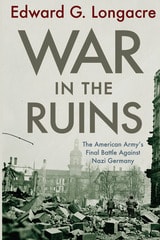
War in the Ruins
The American Army's Final Battle Against Nazi GermanyEdward G. Longacre
Westholme Publishing, 2010
The Last Major Combat for American Troops in Germany During the Final Days of World War II
By April 1945, the last German counteroffensive in the west had been defeated, the vaunted Siegfried Line was no more, the Rhine River had been crossed, and major German cities were being bombed relentlessly. The war in Europe appeared to be in its final stages. As American and British armies overran central Germany, the Russians were smashing their way from the east toward Berlin. Optimism reigned up and down the Allied lines. But as the American Army’s 100th Infantry Division pushed along the west bank of the Neckar River across from bomb-shattered Heilbronn, resistance unexpectedly stiffened. In that 700-year-old city, a major industrial and communications center still operating for the benefit of the Nazi war machine, Hitler’s subordinates had battened down for a last-ditch stand. For sheer ferocity, it would exceed anything the now-battle-hardened Americans had experienced. Here, American troops faced a grueling campaign of house-to-house fighting, with Hitler Youth, Volkssturm militia, and an SS division attempting to stop the American advance at this critical sector of the European theater. Having been repeatedly targeted by Alllied aircraft, the city resembled a vast, Hellish ruin, and as American soldiers inched their way forward, they encountered booby traps, withering sniper fire, deadly Panzerfaust rounds, and a fanatical enemy. The nine-day battle for Heilbronn would be the last major combat for American troops in Europe. Within three weeks of their securing the city, Hitler would be dead and Germany defeated.
In War in the Ruins: The American Army’s Final Battle Against Nazi Germany, Edward G. Longacre recounts this neglected but essential chapter in the history of World War II, describing the 100th Division’s swift but grueling advance through the Vosges Mountains, their Rhine River crossing, the assault on the historic Maginot Line, and the ominous approach to Heilbronn. The author then describes the entire bitter battle and its aftermath, using private letters, journals, German and American action reports, and other primary source material, to establish War in the Ruins as an essential volume in the history of World War II in Europe.
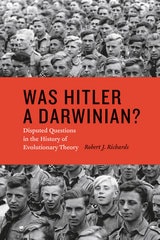
Was Hitler a Darwinian?
Disputed Questions in the History of Evolutionary TheoryRobert J. Richards
University of Chicago Press, 2013
Wayward Threads
Robert Goldmann
Northwestern University Press, 1998
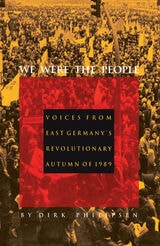
We Were the People
Voices from East Germany’s Revolutionary Autumn of 1989Dirk Philipsen
Duke University Press, 1993
The drama We Were the People recreates is remarkable for its richness and complexity. Here are citizens organizing despite threats of bloody crackdowns; party functionaries desperately trying to survive as time-honored political prerogatives crumble beneath their feet; an oppressed people discovering the possibilities of power and freedom, but also the sobering strangeness of new political realities. With their success, East Germans encountered the overpowering might of thie Western neighbor--and stand perplexed before the onslaught of real estate agents, glossy consumer ads, political professionalism--and the discovery that a lifetime of social experience has suddenly lost all usable context. They became, in the words of one participant, a people "without biography."
Over all the recent events and unlikely turns recounted here, one thing remains paramount: the sweep of the initial democratic conception that animated the East German revolution. We Were the People brings this movement to life in all its drama and detail, and vividly recovers a historic moment that altered forever the shape of modern Europe.
Some Voices of the People
Bärbel Bohley/ "Mother of the Revolution"
Rainer Eppelmann/ Protestant Pastor
Klaus Kaden/ Church Emissary to the Opposition
Hans Modrow/ Former Communist Prime Minister
Ludwig Mehlhorn/ Opposition Theorist
Ingrid Köppe/ Opposition Representative
Frank Eigenfeld/ New Forum
Harald Wagner/ Democracy Now
Sebastian Pflugbeil/ Democratic Strategist
East German Workers
Cornelia Matzke/ Independent Women's Alliance
André Brie/ Party Vice-Chairman
Gerhard Ruden/ Environmental Activist
Werner Bramke/ Party Academic
We are the People
The Rise of the AfD in GermanyPenny Bochum
Haus Publishing, 2020
We are the People analyzes the sudden growth and radicalization of the AfD, from its Euroskeptic beginnings in 2013 to its increasing extremism. Penny Bochum shows us how the leaders’ use of inflammatory, xenophobic, and even Nazi-era language mirrors that of emerging far-right forces across much of the Western world. At the same time, through a lucid examination of the group’s ideology, Bochum shows how their brand of populism is distinct and based on German experiences and history.

Weimar Under the Palms
Pacific Palisades, German Exiles, and the Invention of HollywoodThomas Blubacher
Brandeis University Press, 2025
In the early twentieth century, Pacific Palisades was home to America’s most modern film studio of the time as well as the proposed site of the world’s largest Christian center. But by the end of the 1920s, the Los Angeles neighborhood had become the refuge of the rich and beautiful as German and Austrian filmmakers, among them Salka and Berthold Viertel, settled there. They were soon followed by cultural and intellectual giants of the Weimar Republic who were fleeing Europe, such as Max Reinhardt, Hanns Eisler, or Max Horkheimer. These great minds turned Pacific Palisades into a “Weimar under the palm trees.” Though many were successful in exile—including Vicki Baum, Thomas Mann, and Lion Feuchtwanger—others felt as if they were in a “sun prison” far from home.
Recounting a story of glamor and great minds, Thomas Blubacher tells of the history of German-speaking exiles that is still alive there today, going on a foray through the film industry, taking us on a journey to this special place that was so recently devastated by fire. Many of the homes in this book have now gone, but Marta Feuchtwanger’s Villa Aurora and the Thomas Mann house still stand as a testament to luck, resilience, and history.
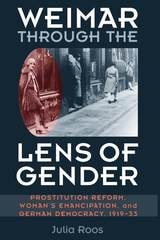
Weimar through the Lens of Gender
Prostitution Reform, Woman's Emancipation, and German Democracy, 1919-33Julia Roos
University of Michigan Press, 2010
"This book will make a valuable contribution to the field of German history, as well as the histories of gender and sexuality. The argument that Weimar feminism did bring about tangible gains for women needs to be made, and Roos has done so convincingly."
---Julia Sneeringer, Queens College
Until 1927, Germany had a system of state-regulated prostitution, under which only those prostitutes who submitted to regular health checks and numerous other restrictions on their personal freedom were tolerated by the police. Male clients of prostitutes were not subject to any controls. The decriminalization of prostitution in 1927 resulted from important postwar gains in women's rights; yet this change---while welcomed by feminists, Social Democrats, and liberals—also mobilized powerful conservative resistance. In the early 1930s, the right-wing backlash against liberal gender reforms like the 1927 prostitution law played a fateful role in the downfall of the Weimar Republic and the rise of Nazism.
Weimar through the Lens of Gender combines the political history of early twentieth-century Germany with analytical perspectives derived from the fields of gender studies and the history of sexuality. The book's argument will be of interest to a broad readership: specialists in the fields of gender studies and the history of sexuality, as well as historians and general readers interested in Weimar and Nazi Germany.
Julia Roos is Assistant Professor of History at Indiana University, Bloomington.
Jacket art: "Hamburg, vermutlich St. Pauli, 1920er–30er Jahre," photographer unknown, s/w-Fotografie. (Courtesy of the Museum für Hamburgische Geschichte.)
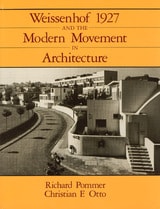
Weissenhof 1927 and the Modern Movement in Architecture
Richard Pommer and Christian F. Otto
University of Chicago Press, 1991
Recipient of the Award for Excellence in Professional and Scholarly Publishing
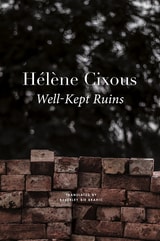
Well-Kept Ruins
Hélène Cixous
Seagull Books, 2022
In the Lower Saxony region of northwestern Germany sits the city of Osnabrück. This is where, in 1648, the Peace of Westphalia was signed, bringing the Thirty Years’ War and one of the most calamitous periods of European history to an end. But the city was later to witness another calamity.
Today, as one walks through Old Synagogue Street in a rich neighborhood of Osnabrück, one might miss noticing a pile of pale stones held together by chicken wire that sits between two fashionable homes. These are the well-kept ruins from behind which stares a gaping space—a place of memory and oblivion. Four polished plaques tell the tale of the horror-filled night of November 9, 1938—today known as Kristallnacht—when the synagogue that had stood on this spot was desecrated, looted, set on fire, and eventually demolished by Hitler’s forces. On the same day, ninety parishioners were imprisoned by the Gestapo and eventually sent to the Buchenwald concentration camp.
Osnabrück was also home to Eve Klein, a member of the city’s early-twentieth-century Jewish community and the mother of author Hélène Cixous. In Well-Kept Ruins, Cixous returns to the historic city in 2019 and reflects on the remains of the synagogue that “express the life lost, the life kept.” Walking the streets of the city, plumbing the depths of the past along with her own family’s history, looking deep into the future, and punctuating her poetic prose with haunting photographs, Cixous explores the ruins at the heart of humanity. Part memoir, part philosophical meditation, Well-Kept Ruins is a genre-defying and timely reflection of the contemporary human condition.
West German Reparations to Israel
Balabkins, Nicholas W
Rutgers University Press, 1971
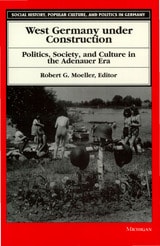
West Germany under Construction
Politics, Society, and Culture in the Adenauer EraRobert G. Moeller, Editor
University of Michigan Press, 1997
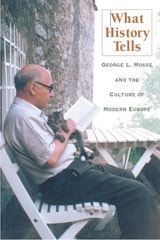
What History Tells
George L. Mosse and the Culture of Modern EuropeEdited by Stanley G. Payne, David J. Sorkin, and John S. Tortorice
University of Wisconsin Press, 2004
The contributors include Walter Laqueur, David Sabean, Johann Sommerville, Emilio Gentile, Roger Griffin, Saul Friedländer, Jay Winter, Rudy Koshar, Robert Nye, Janna Bourke, Shulamit Volkov, and Steven E. Aschheim.
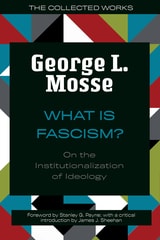
What Is Fascism?
On the Institutionalization of IdeologyGeorge L. Mosse
University of Wisconsin Press, 2026
In 1963, nearly two decades after the end of the most destructive war in human history, George L. Mosse assembled a group of interdisciplinary scholars from diverse backgrounds to answer a seemingly simple question: What is fascism? The landmark seminar that followed, held at Stanford University, came to define the intellectual conversation about European fascism throughout the postwar era. Mosse strove to better understand the legacy of fascism by debating its origins—often contentiously—with the sharpest minds of his generation.
In this volume, which collects Mosse’s lectures as well as his peers’ responses, Mosse and his colleagues wrestle with fascism’s origins and impact. The straightforward question that launched the seminar quickly expands to deeper debates: What are the intellectual foundations of right-wing populist political movements? How had these particular movements risen to power so quickly and then left so much devastation in their wakes? Were charismatic leaders like Hitler and Mussolini driving forces or did the various incarnations of fascism throughout Europe and beyond constitute a broader “revolution”? What was the relationship of religious and cultural institutions to fascism’s rise and cataclysmic fall?
As the word “fascism” takes on new meaning in the twenty-first century, it is more urgent than ever to revisit the work of scholars who witnessed its birth—and its defeat. In the foreword, Stanley G. Payne situates the lively debate in its historical context, and in the critical introduction, James J. Sheehan shares his own memories of the seminar and reflects on how the experience drove Mosse’s later work.
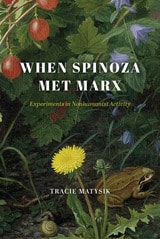
When Spinoza Met Marx
Experiments in Nonhumanist ActivityTracie Matysik
University of Chicago Press, 2022
Karl Marx was a fiery revolutionary theorist who heralded the imminent demise of capitalism, while Spinoza was a contemplative philosopher who preached rational understanding and voiced skepticism about open rebellion. Spinoza criticized all teleological ideas as anthropomorphic fantasies, while Marxism came to be associated expressly with teleological historical development. Why, then, were socialists of the German nineteenth century consistently drawn to Spinoza as their philosophical guide? Tracie Matysik shows how the metaphorical meeting of Spinoza and Marx arose out of an intellectual conundrum around the meaning of activity. How is it, exactly, that humans can be fully determined creatures but also able to change their world? To address this paradox, many revolutionary theorists came to think of activity in the sense of Spinoza—as relating. Matysik follows these Spinozist-socialist intellectual experiments as they unfolded across the nineteenth century, drawing lessons from them that will be meaningful for the contemporary world.
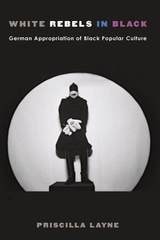
White Rebels in Black
German Appropriation of Black Popular CulturePriscilla Layne
University of Michigan Press, 2018
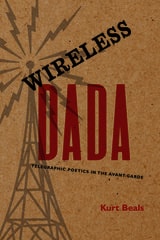
Wireless Dada
Telegraphic Poetics in the Avant-GardeKurt Beals
Northwestern University Press, 2020
Wireless Dada: Telegraphic Poetics in the Avant-Garde demonstrates that the poetics of the Dada movement was profoundly influenced by the telegraph and the technological and social transformations that it brought about in the nineteenth and early twentieth centuries. While telegraphy’s impact on Italian Futurism and German Expressionism is widely acknowledged, its formative role in Dada poetics has been largely neglected. Drawing on media history and theory, avant-garde studies, and German literary studies, Kurt Beals shows how the telegraph and the cultural discourses that surrounded it shaped the radical works of this seminal avant-garde movement. The “nonsense” strain in Dada is frequently seen as a response to the senseless violence of the First World War. Beals argues that it was not just the war that turned Dada poetry into a jumble of senseless signals—it was also the wireless.
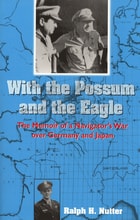
With the Possum and the Eagle
The Memoir of a Navigator's War over Germany and JapanRalph Nutter
University of North Texas Press, 2005

Women Political Prisoners in Germany
Narratives of Self and Captivity, 1915-91Kim Richmond
University of London Press, 2016
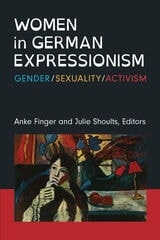
Women in German Expressionism
Gender, Sexuality, ActivismAnke Finger and Julie Shoults, Editors
University of Michigan Press, 2023
Work, Race, and the Emergence of Radical Right Corporatism in Imperial Germany
Dennis Sweeney
University of Michigan Press, 2010
---Andrew Zimmerman, George Washington University
World in the Balance
Behind the Scenes of World War IIGerhard L. Weinberg
Brandeis University Press, 1981
Worldly Provincialism
German Anthropology in the Age of EmpireH. Glenn Penny and Matti Bunzl, Editors
University of Michigan Press, 2003
Furthermore, this volume calls for a more nuanced understanding of Germany's standing in postcolonial studies. In contrast to the prevailing view of German imperialism as a direct precursor to Nazi atrocities, this volume proposes a key insight that goes to the heart of German historiography: There is no clear trajectory to be drawn from the complex ideologies of imperial anthropology to the race science embraced by the Nazis. Instead of relying on a nineteenth-century explanation for twentieth-century crimes, this volume ultimately illuminates German ethnology and anthropology as local phenomena, best approached in terms of their own worldly provincialism.
H. Glenn Penny is Assistant Professor of History at the University of Missouri, Kansas City.
Matti Bunzl Assistant Professor of Anthropology and History at the University of Illinois at Urbana-Champaign.
Writing against Hitler
Hermann Budzislawski and the Making of Twentieth-Century SocialismDaniel Siemens, Translated by Ben Fowkes
University of Wisconsin Press, 2025
Through the twin stories of a highly ambitious figure and the legendary publication he headed, Siemens charts the course of the intellectual Left’s rise and decline in power during the decades that shaped the political divides of the mid-twentieth century. Crucially, his account challenges the widely held belief that post-1989 German unification has represented a victory over the traumas of the past. Instead, Siemens shows the complexity of different strains of socialist thought and activity and reveals the contested place of Nazi Germany’s exiles at the center of Cold War Germany’s cultural history.
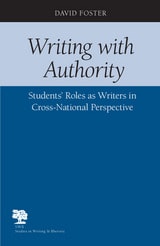
Writing with Authority
Students' Roles as Writers In Cross-National PerspectiveDavid Foster
Southern Illinois University Press, 2006
Writing with Authority: Students’ Roles as Writers in Cross-National Perspective offers a comparison of student writers in two university cultures—one German and one American—as the students learn to connect their writing to academic content. David Foster demonstrates the effectiveness of using cross-cultural comparisons to assess differences in literacy activities and suggests teaching approaches that will help American students better develop their roles as writers in knowledge-based communities. He proposes that American universities make stronger efforts to nurture the autonomy of American undergraduates as learner-writers and to create apprenticeship experiences that more closely reflect the realities of working in the academic community.
This comparative analysis identifies crucial differences in the ways German and American students learn to become academic writers, emphasizing two significant issues: the importance of self-directed, long-term planning and goal setting in developing knowledge-based projects and the impact of time structures on students’ writing practices. Foster suggests that students learn to write as knowledge makers, using cumulative, recursive task development as reflexive writing practices. He argues for the full integration of extended, self-managed, knowledge-based writing tasks into the American undergraduate curriculum from the onset of college study.
A cross-national perspective offers important insights into the conditions that influence novice writers, Foster says, including secondary preparations and transitions to postsecondary study. Foster proposes that students be challenged to write transformatively—to master new forms of authorship and authority based on self-directed planning, researching, and writing in specific academic communities. The text also addresses contested issues of power relations in students’ roles as academic writers and their perception of personal authority and freedom as writers.
A course model incorporates significant, self-directed writing projects to help students build sustainable roles as transformative writers, outlines “change goals” to help teachers develop curricular structures that support cumulative writing projects across the undergraduate curriculum, and shows how teachers can develop self-directed writing projects in a variety of program environments.