Results by title
433 books match the query 'Immigrants' and 15 start with w
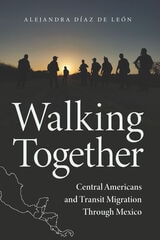
Walking Together
Central Americans and Transit Migration Through MexicoAlejandra Díaz de León
University of Arizona Press, 2023
Migrants in transit form several types of social networks, develop trust, and engage in acts of solidarity. The need to be recognized and grieved, compounded by the practical use of pooling information and resources, leads migrants to form small, strong groups called road families. Through the generalized sharing of information and small items such as food and blankets, migrants also form a transient community that includes everyone on the road at the same time. Sociologist Alejandra Díaz de León shows the trajectories of families that left together, showing, surprisingly, that families might not be the best social arrangement in transit.
Drawing on multisited research, this work contributes to debates on the role of social networks in clandestine migration processes and to discussions on how people create social networks and trust under violent and stressful situations. The detailed ethnographic narratives and accessible writing weave together theory with empirical observations to highlight and humanize the migrant experience.
Sitting at the intersection of border studies, immigration studies, and Latinx studies, this concise volume shows how Central American migrants in transit through Mexico survive the precarious and unpredictable road by forming different types of social ties.

Warriors for Social Justice and Equality
Maria Jimenez of Houston and Mexican American ActivismLinda J. Quintanilla
University of North Texas Press, 2025
We Are A People
Paul Spickard
Temple University Press, 2000
The growing recognition that ethnicity is not fixed and inherent, but elastic and constructed, fuels the essays in this collection. Regarding identity as a dynamic, on-going, formative and transformative process, We Are a People considers narrative -- the creation and maintenance of a common story -- as the keystone in building a sense of peoplehood. Myths of origin, triumph over adversity, migration, and so forth, chart a group's history, while continual additions to the larger narrative stress moving into the future as a people.
Still, there is more to our stories as individuals and groups. Most of us are aware that we take on different roles and project different aspects of ourselves depending on the situation. Some individuals who have inherited multiple group affiliations from their families view themselves not as this or that but all at once. So too with ethnic groups. The so-called hyphenated Americans are not the only people in the world to recognize or embrace their plurality. This relatively recent acknowledgment of multiplicity has potentially wide implications, destabilizing the limited (and limiting) categories inscribed in, for example, public policy and discourse on race relations.
We Are a People is a path-breaking volume, boldly illustrating how ethnic identity works in the real world.
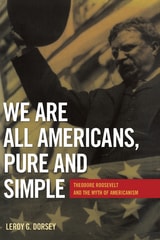
We Are All Americans, Pure and Simple
Theodore Roosevelt and the Myth of AmericanismLeroy G. Dorsey
University of Alabama Press, 2008
Redefining American identity through Roosevelt’s words.
The turn of the 20th century represented one of the most chaotic periods in the nation's history, as immigrants, Native Americans, and African Americans struggled with their roles as Americans while white America feared their encroachments on national identity. This book examines Theodore Roosevelt’s public rhetoric—speeches, essays, and narrative histories—as he attempted to craft one people out of many. Leroy G. Dorsey observes that Roosevelt's solution to the problem appeared straightforward: everyone could become "Americans, pure and simple" if they embraced his notion of "Americanism." Roosevelt grounded his idea of Americanism in myth, particularly the frontier myth—a heroic combination of individual strength and character. When nonwhites and immigrants demonstrated these traits, they would become true Americans, earning an exalted status that they had heretofore been denied.
Dorsey’s analysis illuminates how Roosevelt's rhetoric achieved a number of delicate, if problematic, balancing acts. Roosevelt gave his audiences the opportunity to accept a national identity that allowed "some" room for immigrants and nonwhites, while reinforcing their status as others, thereby reassuring white Americans of their superior place in the nation. Roosevelt’s belief in an ordered and unified nation did not overwhelm his private racist attitudes, Dorsey argues, but certainly competed with them. Despite his private sentiments, he recognized that racist beliefs and rhetoric were divisive and bad for the nation’s progress. The resulting message he chose to propagate was thus one of a rhetorical, if not literal, melting pot.
By focusing on Roosevelt’s rhetorical constructions of national identity, as opposed to his personal exploits or his role as a policy maker, We Are All Americans offers new insights into Roosevelt’s use of public discourse to bind the nation together during one of the most polarized periods in its history.
We Carry Smoke and Paper
Essays on the Grief and Hope of ConversionMelody S. Gee
University of Iowa Press, 2024
In essays that explore the parallels between conversion and language acquisition, isolated liturgies, cultural inheritances, stalled initiations, disrupted storytelling, and adoption, Gee examines conversion’s grief and hope, losses and gains, hauntings and promises. We Carry Smoke and Paper is a memoir about what we owe to those who sacrifice everything for us, and it is about the many conversions in a lifetime that turn our heads via whispers and shouts, calling us to ourselves.
Welcoming New Americans?
Local Governments and Immigrant IncorporationAbigail Fisher Williamson
University of Chicago Press, 2018
Abigail Fisher Williamson explores why and how local governments across the country are taking steps to accommodate immigrants, sometimes despite serious political opposition. Drawing on case studies of four new immigrant destinations—Lewiston, Maine; Wausau, Wisconsin; Elgin, Illinois; and Yakima, Washington—as well as a national survey of local government officials, she finds that local capacity and immigrant visibility influence whether local governments take action to respond to immigrants. State and federal policies and national political rhetoric shape officials’ framing of immigrants, thereby influencing how municipalities respond. Despite the devolution of federal immigration enforcement and the increasingly polarized national debate, local officials face on balance distinct legal and economic incentives to welcome immigrants that the public does not necessarily share. Officials’ efforts to promote incorporation can therefore result in backlash unless they carefully attend to both aiding immigrants and increasing public acceptance. Bringing her findings into the present, Williamson takes up the question of whether the current trend toward accommodation will continue given Trump’s anti-immigrant rhetoric and changes in federal immigration policy.
West Indian Immigrants
A Black Success Story?Suzanne Model
Russell Sage Foundation, 2008
What That Pig Said to Jesus
On the Uneasy Permanence of Immigrant LifePhilip Garrison
University of Utah Press, 2017
Philip Garrison says his book of essays is “in praise of mixed feelings,” particularly the mixed feelings he and his neighbors have toward the places they came from. His neighborhood is the Columbia Plateau, one of many North American nodes of immigration. Following a meandering, though purposeful trail, Garrison catches hillbillies and newer Mexican arrivals in ambiguous, wary encounters on a set four hundred years in the making, built on a foundation of Native American displacement. Garrison is the product of the earlier surge of new arrivals: from the 1930s to the 1970s, those he calls hillbillies left such mid-nation states as Arkansas, Missouri, Oklahoma, Kansas, and the Dakotas for the West. The more recent wave, from 1990 to 2010, came mostly from the central plateau of Mexico. These are folks with whom Garrison communes in multiple ways. Anecdotes from sources as varied as pioneer diaries, railroad promotions, family Bibles, Wikipedia, and local gossip “portray the region's immigration as a kind of identity makeover, one that takes the form first of breakdown, then of reassembly, and finally of renewal.” Garrison’s mix of slangy memoir and anthropological field notes shines light on the human condition in today’s West.
Wheeling's Polonia
Reconstructing Polish Community in a West Virginia Steel TownWilliam Hal Gorby
West Virginia University Press, 2020
Wheeling was a center of West Virginia’s labor movement, and Polish immigrants became a crucial element within the city’s active working-class culture. Arriving at what was also the center of the state’s Roman Catholic Diocese, Poles built religious and fraternal institutions to support new arrivals and to seek solace in times of economic strain and family hardship. The city’s history of crime and organized vice also affected new immigrants, who often lived in neighborhoods targeted for selective enforcement of Prohibition.
At once a deeply textured evocation of the city’s ethnic institutions and an engagement with larger questions about belonging, change, and justice, Wheeling’s Polonia is an inspiring account of a diverse working-class culture and the immigrants who built it.
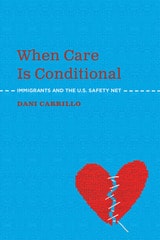
When Care is Conditional
Immigrants and the U.S. Safety NetDani Carrillo
Russell Sage Foundation, 2024
Through in-depth interviews with Latinx immigrants in northern California, Carrillo examines three circumstances—place, gender, and immigration status—that intersect to influence an individual’s access to health care, food assistance, and other benefits. She demonstrates that place of residence affects undocumented immigrants’ ability to get care since more services are available in urban areas, where many immigrants cannot afford to live, than suburban areas, where public transportation is limited. She also shows that while both men and women who are undocumented have difficulty obtaining care, men often confront more challenges. Undocumented women who are pregnant or mothers are eligible for some government safety net programs and rely on informal coethnic networks or a “guiding figure”—a relative, friend, neighbor, or coworker—who explains how to get care and makes them feel confident in accessing it. Most undocumented men, in contrast, are not eligible for public programs except in a medical emergency and often lack someone to guide them directly to care. Men sometimes steer one another to jobs through worker centers—where they may learn about various services and take advantage of those that increase their employability, like English or computer classes—but a culture of masculinity leads them to downplay medical problems and seek health care only in a crisis.
As undocumented immigrants navigate this exclusionary system, Carrillo finds that they resist the rhetoric stigmatizing them as lawbreakers. Dismissing the importance of “papers” and highlighting their work ethic, they question the fairness of U.S. immigration policies and challenge ideas about who deserves care.
Carrillo offers concrete recommendations, such as improving labor conditions and reexamining benefit eligibility, to increase access to care for not only undocumented immigrants but also people who have been excluded because of their race, criminal record, gender identity, sexual orientation, or disability. She argues that working with and across populations creates a powerful form of solidarity in advocating for inclusive care.
When Care Is Conditional provides compelling insights into how safety net and immigration policies intersect to affect people’s everyday lives and calls for a cultural shift so that the United States can provide unconditional care for all.
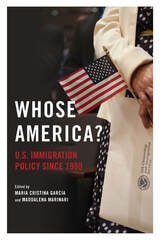
Whose America?
U.S. Immigration Policy since 1980Edited by Maria Cristina Garcia and Maddalena Marinari
University of Illinois Press, 2023
Up-to-date yet rooted in history, Whose America? provides a sophisticated account of recent immigration policy while mapping the ideological struggle to answer an essential question: which people have the right to make America their home or refuge?
Contributors: Leisy Abrego, Carl Bon Tempo, Julio Capó, Jr., Carly Goodman, Julia Rose Kraut, Monique Laney, Carl Lindskoog, Yael Schacher, and Elliott Young
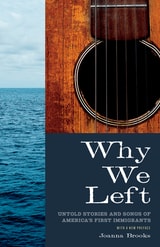
Why We Left
Untold Stories and Songs of America's First ImmigrantsJoanna Brooks
University of Minnesota Press, 2024
A grounded, tender, and mournful reckoning with the catastrophes that launched poor, white Anglos into their role as itinerant foot soldiers for modern imperialism—now in paperback with a new preface
Joanna Brooks’s ancestors were among the early waves of emigrants to leave England for North America. For generations, they lived hardscrabble lives, eking out subsistence in one place after another as they continually moved west in search of a better life. Why, Brooks wondered, did her people and countless other poor English subjects abandon their homeland for such unremitting hardship? The question leads her on a journey through an obscure dimension of American history.
Why We Left reveals the violence and dislocation that propelled seventeenth- and eighteenth-century working-class English emigration, presenting a powerful restorying of how we arrived at our present moment of precarity and rootlessness. Following American folk ballads back across the Atlantic to find histories of economic displacement, environmental destruction, and social betrayal at the heart of the early Anglo-American migrant experience, Brooks offers a scholarly and personal account of the intergenerational traumas that shape the history of white Anglos on Turtle Island.
She shares folk ballads such as “Edward,” which reveals the influence of deforestation on the dislocation of early Anglo-American peasant immigrants, and “The House Carpenter’s Wife,” which emphasizes the impact of economic instability and the colonial enterprise on women. From these ballads, tragic and heartrending, Brooks uncovers an archaeology of the worldviews of America’s earliest immigrants. This tenth-anniversary edition includes a new preface and develops a haunting historical perspective on the ancestors we thought we knew.
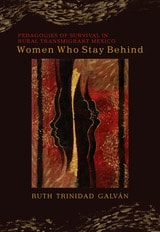
Women Who Stay Behind
Pedagogies of Survival in Rural Transmigrant MexicoRuth Trinidad Galván
University of Arizona Press, 2015
The book studies women’s and families’ use of cultural knowledge, community activism, and teaching and learning spaces. Throughout, Trinidad Galván provides answers to these questions: How does the migration of loved ones alter community, familial, and gender dynamics? And what social relations (convivencia), cultural knowledge, and women-centered pedagogies sustain women’s survival (supervivencia)?
Researchers, educators, and students interested in migration studies, gender studies, education, Latin American studies, and Mexican American studies will benefit from the ethnographic approach and theoretical insight of this groundbreaking work.

Words in Transit
Stories of ImmigrantsIlan Stavans
University of Massachusetts Press, 2016
Gathered together in a beautifully designed book that showcases Beth Reynolds's photographic portraits of each immigrant, these oral histories illuminate the many paths leading to the Pioneer Valley and demonstrate the shared experience among those seeking a new life in a foreign land. Storytellers include a massage therapist from Ireland, a Fulbright scholar from Palestine, a health educator from Taiwan, a literature professor from Spain, and a yoga teacher from Romania. Other participants hail from far-flung places including Haiti, Jamaica, El Salvador, Côte d'Ivoire, the Dominican Republic, Bhutan, Laos, Syria, Cambodia, Sri Lanka, Nepal, Congo, Slovenia, Iraq, and Ukraine. Introduced by the renowned scholar of translation and global literature Ilan Stavans, these stories testify to the resilience, bravery, and hopefulness of western New England émigrés. Proceeds from this book go to scholarships for immigrants at Holyoke Community College.
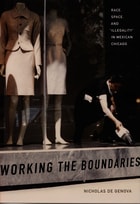
Working the Boundaries
Race, Space, and "Illegality" in Mexican ChicagoNicholas De Genova
Duke University Press, 2005
De Genova worked for two and a half years as a teacher of English in ten industrial workplaces (primarily metal-fabricating factories) throughout Chicago and its suburbs. In Working the Boundaries he draws on fieldwork conducted in these factories, in community centers, and in the homes and neighborhoods of Mexican migrants. He describes how the meaning of “Mexican” is refigured and racialized in relation to a U.S. social order dominated by a black-white binary. Delving into immigration law, he contends that immigration policies have worked over time to produce Mexicans as the U.S. nation-state’s iconic “illegal aliens.” He explains how the constant threat of deportation is used to keep Mexican workers in line. Working the Boundaries is a major contribution to theories of race and transnationalism and a scathing indictment of U.S. labor and citizenship policies.