Results by title
456 books match the query 'India' and 9 start with w
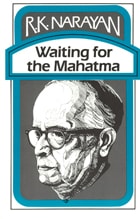
Waiting for Mahatma
R. K. Narayan
University of Chicago Press, 1955
"The experience of reading one of his novels is . . . comparable to one's first reaction to the great Russian novels: the fresh realization of the common humanity of all peoples, underlain by a simultaneous sense of strangeness—like one's own reflection seen in a green twilight."—Margaret Parton, New Herald Tribune Book Review
"The hardest of all things for a novelist to communicate is the extraordinary ordinariness of most human happiness. . . . Jane Austen, Soseki, Chekhov: a few bring it off. Narayan is one of them."—Francis King, Spectator
"The novels of R.K. Narayan are the best I have read in any language for a long time."—Amit Roy, Daily Telegraph
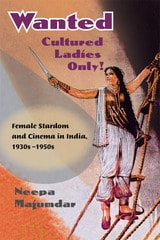
Wanted Cultured Ladies Only!
Female Stardom and Cinema in India, 1930s-1950sNeepa Majumdar
University of Illinois Press, 2008
We Were Adivasis
Aspiration in an Indian Scheduled TribeMegan Moodie
University of Chicago Press, 2015
Moodie takes readers to a diversity of settings, including households, tribal council meetings, and wedding festivals, to reveal the aspirations that are expressed in each. Crucially, she demonstrates how such aspiration and identity-building are strongly gendered, requiring different dispositions required of men and women in the pursuit of collective social uplift. The Dhanka strategy for occupying the role of adivasi in urban India comes at a cost: young women must relinquish dreams of education and employment in favor of community-sanctioned marriage and domestic life. Ultimately, We Were Adivasis explores how such groups negotiate their pasts to articulate different visions of a yet uncertain future in the increasingly liberalized world.
When Borne Across
Literary Cosmopolitics in the Contemporary Indian NovelBishnupriya Ghosh
Rutgers University Press, 2004
India’s 1997 celebration of the Golden Jubilee marked fifty years of independence from British colonial rule. This anniversary is the impetus for Bishnupriya Ghosh’s exploration of the English language icons of South Asian post-colonial literature: Salman Rushdie, Vikram Chandra, Amitav Ghosh, Upamanyu Chatterjee, and Arundhati Roy. These authors, grouped together as South Asian cosmopolitical writers, produce work challenging and expanding preconceived notions of Indian cultural identity, while being sold simultaneously as popular English literature within the global market. This commodification of Indian language and identity reinforces incomplete and simplified images of India and its writers, and at times counteracts the expressed agenda of the writers. In When Borne Across, Ghosh focuses on the politics of language and history, and the related processes of translation and migration within the global network. In so doing, she develops a new approach to literary studies that adapts conventional literary analysis to the pressures, constraints, and liberties of our present era of globalization.
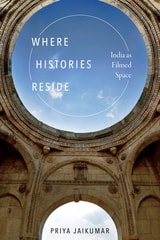
Where Histories Reside
India as Filmed SpacePriya Jaikumar
Duke University Press, 2019
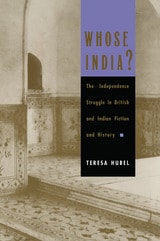
Whose India?
The Independence Struggle in British and Indian Fiction and HistoryTeresa Hubel
Duke University Press, 1996
Hubel collapses the boundary between literature and history by emphasizing the selected nature of the “facts” that comprise historical texts, and by demonstrating the historicity of fiction. In analyzing the orthodox construction of the British/Indian encounter, Hubel calls into question assumptions about the end of nationalism implicit in mainstream histories and fiction, which generally describe a battleground on which only ruling-class Indians and British meet. Marginalized texts by women, untouchables, and overt imperialists alike are, therefore, examined alongside the well-known work of figures such as Rudyard Kipling, Jawaharlal Nehru, E. M. Forster, and Mahatma Gandhi.
In Whose India? discursive ownership and resistance to ownership are mutually constructing categories. As a result, the account of Indian nationalism and British imperialism that emerges is much more complicated, multivocal, and even more contradictory than previous studies have imagined. Of interest to students and scholars engaged in literary, historical, colonial/postcolonial, subaltern, and Indian studies, Whose India? will also attract readers concerned with gender issues and the canonization of texts.
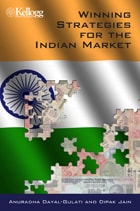
Winning Strategies for the Indian Market
Anuradha Dayal-Gulati
Northwestern University Press, 2010
The authors describe how the sector might evolve during the next five to ten years, within the broad canvas of the deeper economic and demographic transitions that are taking place in India, and in turn, what this evolution implies for the challenges and opportunities that companies, both domestic and multinational, may face in India. Essays on the emergence of the Indian consumer, the effect of credit cards on India’s consumer culture, and entrepreneurship and India’s poor the emergence of the Indian Consumer round out this profile of India’s market.
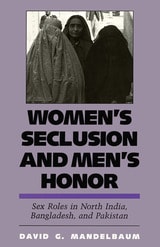
Women's Seclusion and Men's Honor
Sex Roles in North India, Bangladesh, and PakistanDavid G. Mandelbaum
University of Arizona Press, 1988
Writing Under the Raj
Gender, Race, and Rape in the British Colonial Imagination, 1830-1947Nancy L. Paxton
Rutgers University Press, 1999
Writing Under the Raj is the first study to challenge the long-held critical assumption that the rape of colonizing women by colonized men was the first, or the only, rape script in British colonial literature. Nancy Paxton asks why rape disappears in British literature about English domestic life in the 1790s and charts its reappearance in British literature about India written between 1830 and 1947. Paxton displays the hybrid qualities of familiar novels like Kipling’s Kim and Forster’s A Passage to India by situating them in a richly detailed cultural context that reveals the dynamic relationship between metropolitan British literature and novels written by men and women who lived in the colonial contact zone of British India throughout this period.
Drawing on current feminist and gender theory as well as a wide range of historical and cultural sources, Paxton identifies four different “scripts” about interracial and intraracial rape that appear in novels about India during the period of British rule. Surveying more than thirty canonized and popular Anglo-Indian novels, Paxton shows how the treatment of rape reflects basic conflicts in the social and sexual contracts defining British and Indian women’s relationship to the nation state throughout the period. This study reveals how and why novels written after the Indian Uprising of 1857 popularized the theme of English women victimized by Indian men. Paxton demonstrates how all these novels reflect unresolved ideological and symbolic conflicts in British ideas about sex, violence, and power.