Results by title
63 books match the query 'Indigenous Languages in the Americas' and 2 start with w
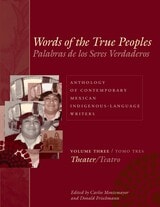
Words of the True Peoples/Palabras de los Seres Verdaderos
Anthology of Contemporary Mexican Indigenous-Language Writers/Antología de Escritores Actuales en Lenguas Indígenas de México: Volume Three/Tomo Tres: Theater/TeatroEdited by Carlos Montemayor and Donald Frischmann
University of Texas Press, 2007
As part of the larger, ongoing movement throughout Latin America to reclaim non-Hispanic cultural heritages and identities, indigenous writers in Mexico are reappropriating the written word in their ancestral tongues and in Spanish. As a result, the long-marginalized, innermost feelings, needs, and worldviews of Mexico's ten to twenty million indigenous peoples are now being widely revealed to the Western societies with which these peoples coexist. To contribute to this process and serve as a bridge of intercultural communication and understanding, this groundbreaking, three-volume anthology gathers works by the leading generation of writers in thirteen Mexican indigenous languages: Nahuatl, Maya, Tzotzil, Tzeltal, Tojolabal, Tabasco Chontal, Purepecha, Sierra Zapoteco, Isthmus Zapoteco, Mazateco, Ñahñu, Totonaco, and Huichol.
Volume Three contains plays by six Mexican indigenous writers. Their plays appear first in their native language, followed by English and Spanish translations. Montemayor and Frischmann have abundantly annotated the Spanish, English, and indigenous-language texts and added glossaries and essays that introduce the work of each playwright and discuss the role of theater within indigenous communities. These supporting materials make the anthology especially accessible and interesting for nonspecialist readers seeking a greater understanding of Mexico's indigenous peoples.
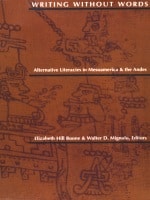
Writing Without Words
Alternative Literacies in Mesoamerica and the AndesElizabeth Hill Boone and Walter D. Mignolo, eds.
Duke University Press, 1994
The contributors--who include art historians, anthropologists, and literary theorists--examine the ways in which ancient Mesoamerican and Andean peoples conveyed meaning through hieroglyphic, pictorial, and coded systems, systems inseparable from the ideologies they were developed to serve. We see, then, how these systems changed with the European invasion, and how uniquely colonial writing systems came to embody the post-conquest American ideologies. The authors also explore the role of these early systems in religious discourse and their relation to later colonial writing.
Bringing the insights from Mesoamerica and the Andes to bear on a fundamental exchange among art history, literary theory, semiotics, and anthropology, the volume reveals the power contained in the medium of writing.
Contributors. Elizabeth Hill Boone, Tom Cummins, Stephen Houston, Mark B. King, Dana Leibsohn, Walter D. Mignolo, John Monaghan, John M. D. Pohl, Joanne Rappaport, Peter van der Loo