Results by title
174 books match the query 'Indigenous peoples' and 6 start with w
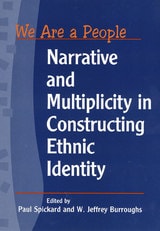
We Are A People
Paul Spickard
Temple University Press, 2000
The growing recognition that ethnicity is not fixed and inherent, but elastic and constructed, fuels the essays in this collection. Regarding identity as a dynamic, on-going, formative and transformative process, We Are a People considers narrative -- the creation and maintenance of a common story -- as the keystone in building a sense of peoplehood. Myths of origin, triumph over adversity, migration, and so forth, chart a group's history, while continual additions to the larger narrative stress moving into the future as a people.
Still, there is more to our stories as individuals and groups. Most of us are aware that we take on different roles and project different aspects of ourselves depending on the situation. Some individuals who have inherited multiple group affiliations from their families view themselves not as this or that but all at once. So too with ethnic groups. The so-called hyphenated Americans are not the only people in the world to recognize or embrace their plurality. This relatively recent acknowledgment of multiplicity has potentially wide implications, destabilizing the limited (and limiting) categories inscribed in, for example, public policy and discourse on race relations.
We Are a People is a path-breaking volume, boldly illustrating how ethnic identity works in the real world.
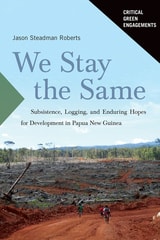
We Stay the Same
Subsistence, Logging, and Enduring Hopes for Development in Papua New GuineaJason Steadman Roberts
University of Arizona Press, 2024
Following a long history of smaller-scale and largely unsuccessful resource development efforts, New Hanover became the site of three multinational-controlled special agricultural and business leases (SABLs) that combined to cover over 75 percent of the island for ninety-nine-year lease terms. These agroforestry projects were part of a national effort to encourage “sustainable” rural development by tapping into the growing global demand for agricultural lands and crops like oil palm and biofuels. They were supposed to succeed where the smaller-scale projects of the past had failed. Unfortunately, these SABLs resulted in significant forest loss and livelihood degradation, while doing little to promote the type of economic development that many Lavongai had been hoping for.
It is within this context that We Stay the Same grounds questions of hope for transformative economic change within Lavongai assessments of the inequitable relationships between global processes of resource development and the local lives that have become increasingly defined by the necessities and failures of these processes. Written in a clear and relatable style for students, We Stay the Same combines ethnographic and ecological research to show how the Lavongai continue to survive and make meaningful lives in a situation where their own hopes for a better future have often been used against them as a mechanism of a more distantly profitable dispossession.
When Forests Run Amok
War and Its Afterlives in Indigenous and Afro-Colombian TerritoriesDaniel Ruiz-Serna
Duke University Press, 2023
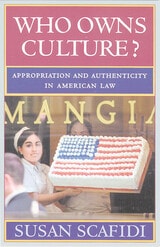
Who Owns Culture?
Appropriation and Authenticity in American LawScafidi, Susan
Rutgers University Press, 2005
While claims of authenticity or quality may prompt some consumers to seek cultural products at their source, the communities of origin are generally unable to exclude copyists through legal action. Like other works of unincorporated group authorship, cultural products lack protection under our system of intellectual property law. But is this legal vacuum an injustice, the lifeblood of American culture, a historical oversight, a result of administrative incapacity, or all of the above?
Who Owns Culture? offers the first comprehensive analysis of cultural authorship and appropriation within American law. From indigenous art to Linux, Susan Scafidi takes the reader on a tour of the no-man's-land between law and culture, pausing to ask: What prompts us to offer legal protection to works of literature, but not folklore? What does it mean for a creation to belong to a community, especially a diffuse or fractured one? And is our national culture the product of Yankee ingenuity or cultural kleptomania?
Providing new insights to communal authorship, cultural appropriation, intellectual property law, and the formation of American culture, this innovative and accessible guide greatly enriches future legal understanding of cultural production.
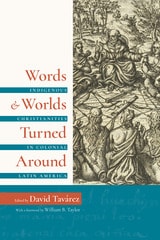
Words and Worlds Turned Around
Indigenous Christianities in Colonial Latin AmericaDavid Tavárez
University Press of Colorado, 2017
A sophisticated, state-of-the-art study of the remaking of Christianity by indigenous societies, Words and Worlds Turned Around reveals the manifold transformations of Christian discourses in the colonial Americas. The book surveys how Christian messages were rendered in indigenous languages; explores what was added, transformed, or glossed over; and ends with an epilogue about contemporary Nahuatl Christianities.
In eleven case studies drawn from eight Amerindian languages—Nahuatl, Northern and Valley Zapotec, Quechua, Yucatec Maya, K'iche' Maya, Q'eqchi' Maya, and Tupi—the authors address Christian texts and traditions that were repeatedly changed through translation—a process of “turning around” as conveyed in Classical Nahuatl. Through an examination of how Christian terms and practices were made, remade, and negotiated by both missionaries and native authors and audiences, the volume shows the conversion of indigenous peoples as an ongoing process influenced by what native societies sought, understood, or accepted.
The volume features a rapprochement of methodologies and assumptions employed in history, anthropology, and religion and combines the acuity of of methodologies drawn from philology and historical linguistics with the contextualizing force of the ethnohistory and social history of Spanish and Portuguese America.
Contributors: Claudia Brosseder, Louise M. Burkhart, Mark Christensen, John F. Chuchiak IV, Abelardo de la Cruz, Gregory Haimovich, Kittiya Lee, Ben Leeming, Julia Madajczak, Justyna Olko, Frauke Sachse, Garry Sparks
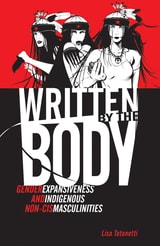
Written by the Body
Gender Expansiveness and Indigenous Non-Cis MasculinitiesLisa Tatonetti
University of Minnesota Press, 2021
Examining the expansive nature of Indigenous gender representations in history, literature, and film
Within Native American and Indigenous studies, the rise of Indigenous masculinities has engendered both productive conversations and critiques. Lisa Tatonetti intervenes in this conversation with Written by the Body by centering how female, queer, and/or Two-Spirit Indigenous people take up or refute masculinity, and, in the process, offer more expansive understandings of gender.
Written by the Body moves from the eighteenth- and nineteenth-century archive to turn-of-the-century and late-twentieth-century fiction to documentaries, HIV/AIDS activism, and, finally, recent experimental film and literature. Across it all, Tatonetti shows how Indigenous gender expansiveness, and particularly queer and non-cis gender articulations, moves between and among Native peoples to forge kinship, offer protection, and make change. She charts how the body functions as a somatic archive of Indigenous knowledge in Native histories, literatures, and activisms—exploring representations of Idle No More in the documentary Trick or Treaty, the all-female wildland firefighting crew depicted in Apache 8, Chief Theresa Spence, activist Carole laFavor, S. Alice Callahan, Thirza Cuthand, Joshua Whitehead, Carrie House, and more.
In response to criticisms of Indigenous masculinity studies, Written by the Body de-sutures masculinity from the cis-gendered body and investigates the ways in which female, trans, and otherwise nonconforming masculinities carry the traces of Two-Spirit histories and exceed the limitations of settler colonial imaginings of gender.