Results by title
110 books match the query 'Italian' and 3 start with w
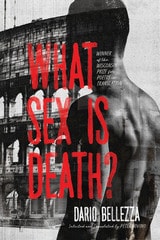
What Sex Is Death?
Dario Bellezza, Selected and Translated by Peter Covino
University of Wisconsin Press, 2025
Dario Bellezza—Italy’s first openly gay, major prize winning poet-novelist-playwright—was a bold, daring writer who energetically explored love, sexual transformation, and death. Bellezza embraced a variety of forms, from unabashed love-lyric to political narrative, and the fervor of his voice makes a compelling argument for his lasting importance as one of the most remarkable poets of the late twentieth century. Yet, until now, his work has never been available in English. Award-winning translator Peter Covino offers a wide-ranging selection of representative poetry from Bellezza’s career. Influenced by Rimbaud, the Beats, and the growing European gay rights movements, his poetry remains innovative and timely. Ranging from stray cats in the graveyards of Rome, to the literal and metaphoric fallout from the Chernobyl disaster, to the joys and disappointments of random hookups, Bellezza’s dazzling visions will sparkle in readers’ eyes like sunspots long after they complete this magnificent volume.
[more]
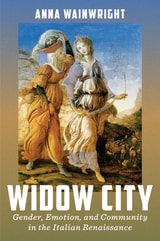
Widow City
Gender, Emotion, and Community in the Italian RenaissanceAnna Wainwright
University of Delaware Press, 2025
Widow City: Gender, Emotion, and Community in the Italian Renaissance investigates the ever-evolving role of the widow in medieval and early modern Italian literature, from canonical authors such as Dante, Petrarch, and Boccaccio, to the numerous widowed writers who rose to prominence in the sixteenth century—including Vittoria Colonna, Veronica Gambara, and Francesca Turina—and radically changed the conversation on public mourning. Engaging with broader intellectual discussions around gender, the history of emotions, the politics of mourning, and the construction of community, Widow City argues that widows served as key models demonstrating to readers not just how to mourn, but how to live well after devastating loss. At the same time, widows were figures of great anxiety: their status as unattached women, and the public performance of their grief, were viewed as very real threats to the stability of the social order. They are thus key to broader intellectual understandings of community and civic life in the Italian Middle Ages and Renaissance.
[more]
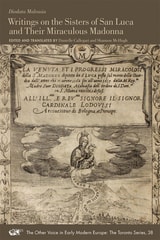
Writings on the Sisters of San Luca and Their Miraculous Madonna
Diodata Malvasia
Iter Press, 2015
The Bolognese nun Diodata Malvasia was presumed to have authored only one work, The Arrival and the Miraculous Workings of the Glorious Image of the Virgin (1617). In her recently discovered second manuscript chronicle, A Brief Discourse on What Occurred to the Most Reverend Sisters of the Joined Convents of San Mattia and San Luca (1575), her writing demonstrates active resistance to Tridentine convent reform. Together, Malvasia’s works read as the bookends to a lifelong crusade on behalf of her convent.
[more]