Results by title
356 books match the query 'Jewish Studies' and 15 start with w
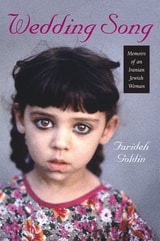
Wedding Song
Memoirs of an Iranian Jewish WomanFarideh Goldin
Brandeis University Press, 2004
Wet Earth and Dreams
A Narrative of Grief and RecoveryJane Lazarre
Duke University Press, 1998
As she contends with the pain and many indignities of her treatment for cancer, Lazarre realizes that successful medical treatment will only be part of her healing process. Her own illness becomes the vehicle for coming to terms with key moments of loss and grief—the death of a beloved therapist from breast cancer, her brother-in-law’s death from AIDS, a traumatic disappointment in her work life, and the unresolved pain of being a motherless child. The gift of Lazarre’s writing is her ability to transform her narratives of grief and loss into a story whose power to heal lies in its ability to penetrate the unconscious and give voice to the elusive truths hidden there. Through her writing, Lazarre is able to embrace grief—even her own inarticulate grief as a child—and find her way through the story to a restored sense of wholeness.
In Wet Earth and Dreams Jane Lazarre once again proves herself to be both companion and guide through some of the most difficult challenges life has to offer. As always, she draws strength not only from sustaining friendship and love, but also from her own faith in the power of storytelling to make bearable the seemingly unbearable. Lazarre’s bravely and beautifully written account of grief, illness, and death is at the last a celebration of the redemptive possibilities of the creative spirit.
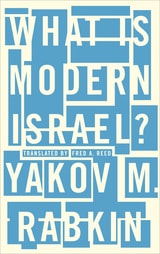
What is Modern Israel?
Yakov M. Rabkin
Pluto Press, 2016
Drawing on many overlooked pages of history, including English, French, Hebrew, Yiddish and Russian sources, Yakov Rabkin shows that Zionism was conceived as a sharp break with Judaism and Jewish continuity. Israel’s past and present must be seen in the context of European ethnic nationalism, colonial expansion and geopolitical interests, rather than as an incarnation of Biblical prophecies or a culmination of Jewish history.
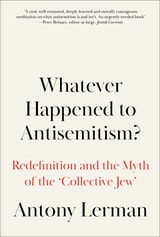
Whatever Happened to Antisemitism?
Redefinition and the Myth of the 'Collective Jew'Antony Lerman
Pluto Press, 2020
'This elegantly written, erudite book is essential reading for all of us, whatever our identifications' - Lynne Segal
Antisemitism is one of the most controversial topics of our time. The public, academics, journalists, activists and Jewish people themselves are divided over its meaning. Antony Lerman shows that this is a result of a 30-year process of redefinition of the phenomenon, casting Israel, problematically defined as the 'persecuted collective Jew', as one of its main targets.
This political project has taken the notion of the 'new antisemitism' and codified it in the flawed International Holocaust Remembrance Alliance's 'working definition' of antisemitism. This text is the glue holding together an international network comprising the Israeli government, pro-Israel advocacy groups, Zionist organizations, Jewish communal defence bodies and sympathetic governments fighting a war against those who would criticize Israel.
The consequences of this redefinition have been alarming, supressing free speech on Palestine/Israel, legitimizing Islamophobic right-wing forces, and politicizing principled opposition to antisemitism.

Whatever Happened to Antisemitism?
Redefinition and the Myth of the 'Collective Jew'Antony Lerman
Pluto Press, 2020
'This elegantly written, erudite book is essential reading for all of us, whatever our identifications' - Lynne Segal
Antisemitism is one of the most controversial topics of our time. The public, academics, journalists, activists and Jewish people themselves are divided over its meaning. Antony Lerman shows that this is a result of a 30-year process of redefinition of the phenomenon, casting Israel, problematically defined as the ‘persecuted collective Jew’, as one of its main targets.
This political project has taken the notion of the ‘new antisemitism’ and codified it in the flawed International Holocaust Remembrance Alliance’s ‘working definition’ of antisemitism. This text is the glue holding together an international network comprising the Israeli government, pro-Israel advocacy groups, Zionist organizations, Jewish communal defence bodies and sympathetic governments fighting a war against those who would criticize Israel.
The consequences of this redefinition have been alarming, supressing free speech on Palestine/Israel, legitimizing Islamophobic right-wing forces, and politicizing principled opposition to antisemitism.
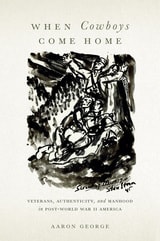
When Cowboys Come Home
Veterans, Authenticity, and Manhood in Post–World War II AmericaAaron George
Rutgers University Press, 2024
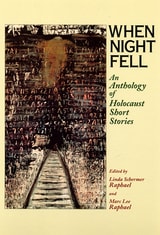
When Night Fell
An Anthology of Holocaust Short StoriesLinda Schermer Raphael and Marc Lee Raphael
Rutgers University Press, 1999
Both survivors of the Holocaust and those who were not there agree that it is impossible to tell what happened as the Nazi Final Solution was put into effect. No writing can adequately imagine the concentration camps, ghettos, and death camps. And that is precisely why writers must tell-and retell-what happened there.
In When Night Fell: An Anthology of Holocaust Short Stories, Linda Schermer Raphael and Marc Lee Raphael have collected twenty-six short stories that tell of the human toll of the Holocaust on those who survived its horrors, as well as later generations touched by its memory. The stories are framed by discussion of the current debate about who owns the Holocaust and who is entitled to speak about it.
Some of the stories included here are by internationally acclaimed authors. Others may be new to many readers. When Night Fell is a fitting memorial to this genocidal horror, putting eloquent voice to human endurance that is-almost-beyond words.
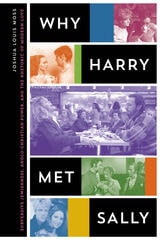
Why Harry Met Sally
Subversive Jewishness, Anglo-Christian Power, and the Rhetoric of Modern LoveBy Joshua Louis Moss
University of Texas Press, 2017
From immigrant ghetto love stories such as The Cohens and the Kellys (1926), through romantic comedies including Meet the Parents (2000) and Knocked Up (2007), to television series such as Transparent (2014–), Jewish-Christian couplings have been a staple of popular culture for over a century. In these pairings, Joshua Louis Moss argues, the unruly screen Jew is the privileged representative of progressivism, secular modernism, and the cosmopolitan sensibilities of the mass-media age. But his/her unruliness is nearly always contained through romantic union with the Anglo-Christian partner. This Jewish-Christian meta-narrative has recurred time and again as one of the most powerful and enduring, although unrecognized, mass-culture fantasies.
Using the innovative framework of coupling theory, Why Harry Met Sally surveys three major waves of Jewish-Christian couplings in popular American literature, theater, film, and television. Moss explores how first-wave European and American creators in the early twentieth century used such couplings as an extension of modernist sensibilities and the American “melting pot.” He then looks at how New Hollywood of the late 1960s revived these couplings as a sexually provocative response to the political conservatism and representational absences of postwar America. Finally, Moss identifies the third wave as emerging in television sitcoms, Broadway musicals, and “gross-out” film comedies to grapple with the impact of American economic globalism since the 1990s. He demonstrates that, whether perceived as a threat or a triumph, Jewish-Christian couplings provide a visceral, easily graspable, template for understanding the rapid transformations of an increasingly globalized world.
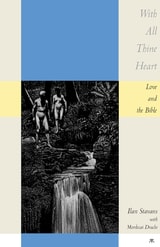
With All Thine Heart
Love and the BibleStavans, Ilan
Rutgers University Press, 2010
Presented in an engaging, conversational format and touched with striking artwork, the textured dialogue between Stavans and Drache is meant to show how the Bible is a multidimensional text and one that, when considered over the course of history, still has the power to shape our world. The theme of love provides the connective tissue that binds this work.
Addressing a wide range of topics, from biblical archaeology and fundamentalism to Hollywood movies, lexicography, and the act of praying, With All Thine Heart suggests that the Hebrew Bible is a novel worth decoding patiently, such as one does with classics like Don Quixote de la Mancha, In Search of Lost Time, and Anna Karenina. Similar to the protagonists in these tales, biblical characters, although not shaped with the artistic nuance of modern literature, allow for astonishing insight. This exploration of love through the pages of the Bible—organized chronologically from Genesis to Exodus and followed by insightful meditations on the Song of Songs and the Book of Job—is a delightful intellectual and spiritual treat . . . Shema Ysrael!
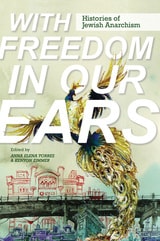
With Freedom in Our Ears
Histories of Jewish AnarchismEdited by Anna Elena Torres and Kenyon Zimmer
University of Illinois Press, 2023
Contributors bring to light the presence and persistence of Jewish anarchism throughout histories of radical labor, women’s studies, political theory, multilingual literature, and ethnic studies.
These essays reveal an ongoing engagement with non-Jewish radical cultures, including the translation practices of the Jewish anarchist press. Jewish anarchists drew from a matrix of secular, cultural, and religious influences, inventing new anarchist forms that ranged from mystical individualism to militantly atheist revolutionary cells.
With Freedom in Our Ears brings together more than a dozen scholars and translators to write the first collaborative history of international, multilingual, and transdisciplinary Jewish anarchism.
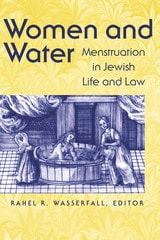
Women and Water
Menstruation in Jewish Life and LawEdited by Rahel Wasserfall
Brandeis University Press, 1999
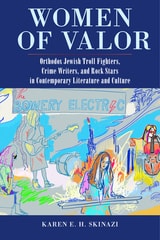
Women of Valor
Orthodox Jewish Troll Fighters, Crime Writers, and Rock Stars in Contemporary Literature and CultureKaren E. H. Skinazi
Rutgers University Press, 2018
Media portrayals of Orthodox Jewish women frequently depict powerless, silent individuals who are at best naive to live an Orthodox lifestyle, and who are at worst, coerced into it. Karen E. H. Skinazi delves beyond this stereotype in Women of Valor to identify a powerful tradition of feminist literary portrayals of Orthodox women, often created by Orthodox women themselves. She examines Orthodox women as they appear in memoirs, comics, novels, and movies, and speaks with the authors, filmmakers, and musicians who create these representations. Throughout the work, Skinazi threads lines from the poem “Eshes Chayil,” the Biblical description of an Orthodox “Woman of Valor.” This proverb unites Orthodoxy and feminism in a complex relationship, where Orthodox women continuously question, challenge, and negotiate Orthodox and feminist values. Ultimately, these women create paths that unite their work, passions, and families under the framework of an “Eshes Chayil,” a woman who situates religious conviction within her own power.
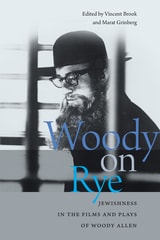
Woody on Rye
Jewishness in the Films and Plays of Woody AllenEdited by Vincent Brook and Marat Grinberg
Brandeis University Press, 2013
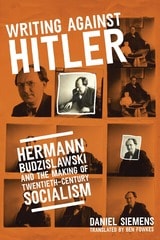
Writing against Hitler
Hermann Budzislawski and the Making of Twentieth-Century SocialismDaniel Siemens, Translated by Ben Fowkes
University of Wisconsin Press, 2025
Through the twin stories of a highly ambitious figure and the legendary publication he headed, Siemens charts the course of the intellectual Left’s rise and decline in power during the decades that shaped the political divides of the mid-twentieth century. Crucially, his account challenges the widely held belief that post-1989 German unification has represented a victory over the traumas of the past. Instead, Siemens shows the complexity of different strains of socialist thought and activity and reveals the contested place of Nazi Germany’s exiles at the center of Cold War Germany’s cultural history.
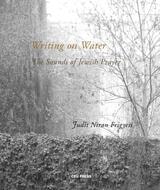
Writing on Water
The Sounds of Jewish PrayerJudit Niran Frigyesi
Central European University Press, 2018
Writing on Water grasps the phenomenon of sound in prayer, that is, a meaning in sounds and soundscapes, and a musical essence in the act of praying.
The impetus for the book arose from the author’s fieldwork among traditional Jews during the era of communism in Budapest and Prague. In that period the Jewish religion and Jewishness in general were supressed and rituals became semi-secret and turned inward. The book is a witness to these communities and their rituals, but it goes beyond documentation. The uniqueness of the sounds of the rituals compelled the author to try to comprehend how melodies and soundscapes became the sustaining/protective environment, as well as the vehicle, for the expression of a world-orientation—in a situation where open discourse was inconceivable.
The book is based on extensive interviews, musical recordings, photographs and scholarly analyses. It is unique in its choice of communities, its wealth of original documents, and its novel interpretation of sound.
Writing on Water is creative non-fiction. The presentation is evocative and poetic, but at the same time it transmits knowledge. The book can aid research and serve in courses in philosophy, religion, music, ethnomusicology, anthropology, aesthetics, Jewish studies, folklore, oral history, and performance studies. It is also a work of art and literature.