Results by title
593 books match the query 'Jews' and 15 start with w
Waiting for Hope
Jewish Displaced Persons in Post-World War II GermanyAngelika Konigseder
Northwestern University Press, 2001
Starting with the discovery of death camps by Allied forces, Königseder and Wetzel describe the inadequate preparations made for the survivors. The soldiers were ill equipped to deal with the physical wreckage and mental anguish of their charges, but American rabbis soon arrived to perform invaluable work helping the survivors cope. The historians also devote attention to autonomous Jewish life in and near the camps: theater groups and orchestras prospered, schools were founded, a tuberculosis hospital and clinic for DPs was established, and underground organizations handled illegal immigration to Israel and trained soldiers to fight in Palestine.
Drawing on original documents and the work of other historians, Waiting for Hope sheds light on a largely unknown period in postwar Jewish history and shows that the suffering of the survivors did not end with the war.
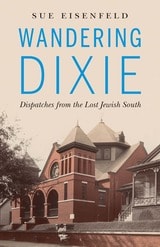
Wandering Dixie
Dispatches from the Lost Jewish SouthSue Eisenfeld
The Ohio State University Press, 2020
From South Carolina to Arkansas, she explores the small towns where Jewish people once lived and thrived. She visits the site of her distant cousin and civil rights activist Andrew Goodman’s murder during 1964’s Freedom Summer. She also talks with the only Jews remaining in some of the “lost” places, from Selma to the Mississippi Delta to Natchitoches, and visits areas with no Jewish community left—except for an old temple or overgrown cemetery. Eisenfeld follows her curiosity about Jewish Confederates and casts an unflinching eye on early southern Jews’ participation in slavery. Her travels become a journey of revelation about our nation’s fraught history and a personal reckoning with the true nature of America.
Wayward Threads
Robert Goldmann
Northwestern University Press, 1998
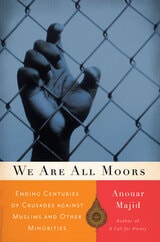
We Are All Moors
Ending Centuries of Crusades against Muslims and Other MinoritiesAnouar Majid
University of Minnesota Press, 2012
In 1609 King Philip III ordered the expulsion of all Moriscos—Spaniards of Muslim descent—from Spain in an ongoing attempt to establish a homogeneous state and remove the last vestiges of Islam from his nation. Four centuries later, Spain and Europe are once again outraged by the presence of Islam within their borders, and, for many, the millions of Muslim immigrants now living there pose a fundamental challenge to European identity. Across the Atlantic Ocean, the vast Hispanic community in the United States, both legal and illegal, has raised similar fears. Exacerbated by globalization and 9/11, these nativist, anti-Islamic, and broadly anti-immigrant attitudes fatally undermine meaningful dialogue and progress essential to creating a more peaceful and just world.
In We Are All Moors, Anouar Majid contends that the acrimonious debates about immigration and Islam in the West are the cultural legacy of the conflict between Christians and Moors. Offering a groundbreaking new history of the West’s perception and treatment of minority cultures, Majid explores how “the Moor” emerged as the archetypal Other against which Europe would define itself. The characteristics attributed to this quintessential minority—racial inferiority, religious impurity, cultural incompatibility—would be reapplied to other non-European and non-Christian peoples: Native Americans, black Africans, Jews, and minority immigrant communities, among others.
The Moor, Majid reveals, has served as an unacknowledged but potent metaphor for all minority peoples in the West, endlessly reincarnated by the majority. Only by recognizing the connections between current fears about immigration and Islam and medieval Christianity’s crusade against the Moor, he argues, can we begin to redress centuries of oppression, learn from the tragedies of the past, and find common ground in a globalized world.
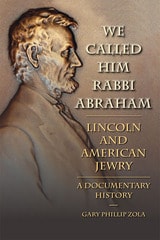
We Called Him Rabbi Abraham
Lincoln and American Jewry, a Documentary HistoryGary Phillip Zola
Southern Illinois University Press, 2014
Over the course of American history, Jews have held many American leaders in high esteem, but they maintain a unique emotional bond with Abraham Lincoln. From the time of his presidency to the present day, American Jews have persistently viewed Lincoln as one of their own, casting him as a Jewish sojourner and, in certain respects, a Jewish role model. This pioneering compendium— The first volume of annotated documents to focus on the history of Lincoln’s image, influence, and reputation among American Jews— considers how Lincoln acquired his exceptional status and how, over the past century and a half, this fascinating relationship has evolved.
Organized into twelve chronological and thematic chapters, these little-known primary source documents—many never before published and some translated into English for the first time—consist of newspaper clippings, journal articles, letters, poems, and sermons, and provide insight into a wide variety of issues relating to Lincoln’s Jewish connection. Topics include Lincoln’s early encounters with Central European Jewish immigrants living in the Old Northwest; Lincoln’s Jewish political allies; his encounters with Jews and the Jewish community as President; Lincoln’s response to the Jewish chaplain controversy; General U. S. Grant’s General Orders No. 11 expelling “Jews, as a class” from the Military Department of Tennessee; the question of amending the U.S. Constitution to legislate the country’s so-called Christian national character; and Jewish eulogies after Lincoln’s assassination. Other chapters consider the crisis of conscience that arose when President Andrew Johnson proclaimed a national day of mourning for Lincoln on the festival of Shavuot (the Feast of Weeks), a day when Jewish law enjoins Jews to rejoice and not to mourn; Lincoln’s Jewish detractors contrasted to his boosters; how American Jews have intentionally “Judaized” Lincoln ever since his death; the leading role that American Jews have played in in crafting Lincoln’s image and in preserving his memory for the American nation; American Jewish reflections on the question “What Would Lincoln Do?”; and how Lincoln, for America’s Jewish citizenry, became the avatar of America’s highest moral aspirations.
With thoughtful chapter introductions that provide readers with a context for the annotated documents that follow, this volume provides a fascinating chronicle of American Jewry’s unfolding historical encounter with the life and symbolic image of Abraham Lincoln, shedding light on how the cultural interchange between American ideals and Jewish traditions influences the dynamics of the American Jewish experience.
Finalist, 2014 National Jewish Book Award
Finalist, 2015 Ohioana Book Award
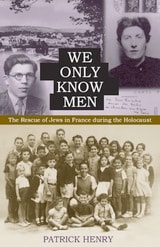
We Only Know Men
The Rescue of Jews in France during the HolocaustPatrick Henry
Catholic University of America Press, 2007
Wedding Song
Memoirs of an Iranian Jewish WomanFarideh Goldin
Brandeis University Press, 2004
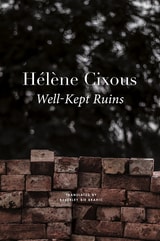
Well-Kept Ruins
Hélène Cixous
Seagull Books, 2022
In the Lower Saxony region of northwestern Germany sits the city of Osnabrück. This is where, in 1648, the Peace of Westphalia was signed, bringing the Thirty Years’ War and one of the most calamitous periods of European history to an end. But the city was later to witness another calamity.
Today, as one walks through Old Synagogue Street in a rich neighborhood of Osnabrück, one might miss noticing a pile of pale stones held together by chicken wire that sits between two fashionable homes. These are the well-kept ruins from behind which stares a gaping space—a place of memory and oblivion. Four polished plaques tell the tale of the horror-filled night of November 9, 1938—today known as Kristallnacht—when the synagogue that had stood on this spot was desecrated, looted, set on fire, and eventually demolished by Hitler’s forces. On the same day, ninety parishioners were imprisoned by the Gestapo and eventually sent to the Buchenwald concentration camp.
Osnabrück was also home to Eve Klein, a member of the city’s early-twentieth-century Jewish community and the mother of author Hélène Cixous. In Well-Kept Ruins, Cixous returns to the historic city in 2019 and reflects on the remains of the synagogue that “express the life lost, the life kept.” Walking the streets of the city, plumbing the depths of the past along with her own family’s history, looking deep into the future, and punctuating her poetic prose with haunting photographs, Cixous explores the ruins at the heart of humanity. Part memoir, part philosophical meditation, Well-Kept Ruins is a genre-defying and timely reflection of the contemporary human condition.
West Germany under Construction
Politics, Society, and Culture in the Adenauer EraRobert G. Moeller, Editor
University of Michigan Press, 1997
What History Tells
George L. Mosse and the Culture of Modern EuropeEdited by Stanley G. Payne, David J. Sorkin, and John S. Tortorice
University of Wisconsin Press, 2004
The contributors include Walter Laqueur, David Sabean, Johann Sommerville, Emilio Gentile, Roger Griffin, Saul Friedländer, Jay Winter, Rudy Koshar, Robert Nye, Janna Bourke, Shulamit Volkov, and Steven E. Aschheim.
White Boy
A MemoirMark D. Naison
Temple University Press, 2002

William & Rosalie
A Holocaust TestimonyWilliam Schiff
University of North Texas Press, 2007
Women, Jews and Muslims in the Texts of Reconquest Castile
Louise Mirrer
University of Michigan Press, 1996
This volume is the first in the field of medieval Hispanic studies to reexamine the canon in the light of recent critical work on language, gender, power, and the effects of domination. It shows how the texts imaginarily liberate Christian women from the authority of their husbands, in order to demonstrate how women's access to the discourses of power leads to tragedy and ruin for the men who fail to silence them.
Women, Jews, and Muslims in the Texts of Reconquest Castile makes the argument that dominant-"other" struggle, waged on the terrains of gender, religion, and war, is the most appropriate paradigm for discussing literary texts produced in the last centuries of reconquest. More than any other culture, medieval Spain reminds us of the provisional nature of national, religious, and sexual identity.
Exploring the gendering of subjects in society, the volume will be of interest to those in cultural and gender studies, Hispanic studies, medieval studies, and Middle Eastern studies. All texts are translated, and maps and illustrations help orient the reader.
Louise Mirrer is Professor and Chair, Department of Spanish and Portuguese, University of Minnesota.
Worship, Women and War
Essays in Honor of Susan NiditchJohn J. Collins
SBL Press, 2015
Celebrate the career of an inspirational scholar and teacher concerned with revealing voices from the margins
This volume of essays honors Susan Niditch, author of War in the Hebrew Bible: A Study in the Ethics of Violence (1993), “My Brother Esau Is a Hairy Man”: Hair and Identity in Ancient Israel (2008), and most recently, The Responsive Self: Personal Religion in Biblical Literature of the Neo-Babylonian and Persian Periods (forthcoming), among other influential publications. Essays touch on topics such as folklore, mythology, and oral history, Israelite religion, ancient Judaism, warfare, violence, and gender.
Features:
- Essays from nineteen scholars, all experts in their fields
- Exploration of texts from Mesopotamia, the Hebrew Bible, and the New Testament
- Bibliography of Niditch's scholarly contributions
Writing on Water
The Sounds of Jewish PrayerJudit Niran Frigyesi
Central European University Press, 2018
Writing on Water grasps the phenomenon of sound in prayer, that is, a meaning in sounds and soundscapes, and a musical essence in the act of praying.
The impetus for the book arose from the author’s fieldwork among traditional Jews during the era of communism in Budapest and Prague. In that period the Jewish religion and Jewishness in general were supressed and rituals became semi-secret and turned inward. The book is a witness to these communities and their rituals, but it goes beyond documentation. The uniqueness of the sounds of the rituals compelled the author to try to comprehend how melodies and soundscapes became the sustaining/protective environment, as well as the vehicle, for the expression of a world-orientation—in a situation where open discourse was inconceivable.
The book is based on extensive interviews, musical recordings, photographs and scholarly analyses. It is unique in its choice of communities, its wealth of original documents, and its novel interpretation of sound.
Writing on Water is creative non-fiction. The presentation is evocative and poetic, but at the same time it transmits knowledge. The book can aid research and serve in courses in philosophy, religion, music, ethnomusicology, anthropology, aesthetics, Jewish studies, folklore, oral history, and performance studies. It is also a work of art and literature.