187 books match the query 'Justice' and 8 start with w
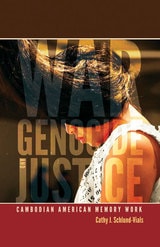
cover of War, Genocide, and Justice: Cambodian American Memory Work

War, Genocide, and Justice

Cambodian American Memory Work

Cathy J. Schlund-Vials

University of Minnesota Press, 2012

In the three years, eight months, and twenty days of the Khmer Rouge’s deadly reign over Cambodia, an estimated 1.7 million Cambodians perished as a result of forced labor, execution, starvation, and disease. Despite the passage of more than thirty years, two regime shifts, and a contested U.N. intervention, only one former Khmer Rouge official has been successfully tried and sentenced for crimes against humanity in an international court of law to date. It is against this background of war, genocide, and denied justice that Cathy J. Schlund-Vials explores the work of 1.5-generation Cambodian American artists and writers.

Drawing on what James Young labels “memory work”—the collected articulation of large-scale human loss—War, Genocide, and Justice investigates the remembrance work of Cambodian American cultural producers through film, memoir, and music. Schlund-Vials includes interviews with artists such as Anida Yoeu Ali, praCh Ly, Sambath Hy, and Socheata Poeuv. Alongside the enduring legacy of the Killing Fields and post-9/11 deportations of Cambodian American youth, artists potently reimagine alternative sites for memorialization, reclamation, and justice. Traversing borders, these artists generate forms of genocidal remembrance that combat amnesic politics and revise citizenship practices in the United States and Cambodia.

Engaged in politicized acts of resistance, individually produced and communally consumed, Cambodian American memory work represents a significant and previously unexamined site of Asian American critique.
[more]
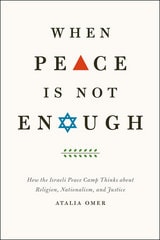
cover of When Peace Is Not Enough: How the Israeli Peace Camp Thinks about Religion, Nationalism, and Justice

When Peace Is Not Enough

How the Israeli Peace Camp Thinks about Religion, Nationalism, and Justice

Atalia Omer

University of Chicago Press, 2013
The state of Israel is often spoken of as a haven for the Jewish people, a place rooted in the story of a nation dispersed, wandering the earth in search of their homeland. Born in adversity but purportedly nurtured by liberal ideals, Israel has never known peace, experiencing instead a state of constant war that has divided its population along the stark and seemingly unbreachable lines of dissent around the relationship between unrestricted citizenship and Jewish identity.
 
By focusing on the perceptions and histories of Israel’s most marginalized stakeholders—Palestinian Israelis, Arab Jews, and non-Israeli Jews—Atalia Omer cuts to the heart of the Israeli-Arab conflict, demonstrating how these voices provide urgently needed resources for conflict analysis and peacebuilding. Navigating a complex set of arguments about ethnicity, boundaries, and peace, and offering a different approach to the renegotiation and reimagination of national identity and citizenship, Omer pushes the conversation beyond the bounds of the single narrative and toward a new and dynamic concept of justice—one that offers the prospect of building a lasting peace.

[more]
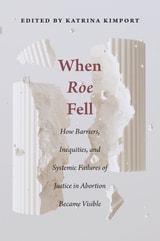
cover of When Roe Fell: How Barriers, Inequities, and Systemic Failures of Justice in Abortion Became Visible

When Roe Fell

How Barriers, Inequities, and Systemic Failures of Justice in Abortion Became Visible

Katrina Kimport

Rutgers University Press, 2026
When Roe Fell examines the history, politics, and practical experiences of abortion leading up to the overturning of Roe v. Wade, placing this judicial decision in a longer history of abortion in the United States. Contributors delve into what the end of Roe revealed about abortion seekers, abortion provision, and abortion advocacy, demystifying abortion and abortion research, laying bare common misunderstandings and misinformation, and belying claims that the fall of Roe "changed everything." Moving beyond legal frameworks, this volume is an opportunity to reorient scholarship and understanding about abortion, recognizing what was already true before Roe was overturned and how losing the protections of Roe forced, enabled, and perhaps even facilitated a new era of abortion.
[more]
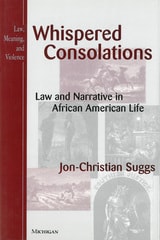
cover of Whispered Consolations: Law and Narrative in African American Life

Whispered Consolations

Law and Narrative in African American Life

Jon-Christian Suggs

University of Michigan Press, 2000
African Americans have experienced life under the rule of law in quite different contexts from those of whites, and they have written about those differences in poems, songs, stories, autobiographies, novels, and memoirs. This book examines the tradition of American law as it appears in African American literary life, from pre-Revolutionary murder trials to gangsta rap. The experience, and the critique it produces, changes our pictures of both American law and African American literature.
This study reads the already canonical works of nineteenth- and twentieth-century black literature in the context of their responses to and critiques of American legal history. At the same time, it examines little known texts of African American life, from the urban humor of James D. Corrothers, through the early political essays of Chester Himes, to the adventures of black comic book heroes like Steel, Wise Son, and Xero. These are contextualized within specific legislation and case law, from the slave laws of early Virginia to the Civil Rights Act of 1964, from the case of Phillis and Mark in 1755 to the Simpson trials of the mid 1990s.
Finally, the legal texts presented are themselves critiqued by the fictions and legal analyses of the African Americans who lived out their implications in their daily lives. Through a positing of the legal and cultural concepts of privacy, property, identity, desire and citizenship, and the romantic ideals of authenticity, irony, and innocence, Suggs is able to show how our understanding of American law should be influenced by African American conceptions of it as depicted through literature.
This book will appeal to students and scholars of literary and cultural studies, law and literature, American history, as well as to scholars of African American literature and culture.
Jon-Christian Suggs is Professor of English, John Jay College, City University of New York.
[more]
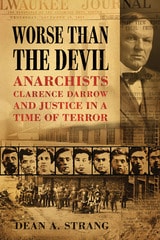
cover of Worse than the Devil: Anarchists, Clarence Darrow, and Justice in a Time of Terror

Worse than the Devil

Anarchists, Clarence Darrow, and Justice in a Time of Terror

Dean A. Strang

University of Wisconsin Press, 2013

In 1917 a bomb exploded in a Milwaukee police station, killing nine officers and a civilian. Those responsible never were apprehended, but police, press, and public all assumed that the perpetrators were Italian. Days later, eleven alleged Italian anarchists went to trial on unrelated charges involving a fracas that had occurred two months before. Against the backdrop of World War I, and amidst a prevailing hatred and fear of radical immigrants, the Italians had an unfair trial. The specter of the larger, uncharged crime of the bombing haunted the proceedings and assured convictions of all eleven. Although Clarence Darrow led an appeal that gained freedom for most of the convicted, the celebrated lawyer's methods themselves were deeply suspect. The entire case left a dark, if hidden, stain on American justice.

Largely overlooked for almost a century, the compelling story of this case emerges vividly in this meticulously researched book by Dean A. Strang. In its focus on a moment when patriotism, nativism, and terror swept the nation, Worse than the Devil exposes broad concerns that persist even today as the United States continues to struggle with administering criminal justice to newcomers and outsiders.
[more]
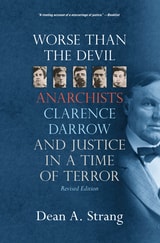
cover of Worse than the Devil: Anarchists, Clarence Darrow, and Justice in a Time of Terror

Worse than the Devil

Anarchists, Clarence Darrow, and Justice in a Time of Terror

Dean A. Strang

University of Wisconsin Press, 2016
In 1917 a bomb exploded in a Milwaukee police station, killing nine officers and a civilian. Days later, a trial began for eleven Italian immigrants who had already been in jail for months for an unrelated riot. The specter of the bombing, for which no one had been arrested, haunted the proceedings. Against the backdrop of World War I and amid a prevailing hatred and fear of radical immigrants and anarchists, the Italians had an unfair trial. Famed attorney Clarence Darrow led an appeal that gained freedom for most of the convicted, but his own methods were deeply suspect. The entire case left a dark, though largely forgotten, stain on American justice.
[more]
cover of Wrong-Doing, Truth-Telling: The Function of Avowal in Justice

Wrong-Doing, Truth-Telling

The Function of Avowal in Justice

Michel Foucault

University of Chicago Press, 2014

Three years before his death, Michel Foucault delivered a series of lectures at the Catholic University of Louvain that until recently remained almost unknown. These lectures—which focus on the role of avowal, or confession, in the determination of truth and justice—provide the missing link between Foucault’s early work on madness, delinquency, and sexuality and his later explorations of subjectivity in Greek and Roman antiquity.
Ranging broadly from Homer to the twentieth century, Foucault traces the early use of truth-telling in ancient Greece and follows it through to practices of self-examination in monastic times. By the nineteenth century, the avowal of wrongdoing was no longer sufficient to satisfy the call for justice; there remained the question of who the “criminal” was and what formative factors contributed to his wrong-doing. The call for psychiatric expertise marked the birth of the discipline of psychiatry in the nineteenth and twentieth centuries as well as its widespread recognition as the foundation of criminology and modern criminal justice.
 
Published here for the first time, the 1981 lectures have been superbly translated by Stephen W. Sawyer and expertly edited and extensively annotated by Fabienne Brion and Bernard E. Harcourt. They are accompanied by two contemporaneous interviews with Foucault in which he elaborates on a number of the key themes. An essential companion to Discipline and Punish, Wrong-Doing, Truth-Telling will take its place as one of the most significant works of Foucault to appear in decades, and will be necessary reading for all those interested in his thought.
[more]
cover of Wrongful Conviction: International Perspectives on Miscarriages of Justice

Wrongful Conviction

International Perspectives on Miscarriages of Justice

edited by C. Ronald Huff and Martin Killias

Temple University Press, 2009

Imperfections in the criminal justice system have long intrigued the general public and worried scholars and legal practitioners. In Wrongful Conviction, criminologists C. Ronald Huff and Martin Killias present an important collection of essays that analyzes cases of injustice across an array of legal systems, with contributors from North America, Europe and Israel. This collection includes a number of well-developed public-policy recommendations intended to reduce the instances of courts punishing innocents. It also offers suggestions for compensating more fairly those who are wrongfully convicted.

[more]