Results by title
74 books match the query 'Kenya' and 5 start with w
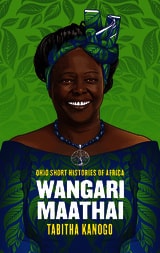
Wangari Maathai
Tabitha Kanogo
Ohio University Press, 2020
Wangari Muta Maathai is one of Africa’s most celebrated female activists. Originally trained as a scientist in Kenya and abroad, Professor Maathai returned to her home country of Kenya with a renewed political consciousness. There, she began her long career as an activist, campaigning for environmental and social justice while speaking out against government corruption. In 2004, Maathai was awarded the Nobel Peace Prize for her leadership of the Green Belt Movement, a conservation effort that resulted in the restoration of African forests decimated during the colonial era.
In this biography, Tabitha Kanogo follows Wangari Maathai from her modest, rural Kenyan upbringing to her rise as a national figure campaigning for environmental and ecological conservation, sustainable development, democracy, human rights, gender equality, and the eradication of poverty until her death in 2011.
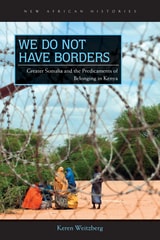
We Do Not Have Borders
Greater Somalia and the Predicaments of Belonging in KenyaKeren Weitzberg
Ohio University Press, 2017
Though often associated with foreigners and refugees, many Somalis have lived in Kenya for generations, in many cases since long before the founding of the country. Despite their long residency, foreign and state officials and Kenyan citizens often perceive the Somali population to be a dangerous and alien presence in the country, and charges of civil and human rights abuses have mounted against them in recent years.
In We Do Not Have Borders, Keren Weitzberg examines the historical factors that led to this state of affairs. In the process, she challenges many of the most fundamental analytical categories, such as “tribe,” “race,” and “nation,” that have traditionally shaped African historiography. Her interest in the ways in which Somali representations of the past and the present inform one another places her research at the intersection of the disciplines of history, political science, and anthropology.
Given tragic events in Kenya and the controversy surrounding al-Shabaab, We Do Not Have Borders has enormous historical and contemporary significance, and provides unique inroads into debates over globalization, African sovereignty, the resurgence of religion, and the multiple meanings of being African.
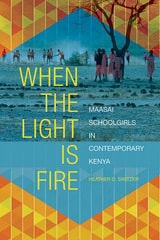
When the Light Is Fire
Maasai Schoolgirls in Contemporary KenyaHeather D. Switzer
University of Illinois Press, 2018
Heather D. Switzer's interviews with over one hundred Kenyan Maasai schoolgirls challenge the widespread view of education as a silver bullet solution to global poverty. In their own voices, the girls offer incisive insights into their commitments, aspirations, and desires. Switzer weaves this ethnographic material into an astute analysis of historical literature, education and development documents, and theoretical literature. Maasai schoolgirls express a particular knowledge about themselves and provocative hopes for their futures. Yet, as Switzer shows, new opportunities force them to face, and navigate, new vulnerabilities and insecurities within a society that is itself in flux.
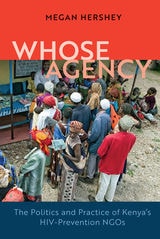
Whose Agency
The Politics and Practice of Kenya's HIV-Prevention NGOsMegan Hershey
University of Wisconsin Press, 2019
By focusing on one particular type of NGO—those organized to help prevent the spread and transmission of HIV in Kenya—Megan Hershey interrogates the ways these organizations achieve (or fail to achieve) their planned outcomes. Along the way, she examines the slippery slope that is often used to define “success” based on meeting donor-set goals versus locally identified needs. She also explores the complex network of bureaucratic requirements at both the national and local levels that affect the delicate relationships NGOs have with the state. Drawing on extensive, original quantitative and qualitative research, Whose Agency serves as a much-needed case study for understanding the strengths and shortcomings of participatory development and community engagement.
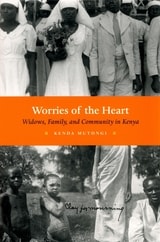
Worries of the Heart
Widows, Family, and Community in KenyaKenda Mutongi
University of Chicago Press, 2007
Throughout the twentieth century and into the twenty-first, rates of widowhood have been remarkably high in Kenya. Yet despite their numbers, widows and their families exist at the margins of society, and their lives act as a barometer for the harsh realities of rural Kenya. Mutongi here argues that widows survive by publicly airing their social, economic, and political problems, their “worries of the heart.” Initially aimed at the men in their community, and then their colonial rulers, this strategy changed after independence as widows increasingly invoked the language of citizenship to demand their rights from the new leaders of Kenya—leaders whose failure to meet the needs of ordinary citizens has led to deep disenchantment and altered Kenyans’ view of their colonial past. An innovative blend of ethnography and historical research, Worries of the Heart is a poignant narrative rich with insights into postcolonial Africa.