Results by title
301 books match the query 'Knowledge' and 14 start with w
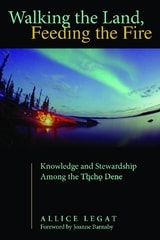
Walking the Land, Feeding the Fire
Knowledge and Stewardship Among the Tlicho DeneBy Allice Legat; Foreword by Joanne Barnaby
University of Arizona Press, 2012
In the Dene worldview, relationships form the foundation of a distinct way of knowing. For the Tlicho Dene, indigenous peoples of Canada's Northwest Territories, as stories from the past unfold as experiences in the present, so unfolds a philosophy for the future. Walking the Land, Feeding the Fire vividly shows how—through stories and relationships with all beings—Tlicho knowledge is produced and rooted in the land.
Tlicho-speaking people are part of the more widespread Athapaskan-speaking community, which spans the western sub-arctic and includes pockets in British Columbia, Alberta, California, and Arizona. Anthropologist Allice Legat undertook this work at the request of Tlicho Dene community elders, who wanted to provide younger Tlicho with narratives that originated in the past but provide a way of thinking through current critical land-use issues. Legat illustrates that, for the Tlicho Dene, being knowledgeable and being of the land are one and the same.
Walking the Land, Feeding the Fire marks the beginning of a new era of understanding, drawing both connections to and unique aspects of ways of knowing among other Dene peoples, such as the Western Apache. As Keith Basso did with his studies among the Western Apache in earlier decades, Legat sets a new standard for research by presenting Dene perceptions of the environment and the personal truths of the storytellers without forcing them into scientific or public-policy frameworks. Legat approaches her work as a community partner—providing a powerful methodology that will impact the way research is conducted for decades to come—and provides unique insights and understandings available only through traditional knowledge.

Wallace Stevens And The Apocalyptic Mode
Woodland, Malcolm
University of Iowa Press, 2005
This study begins with an examination of the textual and generic issues surrounding apocalypse, culminating in the idea of apocalyptic language as a form of “discursive mastery” over the mayhem of events. Woodland provides an informative religious/historical discussion of apocalypse and, engaging with such critics as Parker, Derrida, and Fowler, sets forth the paradoxes and complexities that eventually challenge any clear dualities between apocalyptic and antiapocalyptic thinking.
Woodland then examines some of Stevens’s wartime essays and poems and describes Stevens’s efforts to salvage a sense of self and poetic vitality in a time of war, as well as his resistance to the possibility of cultural collapse. Woodland discusses the major postwar poems “Credences of Summer” and “The Auroras of Autumn” in separate chapters, examining the interaction of (anti)apocalyptic modes with, respectively, pastoral and elegy.
The final chapter offers a perspective on Stevens’s place in literary history by examining the work of a contemporary poet, Jorie Graham, whose poetry quotes from Stevens’s oeuvre and shows other marks of his influence. Woodland focuses on Graham's 1997 collection The Errancy and shows that her antiapocalyptic poetry involves a very different attitude toward the possibility of a radical break with a particular cultural or aesthetic stance.
Wallace Stevens and the Apocalyptic Mode, offering a new understanding of Stevens’s position in literary history, will greatly interest literary scholars and students.
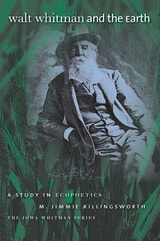
Walt Whitman and the Earth
A Study of EcopoeticsM. Jimmie Killingsworth
University of Iowa Press, 2005
It grows such sweet things out of such corruptions,
It turns harmless and stainless on its axis, with such endless successions of diseas’d corpses,
It distills such exquisite winds out of such infused fetor,
It renews with such unwitting looks its prodigal, annual, sumptuous crops,
It gives such divine materials to men, and accepts such leavings from them at last.
—Walt Whitman, from “This Compost”
Western Law, Russian Justice
Dostoevsky, the Jury Trial, and the LawGary Rosenshield
University of Wisconsin Press, 2005
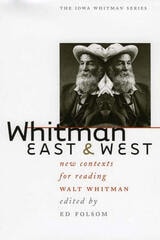
Whitman East and West
New Contexts for Reading Walt WhitmanEd Folsom
University of Iowa Press, 2002
Confirming the growing international spirit of American studies, the essays in Whitman East and West developed out of a landmark conference in Beijing, the first major conference in China to focus on an American poet. Scholars from Asia, Europe, and North America set out to track the ways in which Whitman's poetry has become part of China's cultural landscape as well as the literary landscapes of other countries. By describing his assimilation into other cultures and his resulting transformation into a hybrid poet, these essayists celebrate Whitman's multiple manifestations in other languages and contexts.
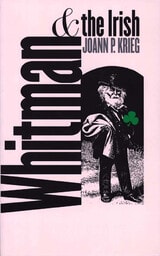
Whitman and the Irish
Joann P. Krieg
University of Iowa Press, 2000
Though Walt Whitman created no Irish characters in his early works of fiction, he did include the Irish as part of the democratic portrait of America that he drew in Leaves of Grass. He could hardly have done otherwise. In 1855, when the first edition of Leaves of Grass was published, the Irish made up one of the largest immigrant populations in New York City and, as such, maintained a cultural identity of their own. All of this “Irishness” swirled about Whitman as he trod the streets of his Mannahatta, ultimately becoming part of him and his poetry. As members of the working class, famous authors, or close friends, the Irish left their mark on Whitman the man and poet. In Whitman and the Irish, Joann Krieg convincingly establishes their importance within the larger framework of Whitman studies.
Focusing on geography rather than biography, Krieg traces Whitman's encounters with cities where the Irish formed a large portion of the population—New York City, Boston, Camden, and Dublin—or where, as in the case of Washington, D.C., he had exceptionally close Irish friends. She also provides a brief yet important historical summary of Ireland and its relationship with America.
Whitman and the Irish does more than examine Whitman's Irish friends and acquaintances: it adds a valuable dimension to our understanding of his personal world and explores a number of vital questions in social and cultural history. Krieg places Whitman in relation to the emerging labor culture of ante-bellum New York, reveals the relationship between Whitman's cultural nationalism and the Irish nationalism of the late nineteenth century, and reflects upon Whitman's involvement with the Union cause and that of Irish American soldiers.
Whose India?
The Independence Struggle in British and Indian Fiction and HistoryTeresa Hubel
Duke University Press, 1996
Hubel collapses the boundary between literature and history by emphasizing the selected nature of the “facts” that comprise historical texts, and by demonstrating the historicity of fiction. In analyzing the orthodox construction of the British/Indian encounter, Hubel calls into question assumptions about the end of nationalism implicit in mainstream histories and fiction, which generally describe a battleground on which only ruling-class Indians and British meet. Marginalized texts by women, untouchables, and overt imperialists alike are, therefore, examined alongside the well-known work of figures such as Rudyard Kipling, Jawaharlal Nehru, E. M. Forster, and Mahatma Gandhi.
In Whose India? discursive ownership and resistance to ownership are mutually constructing categories. As a result, the account of Indian nationalism and British imperialism that emerges is much more complicated, multivocal, and even more contradictory than previous studies have imagined. Of interest to students and scholars engaged in literary, historical, colonial/postcolonial, subaltern, and Indian studies, Whose India? will also attract readers concerned with gender issues and the canonization of texts.
Wild Intelligence
Poets' Libraries and the Politics of Knowledge in Postwar AmericaM. C. Kinniburgh
University of Massachusetts Press, 2022
Information science was a burgeoning field in the early years of the Cold War, and while public and academic libraries acted as significant sites for the information boom, it is unsurprising that McCarthyism and censorship would shape what they granted readers access to and acquired. Wild Intelligence traces a different history of information management, examining the privately assembled collections of poets and their knowledge-building practices at midcentury.
Taking up case studies of four poets who began writing during the 1950s and 1960s, including Charles Olson (1910–1970), Diane di Prima (1934–2020), Gerrit Lansing (1928–2018), and Audre Lorde (1934–1992), M. C. Kinniburgh shows that the postwar American poet’s library should not just be understood according to individual books within their collection but rather as an archival resource that reveals how poets managed knowledge in a growing era of information overload. Exploring traditions and systems that had been overlooked, buried, occulted, or censored, these poets sought to recover a sense of history and chart a way forward.
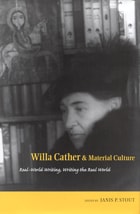
Willa Cather and Material Culture
Real-World Writing, Writing the Real WorldEdited by Janis P. Stout
University of Alabama Press, 2004
Willa Cather and Material Culture is a collection of 11 new essays that tap into a recent and resurgent interest among Cather scholars in addressing her work and her career through the lens of cultural studies. One of the volume's primary purposes is to demonstrate the extent to which Cather did participate in her culture and to correct the commonplace view of her as a literary connoisseur set apart from her times.
The contributors explore both the objects among which Cather lived and the objects that appear in her writings, as well as the commercial constraints of the publishing industry in which her art was made and marketed. Essays address her relationship to quilts both personally and as symbols in her work; her contributions to domestic magazines such as Home Monthly and Woman's Home Companion; the problematic nature of Hollywood productions of her work; and her efforts and successes as a businesswoman. By establishing the centrality of material matters to her writing, these essays contribute to the reclaiming of Cather as a modernist and highlight the significance of material culture, in general, to the study of American literature.
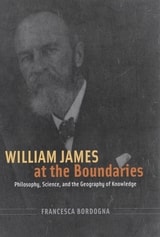
William James at the Boundaries
Philosophy, Science, and the Geography of KnowledgeFrancesca Bordogna
University of Chicago Press, 2008
What was the goal of this unusual speech? Rather than an oddity, Francesca Bordogna asserts that the APA address was emblematic—it was just one of many gestures that James employed as he plowed through the barriers between academic, popular, and pseudoscience, as well as the newly emergent borders between the study of philosophy, psychology, and the “science of man.” Bordogna reveals that James’s trespassing of boundaries was an essential element of a broader intellectual and social project. By crisscrossing divides, she argues, James imagined a new social configuration of knowledge, a better society, and a new vision of the human self. As the academy moves toward an increasingly interdisciplinary future, William James at the Boundaries reintroduces readers to a seminal influence on the way knowledge is pursued.
Women and Knowledge in Mesoamerica
From East L.A. to AnahuacPaloma Martinez-Cruz
University of Arizona Press, 2011
The few works looking at the knowledge of women in Mesoamerica generally examine only the written—even academic—world, accessible only to the most elite segments of (customarily male) society. These works have consistently excluded the essential repertoire and performed knowledge of women who think and work in ways other than the textual. And while two of the book’s chapters critique contemporary novels, Martinez-Cruz also calls for the exploration of non-textual knowledge transmission. In this regard, the book's goals and methods are close to those of performance scholarship and anthropology, and these methods reveal Mesoamerican women to be public intellectuals. In Women and Knowledge in Mesoamerica, fieldwork and ethnography combine to reveal women healers as models of agency.
Her multidisciplinary approach allows Martinez-Cruz to disrupt Euro-based intellectual hegemony and to make a case for the epistemic authority of Native women. Written from a Chicana perspective, this study is learned, personal, and engaging for anyone who is interested in the wisdom that prevailing analytical cultures have deemed “unintelligible.” As it turns out, those who are unacquainted with the sometimes surprising extent and depth of wisdom of indigenous women healers simply haven’t been looking in the right places—outside the texts from which they have been consistently excluded.

Wordsworth and the Green Romantics
Affect and Ecology in the Nineteenth CenturyLisa Ottum
University of New Hampshire Press, 2016
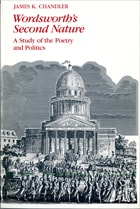
Wordsworth's Second Nature
A Study of the Poetry and PoliticsJames Chandler
University of Chicago Press, 1984
Central to the discussion, which restores Wordsworth to both the French and English contexts in which he matured, is a consideration of his relation to Rousseau and Burke. Chandler maintains that by the time Wordsworth set forth his "program for poetry" in 1798, he had turned away from the Rousseauist idea of nature that had informed his early republican writings. He had already become a poet of what Burke called "second nature"–human nature cultivated by custom, habit, and tradition–and an opponent of the quest for first principles that his friend Coleridge could not forsake. In his analysis of the poetry, Chandler suggests that even Wordsworth's most apparently private moments, the lyrical "spots of time," ideologically embodied the uncalculated habits of an oral narrative discipline and a native English mind.

Writing Beijing
History and Knowledge of the CapitalNaixi Feng
University of Michigan Press, 2027
Writing Beijing offers a comprehensive study of the textual representations of the city from the late Ming dynasty through the Republican era, interrogating how urban narratives were actively constructed, adapted, and repurposed across periods of political transformation. Scholars, officials, and travelers reshaped the capital’s identity by rewriting older texts, borrowing new surveys, and even inserting critiques into guidebooks.. This study reveals how the crises brought by intense social transformation, including dynastic collapse and foreign invasion, forced writers to reinvent Beijing on paper. Some turned the city into a monument to lost glory; others documented everyday life to resist imperialism. These narratives served to critique contemporary sociopolitical conditions, assert cultural legitimacy during times of crisis, and ultimately shape Beijing’s enduring cultural image as China’s symbolic capital.
Naixi Feng bridges literary studies, urban history, and critical historiography by examining a wide range of genres—including literary miscellanies, local gazetteers, Qing imperial compilations, Republican textbooks, social reports, and travel guides—to demonstrate how writing about Beijing was never merely descriptive but always a site of cultural and political contestation.