Results by title
936 books match the query 'LGBTQ+ Studies' and 32 start with w
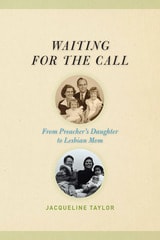
Waiting for the Call
From Preacher's Daughter to Lesbian MomJacqueline Taylor
University of Michigan Press, 2007
“Well-written, absorbing, and a great pleasure to read . . . will appeal to Christians struggling to square their traditional beliefs with acceptance of homosexuality as well as to all those interested in adoption, lesbian marriage, and the changing shape of America’s families.”
—Elizabeth C. Fine, Virginia Tech University
Waiting for the Call takes readers from the foothills of the Appalachians—where Jacqueline Taylor was brought up in a strict evangelical household—to contemporary Chicago, where she and her lesbian partner are raising a family. In a voice by turns comic and loving, Taylor recounts the amazing journey that took her in profoundly different directions from those she or her parents could have ever envisioned.
Taylor’s father was a Southern Baptist preacher, and she struggled to deal with his strictures as well as her mother’s manic-depressive episodes. After leaving for college, Taylor finds herself questioning her faith and identity, questions that continue to mount when—after two divorces, a doctoral degree, and her first kiss with a woman—she discovers her own lesbianism and begins a most untraditional family that grows to include two adopted children from Peru.
Even as she celebrates and cherishes this new family, Taylor insists on the possibility of maintaining a loving connection to her religious roots. While she and her partner search for the best way to explain adoption to their children and answer the inevitable question, “Which one is your mom?” they also seek out a church that will unite their love of family and their faith. Told in the great storytelling tradition of the American South, full of deep feeling and wry humor, Waiting for the Call engagingly demonstrates how one woman bridged the gulf between faith and sexual identity without abandoning her principles.
We Are Having This Conversation Now
The Times of AIDS Cultural ProductionAlexandra Juhasz and Theodore Kerr
Duke University Press, 2022
We Can Do Better
Feminist Manifestos for Media and CommunicationLinda Steiner
Rutgers University Press, 2025
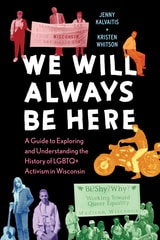
We Will Always Be Here
A Guide to Exploring and Understanding the History of LGBTQ+ Activism in WisconsinJenny Kalvaitis
Wisconsin Historical Society Press, 2021
We Will Always Be Here shines a light on powerful and often untold stories from Wisconsin’s history, featuring individuals across a wide spectrum of identities and from all corners of the state. The LGBTQ+ people, allies, and activists in this guide changed the world by taking steps that young people can take today—by educating themselves, telling their own stories, being true to themselves, building communities, and getting active. The aim of this celebratory book is not only to engage young people in Wisconsin’s LGBTQ+ history, but also to empower them to make positive change in the world.
We've Been Here All Along
Wisconsin's Early Gay HistoryR. Richard Wagner
Wisconsin Historical Society Press, 2020
In We’ve Been Here All Along, R. Richard Wagner draws on historical research and materials from his own extensive archive to uncover previously hidden stories of gay Wisconsinites. This book honors their legacy and confirms that they have been foundational to the development and evolution of the state since its earliest days
Wendy Wasserstein
Jill Dolan
University of Michigan Press, 2017
Wendy Wasserstein provides a critical introduction and a feminist reappraisal of the significant plays of one of the most famous contemporary American women playwrights. Following a biographical introduction, chapters address each of her important plays, situating Wasserstein’s work in the history of the US feminist movement and in a historical moment in which women artists continue to struggle for recognition.
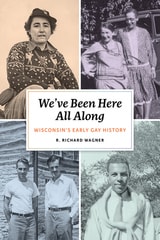
We’ve Been Here All Along
Wisconsin’s Early Gay HistoryR. Richard Wagner
Wisconsin Historical Society Press, 2019
In We’ve Been Here All Along, R. Richard Wagner draws on historical research and materials from his own extensive archive to uncover previously hidden stories of gay Wisconsinites. This book honors their legacy and confirms that they have been foundational to the development and evolution of the state since its earliest days
What Do Gay Men Want?
An Essay on Sex, Risk, and SubjectivityDavid M. Halperin
University of Michigan Press, 2010
“Compelling, timely, and provocative. The writing is sleek and exhilarating. It doesn’t waste time telling us what it will do or what it has just done—it just does it.”
—Don Kulick, Professor of Anthropology, New York University
How we can talk about sex and risk in the age of barebacking—or condomless sex—without invoking the usual bogus and punitive clichés about gay men’s alleged low self-esteem, lack of self-control, and other psychological “deficits”? Are there queer alternatives to psychology for thinking about the inner life of homosexuality? What Do Gay Men Want? explores some of the possibilities.
Unlike most writers on the topic of gay men and risky sex, David Halperin liberates gay male subjectivity from psychology, demonstrating the insidious ways in which psychology’s defining opposition between the normal and the pathological subjects homosexuality to medical reasoning and revives a whole set of unexamined moral assumptions about “good” sex and “bad” sex.
In particular, Halperin champions neglected traditions of queer thought, including both literary and popular discourses, by drawing on the work of well-known figures like Jean Genet and neglected ones like Marcel Jouhandeau. He shows how the long history of of gay men’s uses of “abjection” can offer an alternative, nonmoralistic model for thinking about gay male subjectivity, something which is urgently needed in the age of barebacking.
Anyone searching for nondisciplinary ways to slow the spread of HIV/AIDS among gay men—or interested in new modes of thinking about gay male subjectivity—should read this book.
David M. Halperin is W. H. Auden Collegiate Professor of the History and Theory of Sexuality, Professor of English, Professor of Women’s Studies, Professor of Comparative Literature, and Adjunct Professor of Classical Studies at the University of Michigan.

What's Queer about Queer Studies Now?, Volume 23
David L. Eng, Judith Halberstam and José Esteban Muñoz
Duke University Press, 0
In sixteen timely essays, the contributors map out an urgent intellectual and political terrain for queer studies and the contemporary politics of identity, family, and kinship. Collectively, these essays examine the limits of queer epistemology, the potentials of queer diasporas, and the emergence of queer liberalism. They rethink queer critique in relation to the war on terrorism and the escalation of U.S. imperialism; the devolution of civil rights and the rise of the prison-industrial complex; the continued dismantling of the welfare state; the recoding of freedom in terms of secularization, domesticity, and marriage; and the politics of citizenship, migration, and asylum in a putatively postracial and postidentity age.
Contributors. Michael Cobb, David L. Eng, Roderick A. Ferguson, Elizabeth Freeman, Gayatri Gopinath, Judith Halberstam, Janet R. Jakobsen, Joon Oluchi Lee, Martin F. Manalansan IV, José Esteban Muñoz, Tavia Nyong’o, Hiram Perez, Jasbir K. Puar, Chandan Reddy, Teemu Ruskola, Nayan Shah, Karen Tongson, Amy Villarejo
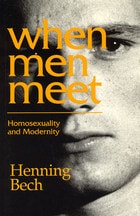
When Men Meet
Homosexuality and ModernityHenning Bech
University of Chicago Press, 1997
Gay society has persevered, even flourished, in this highly charged urban environment, aestheticizing and sexualizing the spaces, both public and private, where men meet. With profound insight and honesty, Bech details this world, candidly reflecting on sex, friendship, love, and life as manifest in the homosexual form of existence. He convincingly demonstrates that, in the face of modern alienation, successful coping strategies developed by gay men are gradually being adopted by mainstream heterosexual society.
These adaptations are often masked by what Bech calls an "absent homosexuality, " in which sublimated themes of homosexuality and masculine love surface, only to be disavowed in expressions of social anxiety. This "absent homosexuality" acts as a kind of cultural filter, allowing key traits of gay life to be absorbed by the mainstream, while shielding heterosexual males from their own homophobic anxieties. Ultimately, Bech foresees, a postmodern convergence of hetero- and homosexual forms of exisce emergent from this urban landscape and, with it, a new masculine synthesis.
Certain to ignite immediate controversy, When Men Meet offers both a penetrating scholarly analysis of the modern homosexual condition and an unflinching cultural vision of the masculine in transition.

When Monsters Speak
A Susan Stryker ReaderSusan Stryker. Edited by McKenzie Wark
Duke University Press, 2024

Which Team Are You On?
Visibility and Gender Dissidence in Brazilian SoccerC. K. Snyder
University of Texas Press, 0
Examines how Brazilian soccer’s trailblazers—women, gay men, and trans players—leverage their visibility to fight marginalization and advance gender justice.
In Brazil, national identity is tightly bound up with soccer. In turn, soccer leaves a masculinist and heteronormative mark on what it means to be Brazilian. After all, for much of the twentieth century, the law deemed futbol “incompatible with female nature,” and women were banned from participating. Though the prohibition was lifted in 1979, the national soccer culture continued to serve the reproduction of a gendered society.
Which Team Are You On? develops theoretical and ethnographic insights into the struggle of dissident athletes for recognition and redistribution. By tracing three groundbreaking "firsts"—pioneer women Olympians, the national LGBTQ+ league (LiGay), and Brazil’s first trans team, the Meninos Bons de Bola—C. K. Snyder examines the athletes’ “visibility dilemma,” in which being seen is essential for legitimacy as futebolistas yet dangerously exposes players to violence and backlash. Snyder argues that, today, soccer is a key battleground for gender justice in Brazil, as a surging reactionary movement lays claim to the nation’s proud sporting heritage, placing women, gay, and trans athletes at even greater risk. To fight back, they take to the pitch, continuing to demand not only respect but also a place in the life of their country.
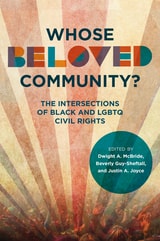
Whose Beloved Community?
The Intersections of Black and LGBTQ Civil RightsEdited by Dwight A. McBride, Beverly Guy-Sheftall, and Justin A. Joyce
University of Illinois Press, 2026
Martin Luther King Jr.’s idea of “the beloved community” focused on the hoped-for new relationship between the oppressor and the oppressed after the success of a nonviolent movement. But the vision excluded, and sometimes still excludes, LGBTQIA+ people and Black women.
The editors curate essays that see beloved community as a generative space that centers justice. Taking inspiration from the radical moral vision of figures like Bayard Rustin and Audre Lorde, the contributors look at how Black queer, feminist, and trans thought and practice can cultivate belonging across lines of race, gender, sexuality, class, and region. Essayists use a variety of disciplinary and methodological perspectives that includes archival recovery, institutional critique, cultural analysis, ethnography, and political theory. The contributors define beloved community for themselves while offering entry points—through art, culture, activism, policy, pedagogy, and theory—for exploring what it means to belong, to resist, and to build.
Expansive and interdisciplinary, <i>Whose Beloved Community?</i> begins the process of advancing toward truly inclusive communities that are more honest, more complex, and more loving.
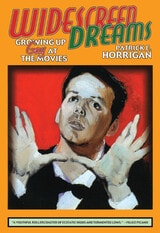
Widescreen Dreams
Growing Up Gay at the MoviesPatrick E. Horrigan
University of Wisconsin Press, 2001

Wild Man
Tobias Schneebaum
University of Wisconsin Press, 2003
Part autobiographical journal, part social-historical novel, Wild Man tracks Tobias Schneebaum's fascinating and almost epic life story, from his earliest contemplation of homoerotic desire through his life in Peru, Borneo, and beyond. A young man from New York, Schneebaum "disappeared" in 1955 on the eastern slopes of the Andes. He was, in actuality, living for more than a year among the remote Harakhambut people, discovering a way of being that was strange, primitive, and powerfully attractive to him. This longing to find the "wild man" in other cultures—and in himself—eventually led him on an odyssey through South America, India, Tibet, Africa, Borneo, New Guinea, and Southeast Asia. He lived among isolated forest peoples, including headhunters and cannibals, in regions where few, if any, white men had ever been.
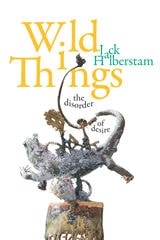
Wild Things
The Disorder of DesireJack Halberstam
Duke University Press, 2020

Wildness
Jack Halberstam and Tavia Nyong'o, special issue editors
Duke University Press, 2018
Contributors: Vanessa Agard-Jones, Jayna Brown, Jodi A. Byrd, Mel Y. Chen, Jack Halberstam, Saidiya Hartman, Lamonda Horton-Stallings, Zakkiyyah Jackson, Martin F. Manalansan IV, Fred Moten, José E. Muñoz, Tavia Nyong’o, Julietta Singh, Riley Snorton, Wu Tsang, Dinesh Wadiwei
Winning Marriage
The Inside Story of How Same-Sex Couples Took on the Politicians and Pundits—and WonMarc Solomon
University Press of New England, 2014
Winning Marriage
The Inside Story of How Same-Sex Couples Took on the Politicians and Pundits—and WonMarc Solomon
University Press of New England, 2015
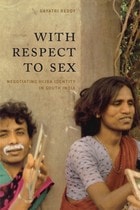
With Respect to Sex
Negotiating Hijra Identity in South IndiaGayatri Reddy
University of Chicago Press, 2005
Hijras are men who sacrifice their genitalia to a goddess in return for the power to confer fertility on newlyweds and newborn children, a ritual role they are respected for, at the same time as they are stigmatized for their ambiguous sexuality. By focusing on the hijra community, Gayatri Reddy sheds new light on Indian society and the intricate negotiations of identity across various domains of everyday life. Further, by reframing hijra identity through the local economy of respect, this ethnography highlights the complex relationships among local and global, sexual and moral, economies.
This book will be regarded as the definitive work on hijras, one that will be of enormous interest to anthropologists, students of South Asian culture, and specialists in the study of gender and sexuality.

Women Reading Women Writing
Ann Louise Keating
Temple University Press, 1996
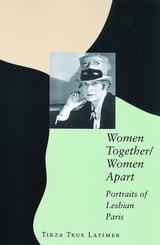
Women Together/Women Apart
Portraits of Lesbian ParisLatimer, Tirza True
Rutgers University Press, 2005
What does it mean to look like a lesbian? Though it remains impossible to conjure a definitive image that captures the breadth of this highly nuanced term, today at least we are able to consider an array of visual representations that have been put into circulation by lesbians themselves over the last six or seven decades. In the early twentieth century, though, no notion of lesbianism as a coherent social or cultural identity yet existed.
In Women Together/Women Apart, Tirza True Latimer explores the revolutionary period between World War I and World War II when lesbian artists working in Paris began to shape the first visual models that gave lesbians a collective sense of identity and allowed them to recognize each other. Flocking to Paris from around the world, artists and performers such as Romaine Brooks, Claude Cahun, Marcel Moore, and Suzy Solidor used portraiture to theorize and visualize a "new breed" of feminine subject. The book focuses on problems of feminine and lesbian self-representation at a time and place where the rights of women to political, professional, economic, domestic, and sexual autonomy had yet to be acknowledged by the law. Under such circumstances, same-sex solidarity and relative independence from men held important political implications.
Combining gender theory with visual, cultural, and historical analysis, Latimer draws a vivid picture of the impact of sexual politics on the cultural life of Paris during this key period. The book also illuminates the far-reaching consequences of lesbian portraiture on contemporary constructions of lesbian identity.

Women in Turmoil
Six Plays by Mercedes de AcostaEdited and with an introduction by Robert A. Schanke
Southern Illinois University Press, 2003
In this first publication of six plays by the flamboyantly uninhibited author, poet, and playwright Mercedes de Acosta (1893–1968), theater historian Robert A. Schanke rescues these lost theatrical writings from the dusty margins of obscurity. Often autobiographical, always rife with gender struggle, and still decidedly stageworthy, Women in Turmoil: Six Plays by Mercedes de Acosta constitutes a significant find for the canon of gay and lesbian drama.
In her 1960 autobiography Here Lies the Heart, de Acosta notes that as she was contemplating marriage to a man in 1920, she was "in a strange turmoil about world affairs, my own writing, suffrage, sex, and my inner spiritual development." The voice in these plays is that of a lesbian in turmoil, marginalized and ignored. Her same-sex desires and struggles for acceptance fueled her writings, and nowhere is that more evident than in the plays contained herein. The women characters struggle with unfulfilling marriages, divorce, unrequited sexual desire, suppressed identity, and a longing for recognition.
Of the six plays, only the first two were ever produced. Jehanne d’Arc (1922) premiered in Paris with de Acosta’s lover at the time, Eva Le Gallienne, starring and Norman Bel Geddes designing the set and lights. In 1934, de Acosta adapted it into a screenplay for Greta Garbo, then her lover, but it was never filmed. Portraying rampant anti-Semitism in a small New England town, Jacob Slovak (1923) was performed both on Broadway and in London, with the London production starring John Gielgud and Ralph Richardson.
The Mother of Christ (1924) is a long one-act play written for the internationally known actress Eleonora Duse. After Duse’s death, several other actresses including Eva Bartok, Jeanne Eagels, and Lillian Gish explored productions of the play. Igor Stravinsky wrote a score, Norman Bel Geddes designed a set, and Gladys Calthrop designed costumes. However, the play was never produced.
Her most autobiographical play, World Without End (1925), and her most sensational play, The Dark Light (1926), both unfold through plots of sibling rivalry, incest, and suicide. With overtones of Ibsen, Illusion (1928) continues the themes of de Acosta’s previous plays with her rough and seedy cast of characters, but here the playwright’s drama grows to incorporate a yearning for belonging as well as strong elements of class conflict.
What notoriety remains associated with de Acosta has less to do with her writing than with her infamous romances with the likes of Greta Garbo, Marlene Dietrich, Isadora Duncan, Alla Nazimova, Eva Le Gallienne, Tamara Karsavina, Pola Negri, and Ona Munson. Through this collection of six powerfully poignant dramas, editor Robert A. Schanke strives to correct myths about Mercedes de Acosta and to restore both her name and her literary achievements to their proper place in history.
Robert A. Schanke has authored the original biography, “That Furious Lesbian:” The Story of Mercedes de Acosta, also available from Southern Illinois University Press.
Women, Gays, and the Constitution
The Grounds for Feminism and Gay Rights in Culture and LawDavid A. J. Richards
University of Chicago Press, 1998
Richards argues that both movements are extensions of rights-based dissent, rooted in antebellum abolitionist feminism that condemned both American racism and sexism. He sees the progressive role of such radical dissent as an emancipated moral voice in the American constitutional tradition. He examines the role of dissident African Americans, Jews, women, and homosexuals in forging alternative visions of rights-based democracy. He also draws special attention to Walt Whitman's visionary poetry, showing how it made space for the silenced and subjugated voices of homosexuals in public and private culture.
According to Richards, contemporary feminism rediscovers and elaborates this earlier tradition. And, similarly, the movement for gay rights builds upon an interpretation of abolitionist feminism developed by Whitman in his defense, both in poetry and prose, of love between men. Richards explores Whitman's impact on pro-gay advocates, including John Addington Symonds, Havelock Ellis, Edward Carpenter, Oscar Wilde, and André Gide. He also discusses other diverse writers and reformers such as Margaret Sanger, Franz Boas, Elizabeth Stanton, W. E. B. DuBois, and Adrienne Rich.
Richards addresses current controversies such as the exclusion of homosexuals from the military and from the right to marriage and concludes with a powerful defense of the struggle for such constitutional rights in terms of the principles of rights-based feminism.
Wonder Woman
Bondage and Feminism in the Marston/Peter Comics, 1941-1948Berlatsky, Noah
Rutgers University Press, 2015
Comics expert Noah Berlatsky takes us on a wild ride through the Wonder Woman comics of the 1940s, vividly illustrating how Marston’s many quirks and contradictions, along with the odd disproportionate composition created by illustrator Harry Peter, produced a comic that was radically ahead of its time in terms of its bold presentation of female power and sexuality. Himself a committed polyamorist, Marston created a universe that was friendly to queer sexualities and lifestyles, from kink to lesbianism to cross-dressing. Written with a deep affection for the fantastically pulpy elements of the early Wonder Womancomics, from invisible jets to giant multi-lunged space kangaroos, the book also reveals how the comic addressed serious, even taboo issues like rape and incest.
Wonder Woman
New edition with full color illustrationsBerlatsky, Noah
Rutgers University Press, 2017
Comics expert Noah Berlatsky takes us on a wild ride through the Wonder Woman comics of the 1940s, vividly illustrating how Marston’s many quirks and contradictions, along with the odd disproportionate composition created by illustrator Harry Peter, produced a comic that was radically ahead of its time in terms of its bold presentation of female power and sexuality. Himself a committed polyamorist, Marston created a universe that was friendly to queer sexualities and lifestyles, from kink to lesbianism to cross-dressing. Written with a deep affection for the fantastically pulpy elements of the early Wonder Woman comics, from invisible jets to giant multi-lunged space kangaroos, the book also reveals how the comic addressed serious, even taboo issues like rape and incest.
Wonder Woman: Bondage and Feminism in the Marston/Peter Comics 1941-1948 reveals how illustrator and writer came together to create a unique, visionary work of art, filled with bizarre ambition, revolutionary fervor, and love, far different from the action hero symbol of the feminist movement many of us recall from television.
Words like Water
Queer Mobilization and Social Change in ChinaFugazzola, Caterina
Temple University Press, 2023
Words like Water explores the nonconfrontational strategies the tongzhi movement uses in contemporary China. Caterina Fugazzola analyzes tongzhi organizers’ conceptualizations of, and approaches to, social change, explaining how they avoid the backlash that meets Western tactics, such as protests, confrontation, and language about individual freedoms. In contrast, the groups’ intentional use of community and family-oriented narratives, discourses, and understandings of sexual identity are more effective, especially in situations where direct political engagement is not possible.
Providing on-the-ground stories that examine the social, cultural, and political constraints and opportunities, Words like Water emphasizes the value of discursive flexibility that allows activists to adapt to changing social and political conditions.
Words to Our Now
Imagination and DissentThomas Glave
University of Minnesota Press, 2007
In these lyrical and powerful essays, Thomas Glave draws on his experiences as a politically committed, gay Jamaican American to deliver a condemnation of the prejudices, hatreds, and inhumanities that persist in the United States and elsewhere. Exposing the hypocrisies of liberal multiculturalism, Glave offers instead a politics of heterogeneity in which difference informs the theory and practice of democracy. At the same time, he experiments with language to provide a model of creative writing as a tool for social change. From the death of black gay poet Essex Hemphill to the revelations of abuse at Abu Ghraib, Glave puts forth an ethical understanding of human rights to make vital connections across nations, races, genders, and sexualities.
Thomas Glave is assistant professor of English at SUNY Binghamton. He is author of Whose Song? and Other Stories.
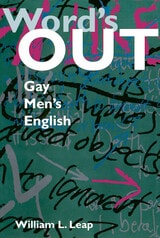
Word’s Out
Gay Men’s EnglishWilliam Leap
University of Minnesota Press, 1996
The first book-length analysis of the language used by gay men.
Do gay men communicate with each other differently than they do with straight people? If they do, how is “gay men’s English” different from “straight English”? In Word’s Out, William Leap addresses these questions in an entertaining account that looks at gay men’s English as a cultural and a linguistic phenomenon.
Whereas previous studies of “gay language” have centered almost entirely on vocabulary, word history, and folklore, Word's Out focuses on the linguistic practices-cooperation, negotiation, and risk taking-that underlie gay men’s conversations, storytelling, verbal dueling, self-description, and construction of outrageous references. Leap “reads” conversations for covert and overt signs of gay men's English, using anecdotes drawn from gay dinner parties, late-night airplane flights, restaurants, department stores, and gourmet shops, and from other all-gay and gay/straight settings. He incorporates material from life-story narratives and other interviews and discussions with gay men, from gay magazines, newspapers, and books, and from events in his own life. The topics addressed include establishing the gay identities of “suspect gays,” recollections of gay childhood, erotic negotiation in health club locker rooms, and gay men’s language of AIDS. Leap shows how gay English speakers use language to create gay-centered spaces within public places, to protect themselves when speaking with strangers, and to establish common interests when speaking with “suspect gays,” and explores why learning gay English is a critical component in gay men’s socialization and entry into gay culture. Provocative and potentially controversial, Word's Out provides fascinating insight into the politics of gay experience by exploring the connections between language and daily experience in gay men's lives.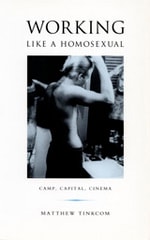
Working Like a Homosexual
Camp, Capital, CinemaMatthew Tinkcom
Duke University Press, 2002
With a special emphasis on the tensions between high and low forms of culture and between good and bad taste, Matthew Tinkcom offers a new vision of queer politics and aesthetics that is critically engaged with Marxist theories of capitalist production. He argues that camp—while embracing the cheap, the scorned, the gaudy, the tasteless, and what Warhol called “the leftovers” of artistic production—is a mode of intellectual production and a critical philosophy of modernity as much as it is an expression of a dissident sex/gender difference. From Minnelli’s musicals and the “everyday glamour” of Warhol’s films to Anger’s experimental films and Waters’s “trash aesthetic,” Tinkcom demonstrates how camp allowed these gay men to design their own relationship to labor and to history in a way that protected them from censure even as they struggled to forge a role for themselves within a system of “value” that failed to recognize them.
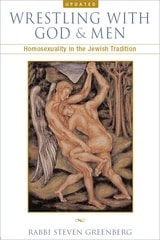
Wrestling with God and Men
Homosexuality in the Jewish TraditionRabbi Steven Greenberg
University of Wisconsin Press, 2005
For millennia, two biblical verses have been understood to condemn sex between men as an act so abhorrent that it is punishable by death. Traditionally Orthodox Jews, believing the scripture to be the word of God, have rejected homosexuality in accordance with this interpretation. In 1999, Rabbi Steven Greenberg challenged this tradition when he became the first Orthodox rabbi ever to openly declare his homosexuality.
Wrestling with God and Men is the product of Rabbi Greenberg’s ten-year struggle to reconcile his two warring identities. In this compelling and groundbreaking work, Greenberg challenges long held assumptions of scriptural interpretation and religious identity as he marks a path that is both responsible to human realities and deeply committed to God and Torah. Employing traditional rabbinic resources, Greenberg presents readers with surprising biblical interpretations of the creation story, the love of David and Jonathan, the destruction of Sodom, and the condemning verses of Leviticus. But Greenberg goes beyond the question of whether homosexuality is biblically acceptable to ask how such relationships can be sacred. In so doing, he draws on a wide array of nonscriptural texts to introduce readers to occasions of same-sex love in Talmudic narratives, medieval Jewish poetry and prose, and traditional Jewish case law literature. Ultimately, Greenberg argues that Orthodox communities must open up debate, dialogue, and discussion—precisely the foundation upon which Jewish law rests—to truly deal with the issue of homosexual love.
This book will appeal not only to members of the Orthodox faith but to all religious people struggling to resolve their belief in the scriptures with a desire to make their communities more open and accepting to gay and lesbian members.
2005 Finalist for the Lambda Literary Awards, for Religion/Spirituality
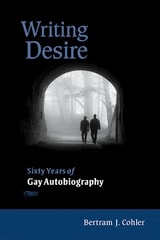
Writing Desire
Sixty Years of Gay AutobiographyBertram J. Cohler
University of Wisconsin Press, 2007
By contrasting the personal experience of these disparate writers, Cohler illustrates the social transformations that these men helped shape. Among Cohler's diverse subjects is Alan Helms, whose journey from Indiana to New York's gay society represents the passage of men who came of age in the 1950s and 1960s, when homosexuality was considered a hidden "disease." The liberating effects of Stonewall's aftermath are chronicled in the life of Arnie Kantrowitz, the prototypical activist for gay rights in the 1970s and the founder the Gay and Lesbian Alliance against Defamation. The artistic works of Tim Miller and Mark Doty evoke loss and shock during of the early stages of the AIDS epidemic in the 1980s. Cohler rounds out this collective group portrait by looking at the newest generation of writers in the Internet age via the blog of BrYaN, who did the previously unthinkable: he "outed" himself to millions of people.
A compelling mix of social history and personal biography, Writing Desire distills the experience of three generations of gay America.