Results by title
172 books match the query 'Legislative Branch' and 13 start with w
WARRING FACTIONS
INTEREST GROUPS, MONEY, SENATE CONFIRMATIONLAUREN COHEN BELL
The Ohio State University Press, 2002
Warring Factions focuses on the United States Senate’s confirmation process, the constitutional process the Senate uses to approve or reject the president’s choices to fill federal government positions. It is a book about history, the evolution, and, arguably, the decline of the process. Most significantly, it is a book that demonstrates the extent to which interest groups and money have transformed the Senate’s confirmation process into a virtual circus.
Based on in-depth research, including two dozen original interviews with United States senators, former senators and Senate staff members and interest group leaders, this volume demonstrates that today’s confirmation process is nothing more than an extension of the Senate’s legislative work. Changes to internal Senate norms in the 1960s and 1970s, coupled with changes to the external political environment, have allowed interest groups to dominate the Senate confirmation process.

Waves of Discontent
Electoral Volatility, Public Policymaking, and the Health of American DemocracyJacob F.H. Smith
University of Michigan Press, 2025
Conducting statistical analyses of a wide array of surveys, Smith found that these feelings of displeasure translate to lower turnout among voters from the president’s party and a higher percentage of independents voting for the other party. Subsequently, he conducted a content analysis of New York Times articles to look at the connection between unrest in American society and seat swings in congressional elections, even before the existence of polling. Examining the consequences of volatility in congressional elections reveals that political amateurs are more likely to win in wave years than in normal years. Based on this data, Smith presents a new theory about the policy process—the policy doom loop—in which frustration among voters at both the inability of Congress to pass policy and anger at policies that actually do pass results in even more churn in congressional elections. Waves of Discontent offers some suggestions to promote constructive policymaking efforts in Washington to reduce frustration in the electorate.

When and Where They Enter
Black Women's Candidate Emergence at the State LevelJamil S. Scott-Cummings
University of Michigan Press, 2027
While Black women are often called the backbone of American democracy, their journeys to political office remain understudied. When and Where They Enter offers a way to develop our understanding of the women transforming American politics. By focusing on state-level elections, it explores what motivates Black women to run for public office, the biases they navigate in the public eye, and the structural factors that help or hinder their path to victory.
By deliberately departing from traditional, single-axis models of political ambition, Jamil Scott-Cummings frames candidate emergence through an explicit intersectional lens, treating Black women’s political agency as a dynamic interplay between psychological motivations, institutional factors, personal characteristics, and race-gender bias. She introduces a new conceptual model that challenges standard strategic entry theories: the intentional candidacy framework. Incorporating experiments, observational data, and elite interviews, When and Where They Enter offers robust empirical evidence of how race-gender identity shapes modern electoral supply. An essential read for voters, changemakers, and future leaders, the book offers a roadmap for understanding identity, power, and the future of political representation in America.
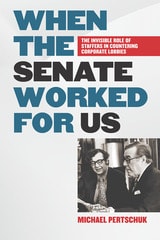
When the Senate Worked for Us
The Invisible Role of Staffers in Countering Corporate LobbiesMichael Pertschuk
Vanderbilt University Press, 2017
What has remained untold is the major behind-the-scenes contribution of entrepreneurial Congressional staff, who planted the seeds of public interest bills in their bosses' minds and maneuvered to counteract the influence of lobbyists to pass laws in consumer protection, public health, and other policy arenas crying out for effective government regulation. They infuriated Nixon's advisor, John Ehrlichman, who called them "bumblebees," a name they wore as a badge of honor.
For his insider account, Pertschuk draws on many interviews, as well as his fifteen years serving on the staff of the Senate Commerce Committee that Senator Warren Magnuson chaired and as the committee's Democratic Staff Director. That committee became, in Ralph Nader's words, "the Grand Central Station for consumer protection advocates."
White-Collar Government
The Hidden Role of Class in Economic Policy MakingNicholas Carnes
University of Chicago Press, 2013
With White-Collar Government, Nicholas Carnes answers this question with a resounding—and disturbing—yes. Legislators’ socioeconomic backgrounds, he shows, have a profound impact on both how they view the issues and the choices they make in office. Scant representation from among the working class almost guarantees that the policymaking process will be skewed toward outcomes that favor the upper class. It matters that the wealthiest Americans set the tax rates for the wealthy, that white-collar professionals choose the minimum wage for blue-collar workers, and that people who have always had health insurance decide whether or not to help those without. And while there is no one cause for this crisis of representation, Carnes shows that the problem does not stem from a lack of qualified candidates from among the working class. The solution, he argues, must involve a variety of changes, from the equalization of campaign funding to a shift in the types of candidates the parties support.
If we want a government for the people, we have to start working toward a government that is truly by the people. White-Collar Government challenges long-held notions about the causes of political inequality in the United States and speaks to enduring questions about representation and political accountability.
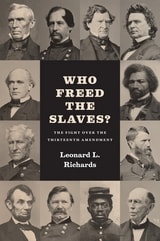
Who Freed the Slaves?
The Fight over the Thirteenth AmendmentLeonard L. Richards
University of Chicago Press, 2015
The real story, however, is much more complicated—and dramatic—than that. With Who Freed the Slaves?, distinguished historian Leonard L. Richards tells the little-known story of the battle over the Thirteenth Amendment, and of James Ashley, the unsung Ohio congressman who proposed the amendment and steered it to passage. Taking readers to the floor of Congress and the back rooms where deals were made, Richards brings to life the messy process of legislation—a process made all the more complicated by the bloody war and the deep-rooted fear of black emancipation. We watch as Ashley proposes, fine-tunes, and pushes the amendment even as Lincoln drags his feet, only coming aboard and providing crucial support at the last minute. Even as emancipation became the law of the land, Richards shows, its opponents were already regrouping, beginning what would become a decades-long—and largely successful—fight to limit the amendment’s impact.
Who Freed the Slaves? is a masterwork of American history, presenting a surprising, nuanced portrayal of a crucial moment for the nation, one whose effects are still being felt today.
Why Americans Split Their Tickets
Campaigns, Competition, and Divided GovernmentBarry C. Burden and David C. Kimball
University of Michigan Press, 2004
Why Congressional Reforms Fail
Reelection and the House Committee SystemE. Scott Adler
University of Chicago Press, 2002
What lies behind the House's resistance to change? Challenging recent explanations of this phenomenon, Scott Adler contends that legislators resist rearranging committee powers and jurisdictions for the same reason they cling to the current House structure—the ambition for reelection. The system's structure works to the members' advantage, helping them obtain funding (and favor) in their districts. Using extensive evidence from three major reform periods—the 1940s, 1970s, and 1990s—Adler shows that the reelection motive is still the most important underlying factor in determining the outcome of committee reforms, and he explains why committee reform in the House has never succeeded and probably never will.
Why Not Parties?
Party Effects in the United States SenateEdited by Nathan W. Monroe, Jason M. Roberts, and David W. Rohde
University of Chicago Press, 2008
Why Washington Won't Work
Polarization, Political Trust, and the Governing CrisisMarc J. Hetherington and Thomas J. Rudolph
University of Chicago Press, 2015
In Why Washington Won’t Work, Marc J. Hetherington and Thomas J. Rudolph argue that a contemporary crisis of trust—people whose party is out of power have almost no trust in a government run by the other side—has deadlocked Congress. On most issues, party leaders can convince their own party to support their positions. In order to pass legislation, however, they must also create consensus by persuading some portion of the opposing party to trust in their vision for the future. Without trust, consensus fails to develop and compromise does not occur. Up until recently, such trust could still usually be found among the opposition, but not anymore. Political trust, the authors show, is far from a stable characteristic. It’s actually highly variable and contingent on a variety of factors, including whether one’s party is in control, which part of the government one is dealing with, and which policies or events are most salient at the moment.
Political trust increases, for example, when the public is concerned with foreign policy—as in times of war—and it decreases in periods of weak economic performance. Hetherington and Rudolph do offer some suggestions about steps politicians and the public might take to increase political trust. Ultimately, however, they conclude that it is unlikely levels of political trust will significantly increase unless foreign concerns come to dominate and the economy is consistently strong.

Why We Lost the ERA
Jane J. Mansbridge
University of Chicago Press, 1986
In March 1972 the Equal Rights Amendment to the United States Constitution-the ERA-passed the Senate of the United States with a vote of 84 to 8, seventeen votes more than the two-thirds required for constitutional amendments. In the ensuing ten years, a majority of Americans consistently told interviewers that they favored this amendment to the Constitution. Yet on June 30, 1982, the deadline for ratifying the amendment passed with only thirty-five of the required thirty-eight states having ratified.
How did this happen? In How We Lost the ERA, political scientist Jane J. Mansbridge tells the story of the ERA's rise and fall, revealing self-defeating, contradictory forces within the movement supporting the amendment and how those contributed to its demise. The surprising challenges Mansbridge uncovers here remain salient to political struggles and democratic theory today.

Women in the Club
Gender and Policy Making in the SenateMichele L. Swers
University of Chicago Press, 2013
In the run-up to the 2012 presidential election, Democrats and Republicans were locked in a fierce battle for the female vote. Democrats charged Republicans with waging a “war on women,” while Republicans countered that Democratic policies actually undermined women’s rights. The women of the Senate wielded particular power, planning press conferences, appearing on political programs, and taking to the Senate floor over gender-related issues such as workplace equality and reproductive rights.
The first book to examine the impact of gender differences in the Senate, Women in the Club is an eye-opening exploration of how women are influencing policy and politics in this erstwhile male bastion of power. Gender, Michele L. Swers shows, is a fundamental factor for women in the Senate, interacting with both party affiliation and individual ideology to shape priorities on policy. Women, for example, are more active proponents of social welfare and women’s rights. But the effects of gender extend beyond mere policy preferences. Senators also develop their priorities with an eye to managing voter expectations about their expertise and advancing their party’s position on a given issue. The election of women in increasing numbers has also coincided with the evolution of the Senate as a highly partisan institution. The stark differences between the parties on issues pertaining to gender have meant that Democratic and Republican senators often assume very different roles as they reconcile their policy views on gender issues with the desire to act as members of partisan teams championing or defending their party’s record in an effort to reach various groups of voters.