Results by title
275 books match the query 'Letters' and 9 start with w
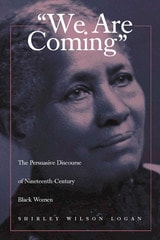
We Are Coming
The Persuasive Discourse of Nineteenth-Century Black WomenShirley Wilson Logan
Southern Illinois University Press, 1999
Shirley Wilson Logan analyzes the distinctive rhetorical features in the persuasive discourse of nineteenth-century black women, concentrating on the public discourse of club and church women from 1880 until 1900.
Logan develops each chapter in this illustrated study around a feature of public address as best exemplified in the oratory of a particular woman speaker of the era. She analyzes not only speeches but also editorials, essays, and letters.
Logan first focuses on the prophetic oratory of Maria Stewart, the first American-born black woman to speak publicly. Turning to Frances Harper, she considers speeches that argue for common interests between divergent communities. And she demonstrates that central to the antilynching rhetoric of Ida Wells is the concept of "presence," or the tactic of enhancing certain selected elements of the presentation.
In her discussion of Fannie Barrier Williams and Anna Cooper, Logan shows that when speaking to white club women and black clergymen, both Williams and Cooper employ what Kenneth Burke called identification. To analyze the rhetoric of Victoria Matthews, she applies Carolyn Miller's modification of Lloyd Bitzer's concept of the rhetorical situation.
Logan also examines the discourse of women associated with the black Baptist women's movement and those participating in college-affiliated conferences.
The book includes an appendix with little-known speeches and essays by Anna Julia Cooper, Selena Sloan Butler, Lucy Wilmot Smith, Mary V. Cook, Adella Hunt Logan, Victoria Earle Matthews, Lucy C. Laney, and Georgia Swift King.

What Clever Friends
The Selected Letters of Jane Kenyon and Alice MattisonEdited by Chad Wriglesworth
University of Michigan Press, 2026
Witty, tender, and aware; tempestuous and lyrical, these letters trace the evolution of a deep and largely unknown friendship that situates Kenyon’s work within a collaborative environment of other poets and novelists who were committed to the flourishing of contemporary women’s writing. With more than 500 edited and annotated letters, a retrospective foreword written by Alice Mattison, and a scholarly introduction written by Chad Wriglesworth, What Clever Friends conveys a compelling story that will interest readers and writers.
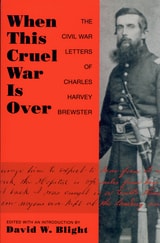
When This Cruel War Is Over
The Civil War Letters of Charles Harvey BrewsterDavid W. Blight
University of Massachusetts Press, 1992
“I am scared most to death every battle we have, but I don't think you need be afraid of my sneaking away unhurt.” Thus wrote Adjutant Charles Harvey Brewster of the 10th Massachusetts to his sister Martha in 1864, in one of over 200 letters he would pen during his four years of service.
Born and raised in Northampton, Massachusetts, Brewster was a twenty-seven-year-old store clerk when he enlisted in Company C of the 10th Massachusetts Volunteers in April 1861. During the next three and a half years he fought in many of the major battles of the Virginia campaigns—Fair Oaks, the Seven Days, Chancellorsville, Gettysburg, the Wilderness, the “Bloody Angle” at Spotsylvania—rising through the ranks to become second lieutenant and later adjutant of his regiment. His letters, most of which were written to his mother and two sisters, record not only the horrors he witnessed on the battlefield, but also his inner struggle with his own values, convictions, and sense of manhood.
In a thoughtful and illuminating introductory essay, David W. Blight explores the evolution of Brewster's understanding of the terrible conflict in which he was engaged. Blight shows how Brewster's attitudes toward race and slavery gradually changed, in part as a result of his contact with escaped slaves and his experience recruiting black troops. He also examines the shift in Brewster's conception of courage, as the realities of war collided with the romantic ideals he had previously embraced. This recently discovered and exceptionally literate collection of 137 letters chronicles the experiences of an ordinary Union soldier caught up in extraordinary events. At times naive and sentimental, at times mature and realistic, Brewster's correspondence not only provides remarkable insight into the meaning of the Civil War for the average Yankee, but also testifies to the persistent power of war to attract and repel the human imagination.
William Faulkner, Letters & Fictions
By James G. Watson
University of Texas Press, 1989
Besides the groundbreaking novels and stories that brought him fame, William Faulkner throughout his life wrote letters—to his publisher, his lovers, his family, and his friends. In this first major study of epistolarity in Faulkner's work, James G. Watson examines Faulkner's personal correspondence as a unique second canon of writing, separate from his literary canon with its many fictional letters but developing along parallel lines. By describing the similarity of forms and conventions in Faulkner's personal and fictional correspondence, Watson clearly demonstrates that Faulkner's personal experience as a writer of letters significantly shaped his imaginative work early and late.
Letters are always about themselves; they re-create a world between the sender and the receiver. In this illuminating study, Faulkner's personal letters are treated as a form of reflexive writing: first-person narratives in which Sender self-consciously portrays Self to a specific Receiver, likewise portrayed in the letter-text. This duality of actual experience and imaginative re-creation measures the personal distances between the life of the writer and the written self-image. It reveals that letters are at once fragments of autobiography and fictions of self.
Such "laws of letters" apply equally to the letters that appear throughout Faulkner's novels and stories. The twenty-one letters and telegrams in The Sound and the Fury, for example, portray character, propel plot, and convey important themes of failed communication and broken identity. From Soldiers' Pay to his last work, Faulkner's carefully lettered canon of fiction is dramatic evidence of his understanding of epistolarity and of the extent to which he adapted letters, including some of his own, to shape his fictional world.
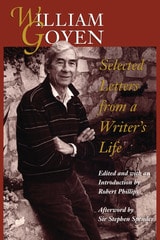
William Goyen
Selected Letters from a Writer’s LifeBy William Goyen
University of Texas Press, 1995
Proclaimed "one of the great American writers of short fiction" by the New York Times Book Review, William Goyen (1915-1983) had a quintessentially American literary career, in which national recognition came only after years of struggle to find his authentic voice, his audience, and an artistic milieu in which to create. These letters, which span the years 1937 to 1983, offer a compelling testament to what it means to be a writer in America.
A prolific correspondent, Goyen wrote regularly to friends, family, editors, and other writers. Among the letters selected here are those to such major literary figures as W. H. Auden, Archibald MacLeish, Joyce Carol Oates, William Inge, Elia Kazan, Elizabeth Spencer, and Katherine Anne Porter.
These letters constitute a virtual autobiography, as well as a fascinating introduction to Goyen's work. They add an important chapter to the study of American and Texas literature of the twentieth century.

William Watts Folwell
The Autobiography and Letters of a Pioneer of CultureWilliam Folwell
University of Minnesota Press, 1933
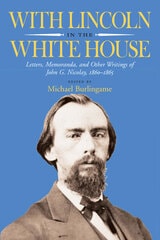
With Lincoln in the White House
Letters, Memoranda, and other Writings of John G. Nicolay, 1860-1865Edited by Michael Burlingame
Southern Illinois University Press, 2000
From the time of Lincoln’s nomination for the presidency until his assassination, John G. Nicolay served as the Civil War president’s chief personal secretary. Nicolay became an intimate of Lincoln and probably knew him as well as anyone outside his own family. Unlike John Hay, his subordinate, Nicolay kept no diary, but he did write several memoranda recording his chief’s conversation that shed direct light on Lincoln. In his many letters to Hay, to his fiancée, Therena Bates, and to others, Nicolay often describes the mood at the White House as well as events there. He also expresses opinions that were almost certainly shaped by the president
For this volume, Michael Burlingame includes all of Nicolay’s memoranda of conversations, all of the journal entries describing Lincoln’s activities, and excerpts from most of the nearly three hundred letters Nicolay wrote to Therena Bates between 1860 and 1865. He includes letters and portions of letters that describe Lincoln or the mood at the White House or that give Nicolay’s personal opinions. He also includes letters written by Nicolay while on troubleshooting missions for the president.
An impoverished youth, Nicolay was an unlikely candidate for the important position he held during the Civil War. It was only over the strong objections of some powerful people that he became Lincoln’s private secretary after Lincoln’s nomination for the presidency in 1860. Prominent Chicago Republican Herman Kreismann found the appointment of a man so lacking in savoir faire
Lacking charm, Nicolay became known at the White House as the “bulldog in the ante-room” with a disposition “sour and crusty.” California journalist Noah Brooks deemed Nicolay a “grim Cerberus of Teutonic descent who guards the last door which opens into the awful presence.” Yet in some ways he was perfectly suited for the difficult job. William O. Stoddard, noting that Nicolay was not popular and could “say 'no'about as disagreeably as any man I ever knew,” still granted that Nicolay served Lincoln well because he was devoted and incorruptible. Stoddard concluded that Nicolay “deserves the thanks of all who loved Mr. Lincoln.”
For his part, Nicolay said he derived his greatest satisfaction “from having enjoyed the privilege and honor of being Mr. Lincoln’s intimate and official private secretary, and of earning his cordial friendship and perfect trust.”
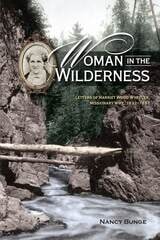
Woman in the Wilderness
Letters of Harriet Wood Wheeler, Missonary Wife, 1832-1892Nancy Bunge
Michigan State University Press, 2010
Harriet's letters reveal her experiences with actors and institutions that played pivotal roles in the history of American women: the nascent literate female work force at the mills in Lowell, Massachusetts; the Ipswich Female Seminary, which was one of the first schools for women teachers; women's associations, especially in churches; and the close and enduring ties that characterized women's relationships in the late nineteenth century.
Harriet's letters also provide an intimate view of the relationships between American Indians and Euro-Americans in the Great Lakes region, where she settled with her Christian missionary husband.
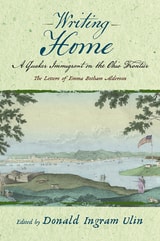
Writing Home
A Quaker Immigrant on the Ohio Frontier; the Letters of Emma Botham AldersonDonald Ingram Ulin
Bucknell University Press, 2020
Introductions and notes situate the letters in relation to their critical, biographical, literary, and historical contexts. Editor Donald Ulin discusses the relationship between Alderson’s letters and her sister Mary Howitt’s Our Cousins in Ohio (1849), a remarkable instance of transatlantic literary collaboration.
Writing Home offers an unparalleled opportunity for studying immigrant correspondence due to Alderson’s unusually well-documented literary and religious affiliations. The notes and introductions provide background on nearly all the places, individuals, and events mentioned in the letters.
Published by Bucknell University Press. Distributed worldwide by Rutgers University Press.