Results by title
262 books match the query 'Love' and 11 start with w
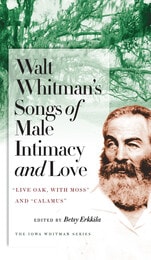
Walt Whitman's Songs of Male Intimacy and Love
"Live Oak, with Moss" and "Calamus"Whitman, Walt
University of Iowa Press, 2011
In his 1859 “Live Oak, with Moss,” Walt Whitman’s unpublished sheaf of twelve poems on manly passion, the poet dreams of a city where men who love men can live and love openly. The revised “Live Oak, with Moss” poems became “Calamus,” Whitman’s cluster of poems on “adhesive” and manly love, comradeship, and democracy, in Leaves of Grass. Commemorating both the first publication of the “Calamus” poems and the little-known manuscript of notebook poems out of which the “Calamus” cluster grew, Whitman scholar Betsy Erkkila brings together in a single edition for the first time the “Live Oak, with Moss” poems, the 1860 “Calamus” poems, and the final 1881 “Calamus” poems. In addition to honoring the sesquicentennial of the “Calamus” cluster, she celebrates the ongoing legacy of Whitman’s songs of manly passion, sex, and love.
The volume begins with Whitman’s elegantly handwritten manuscript of the “Live Oak, with Moss” poems, printed side by side with a typeset transcription and followed by a facsimile of the 1860 version of the “Calamus” poems. The concluding section reprints the final version of the “Calamus” poems from the 1881 edition of Leaves of Grass. In an afterword, Erkkila discusses the radical nature of these poems in literary, sexual, and social history; the changes Whitman made in the “Live Oak” and “Calamus” poems in the post–Civil War and Reconstruction years; the literary, political, and other contests surrounding the poems; and the constitutive role the poems have played in the emergence of modern heterosexual and homosexual identity in the United States and worldwide. The volume closes with a selected bibliography of works that have contributed to the critical and interpretive struggles around Whitman’s man-loving life.
One hundred and fifty years after Whitman’s brave decision to speak publicly about a fully realized democracy, his country is still locked in a struggle over the rights of homosexuals. These public battles have been at the very center of controversies over the life, work, and legacy of Walt Whitman, America’s (and the world’s) major poet of democracy and its major singer of what he called “manly love” in all its moods. Together the poems in this omnibus volume affirm his creation of a radical new language designed to convey and affirm the poet’s man love.
Ways & Power Of Love
Techniques Of Moral TransformationPitirim A. Sorokin
Templeton Press, 2002
The Ways and Power of Love was originally published in 1954 when Pitirim Sorokin was in the twilight of his career and leading the Harvard Research Center in Creative Altruism. His elaborate scientific analysis of love with regard to its higher and lower forms, its causes and effects, its human and cosmic significance, and its core features constitutes the first study on this topic in world literature to date.
Sorokin was the one absolutely essential twentieth-century pioneer in the study of love at the interface of science and religion. Bringing The Ways and Power of Love back into print allows a new generation of readers to appreciate Sorokin's genius and to move forward with his endeavor at a time when civilization itself continues to be threatened by a marked inability to live up to the ideal of love for all humankind. It is certainly right to hope, with Sorokin, that progress in knowledge about love can move humanity forward to a better future. Turning the sciences toward the study of love is no easy task, but it can and must be done.

We All Feel
Understanding Animal Grief and LoveBarbara J. King
University of Chicago Press, 2013

What Counts as Love
Marian Crotty
University of Iowa Press, 2017
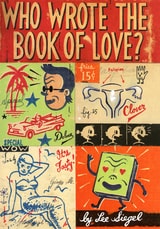
Who Wrote the Book of Love?
Lee Siegel
University of Chicago Press, 2005
Vignettes from the author's childhood provide the material for the construction of what is at once comic fiction, imaginative historical reportage, and an ironically nostalgic confession. The book evokes the tone and tempo of a decade during which America was blatantly happy, wholesome, and confident, and yet, at the same time, deeply fearful of communism and nuclear holocaust. Siegel recounts both the cheer and the paranoia of the period and the ways in which those sentiments informed wondering about sex and falling in love.
"Part of my plan," Mark Twain wrote in The Adventures of Tom Sawyer, "has been to try to pleasantly remind adults of what they once were themselves, and of how they felt and thought and talked." With the same motive, Lee Siegel has written what Twain might have composed had he been Jewish, raised in Beverly Hills in the 1950s, and joyously obsessed with sex and love.
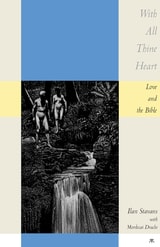
With All Thine Heart
Love and the BibleStavans, Ilan
Rutgers University Press, 2010
Presented in an engaging, conversational format and touched with striking artwork, the textured dialogue between Stavans and Drache is meant to show how the Bible is a multidimensional text and one that, when considered over the course of history, still has the power to shape our world. The theme of love provides the connective tissue that binds this work.
Addressing a wide range of topics, from biblical archaeology and fundamentalism to Hollywood movies, lexicography, and the act of praying, With All Thine Heart suggests that the Hebrew Bible is a novel worth decoding patiently, such as one does with classics like Don Quixote de la Mancha, In Search of Lost Time, and Anna Karenina. Similar to the protagonists in these tales, biblical characters, although not shaped with the artistic nuance of modern literature, allow for astonishing insight. This exploration of love through the pages of the Bible—organized chronologically from Genesis to Exodus and followed by insightful meditations on the Song of Songs and the Book of Job—is a delightful intellectual and spiritual treat . . . Shema Ysrael!

With the World at Heart
Studies in the Secular TodayThomas A. Carlson
University of Chicago Press, 2019
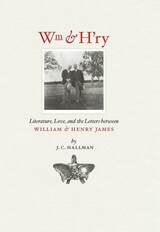
Wm & H'ry
Literature, Love, and the Letters between Wiliam and Henry JamesJ. C. Hallman
University of Iowa Press, 2013
William and Henry James served as each other’s muse and critic. For instance, the event of the death of Mrs. Sands illustrates what H’ry never stated: even if the “matter” of his fiction was light, the minds behind it lived and died as though it was very heavy indeed. He seemed to best understand this himself only after Wm fully fleshed out his system. “I can’t now explain save by the very fact of the spell itself . . . that [Pragmatism] cast upon me,” H’ry wrote in 1907. “All my life I have . . . unconsciously pragmatised.”
Wm was never able to be quite so gracious in return. In 1868, he lashed out at the “every day” elements of two of H’ry’s early stories, and then explained: “I have uttered this long rigmarole in a dogmatic manner, as one speaks, to himself, but of course you will use it merely as a mass to react against in your own way, so that it may serve you some good purpose.” He believed he was doing H’ry a service as he criticized a growing tendency toward “over-refinement” or “curliness” of style. “I think it ought to be of use to you,” he wrote in 1872, “to have any detailed criticism fm even a wrong judge, and you don’t get much fm. any one else.” For the most part, H’ry agreed. “I hope you will continue to give me, when you can, your free impression of my performance. It is a great thing to have some one write to one of one’s things as if one were a 3d person & you are the only individual who will do this.”
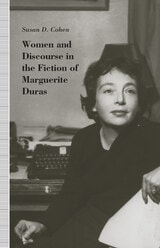
Women and Discourse in the Fiction of Marguerite Duras
Love, Legends, LanguageSusan D. Cohen
University of Massachusetts Press, 1993
One of the most famous living French writers, Marguerite Duras is renowned for her provocative and hauntingly beautiful works of fiction, drama, and cinema. This book offers the first comprehensive study of the narrative and stylistic characteristics of Duras's fiction. Susan D. Cohen examines the entire range of Duras's works, combining close textual analyses with a more general discussion of narrativity and its connections with gender, class, and race. The focus throughout is on language, representation, and difference, which Duras explores on every structural level.
Cohen shows how Duras's writings, even the controversial “erotic” works, expose and subvert the repression of women in traditional, dominant discourse and at the same time present an alternative, nonrepressive discursive model. She formulates a concept of creative “ignorance,” which she identifies as the generative principle of Duras's textual production and the approach to language it proposes. Cohen also explores the distinctive features of Duras's prose, describing how the writer achieves the ritual, legendary aura that characterizes her work.

Women, Guerrillas, and Love
Understanding War in Central AmericaIleana RodriguezTranslated by Ileana Rodriguez and Robert Carr
University of Minnesota Press, 1996
Women, Guerrillas, and Love was first published in 1996. Minnesota Archive Editions uses digital technology to make long-unavailable books once again accessible, and are published unaltered from the original University of Minnesota Press editions.
How can literature show us what went awry in the process of liberation, and in the construction of a different, better world? Ileana Rodriguez pursues this question through a reading of "politically committed" literature—texts produced within the context of Latin American guerrilla movements. Che Guevara's diary, testimonios by Omar Cabezas and Tomás Borge, novels and short stories by Sergio Ramírez and Arturo Arias: These are among the works Rodriguez examines.
Rodriguez seeks to pinpoint the relationship between the collective and woman, and between woman and the nation-state. Women, Guerrillas, and Love challenges current assumptions about the relationship of gender and sexuality to writing and state building during revolutionary moments. Employing several theoretical paradigms—Marxism, feminism, deconstruction—these readings take into account the "implosion" of socialist or socialist-like societies responding to the expansion of positivistic cultures. The book participates in the debate over the subjugation of insolvent nationstates to the mandates of the market, and the consequent substitution of economic master narratives for historical ones.

Writing the Love of Boys
Origins of Bishonen Culture in Modernist Japanese LiteratureJeffrey Angles
University of Minnesota Press, 2010
Jeffrey Angles focuses on key writers, examining how they experimented with new language, genres, and ideas to find fresh ways to represent love and desire between men. He traces the personal and literary relationships between contemporaries such as the poet Murayama Kaita, the mystery writers Edogawa Ranpo and Hamao Shiro, the anthropologist Iwata Jun’ichi, and the avant-garde innovator Inagaki Taruho.
Writing the Love of Boys shows how these authors interjected the subject of male–male desire into discussions of modern art, aesthetics, and perversity. It also explores the impact of their efforts on contemporary Japanese culture, including the development of the tropes of male homoeroticism that recur so often in Japanese girls’ manga about bishonen love.