Results by title
209 books match the query 'Mathematics' and 3 start with w
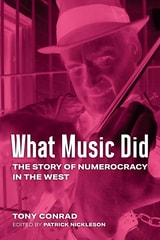
What Music Did
The Story of Numerocracy in the WestTony Conrad. Edited by Patrick Nickleson
University of Michigan Press, 2026
In What Music Did, experimental filmmaker and violinist Tony Conrad explores in depth the relationship between music and mathematics. A work of decades that was left unfinished at the time of his death in 2016, Conrad’s expansive history of the interrelationship of music and mathematics is published here for the first time. Editor Patrick Nickleson describes Conrad’s method as that of an anarchic, interarts haberdasher; much of the research comes from musty and out-of-print sources, giving the impression that Conrad followed paths opened up for him in used book shops and conversations, rather than seeking a direct scholarly argument.
Throughout the book, readers encounter scenes from over two thousand years of history, mathematics, and music: Pythagoras using pebbles to articulate didactic number games to his disciples; Galileo fretting a hill and listening with a musician’s ear to calculate the rate of acceleration under gravity; Rameau trapping Western music in a five-limit tuning system, and what could have been if he were more adept with numbers. Even when drawing on classical sources to explore canonical figures like Saint Augustine, What Music Did offers idiosyncratic critical insights that highlight our ongoing cultural reverence when answers result in simple whole number ratios like 3:2, 4:3, or 5:4. What Music Did is Tony Conrad’s extended indictment of music’s role, from the Pythagoreans to the twentieth century, in upholding the use of number as a clandestine and circumscribed armature of power.
Throughout the book, readers encounter scenes from over two thousand years of history, mathematics, and music: Pythagoras using pebbles to articulate didactic number games to his disciples; Galileo fretting a hill and listening with a musician’s ear to calculate the rate of acceleration under gravity; Rameau trapping Western music in a five-limit tuning system, and what could have been if he were more adept with numbers. Even when drawing on classical sources to explore canonical figures like Saint Augustine, What Music Did offers idiosyncratic critical insights that highlight our ongoing cultural reverence when answers result in simple whole number ratios like 3:2, 4:3, or 5:4. What Music Did is Tony Conrad’s extended indictment of music’s role, from the Pythagoreans to the twentieth century, in upholding the use of number as a clandestine and circumscribed armature of power.
[more]
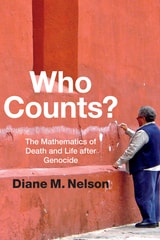
Who Counts?
The Mathematics of Death and Life after GenocideDiane M. Nelson
Duke University Press, 2015
In Who Counts? Diane M. Nelson explores the social life of numbers, teasing out the myriad roles math plays in Guatemalan state violence, economic exploitation, and disenfranchisement, as well as in Mayan revitalization and grassroots environmental struggles. In the aftermath of thirty-six years of civil war, to count—both numerically and in the sense of having value—is a contested and qualitative practice of complex calculations encompassing war losses, migration, debt, and competing understandings of progress. Nelson makes broad connections among seemingly divergent phenomena, such as debates over reparations for genocide victims, Ponzi schemes, and antimining movements. Challenging the presumed objectivity of Western mathematics, Nelson shows how it flattens social complexity and becomes a raced, classed, and gendered skill that colonial powers considered beyond the grasp of indigenous peoples. Yet the Classic Maya are famous for the precision of their mathematics, including conceptualizing zero long before Europeans. Nelson shows how Guatemala's indigenous population is increasingly returning to Mayan numeracy to critique systemic inequalities with the goal of being counted—in every sense of the word.
[more]
Wittgenstein's Lectures on the Foundations of Mathematics, Cambridge, 1939
Ludwig Wittgenstein
University of Chicago Press, 1989
For several terms at Cambridge in 1939, Ludwig Wittgenstein lectured on the philosophical foundations of mathematics. A lecture class taught by Wittgenstein, however, hardly resembled a lecture.
He sat on a chair in the middle of the room, with some of the class sitting in chairs, some on the floor. He never used notes. He paused frequently, sometimes for several minutes, while he puzzled out a problem. He often asked his listeners questions and reacted to their replies. Many meetings were largely conversation.
These lectures were attended by, among others, D. A. T. Gasking, J. N. Findlay, Stephen Toulmin, Alan Turing, G. H. von Wright, R. G. Bosanquet, Norman Malcolm, Rush Rhees, and Yorick Smythies. Notes taken by these last four are the basis for the thirty-one lectures in this book.
The lectures covered such topics as the nature of mathematics, the distinctions between mathematical and everyday languages, the truth of mathematical propositions, consistency and contradiction in formal systems, the logicism of Frege and Russell, Platonism, identity, negation, and necessary truth. The mathematical examples used are nearly always elementary.
[more]