Results by title
58 books match the query 'Meteorology & Climatology' and 6 start with w
Water and Climate in the Western United States
W Lewis
University Press of Colorado, 2003
Waters of the World
The Story of the Scientists Who Unraveled the Mysteries of Our Oceans, Atmosphere, and Ice Sheets and Made the Planet WholeSarah Dry
University of Chicago Press, 2019
From the glaciers of the Alps to the towering cumulonimbus clouds of the Caribbean and the unexpectedly chaotic flows of the North Atlantic, Waters of the World is a tour through 150 years of the history of a significant but underappreciated idea: that the Earth has a global climate system made up of interconnected parts, constantly changing on all scales of both time and space. A prerequisite for the discovery of global warming and climate change, this idea was forged by scientists studying water in its myriad forms. This is their story.
Linking the history of the planet with the lives of those who studied it, Sarah Dry follows the remarkable scientists who summited volcanic peaks to peer through an atmosphere’s worth of water vapor, cored mile-thick ice sheets to uncover the Earth’s ancient climate history, and flew inside storm clouds to understand how small changes in energy can produce both massive storms and the general circulation of the Earth’s atmosphere. Each toiled on his or her own corner of the planetary puzzle. Gradually, their cumulative discoveries coalesced into a unified working theory of our planet’s climate.
We now call this field climate science, and in recent years it has provoked great passions, anxieties, and warnings. But no less than the object of its study, the science of water and climate is—and always has been—evolving. By revealing the complexity of this history, Waters of the World delivers a better understanding of our planet’s climate at a time when we need it the most.
Weather Forecaster to Research Scientist
My Career in MeteorologyRobert M. Atlas
American Meteorological Society, 2022
As a young child, Robert M. Atlas would often look up at the sky, observe the clouds, and ask his parents questions about the weather. That early interest sparked a career in meteorology that took place during a period of rapid development in the field. Weather Forecaster to Research Scientist follows his decades-long career and his innovative research, which led to improvements in the understanding and prediction of extreme weather.
Atlas’s journey begins with his start as an apprentice forecaster for the US Weather Bureau during a time when satellite meteorology and operational numerical weather prediction were just in their infancy. Weather Forecaster to Research Scientist also traces his experiences as an operational forecaster in the US Air Force, discusses his pioneering work on ocean surface winds using satellites, and describes his leadership of scientific organizations within NASA and NOAA as well as his experiences teaching at several universities. An engaging account of a distinguished career, this book will appeal to students, educators, weather forecasters, scientists, and weather enthusiasts alike.
Weather in the Courtroom
Memoirs from a Career in Forensic MeteorologyWilliam H. Haggard
American Meteorological Society, 2016
For a society enthralled by courtroom drama, forensics, and natural disasters, Weather in the Courtroom is a perfect storm: an exciting inside scoop on legendary court cases where the weather may—or may not—have played a crucial role. Haggard explores both the meteorological facts and human stories of a variety of high-profile cases among the hundreds in which, after retiring from the government, he served as an expert witness. Were the disappearance of Alaskan Congressman Nick Begich’s plane on October 16, 1972; the collapse of Tampa Bay’s Skyway Bridge on May 9, 1980; and the crash of Delta Flight 191 in Dallas/Fort Worth on August 2, 1985, natural or human-caused disasters? Haggard’s recounting of these and other litigations reveals just how critical the interpretation of weather and climate data in the courtroom is to our understanding of what happened—and who, if anyone, is at fault.
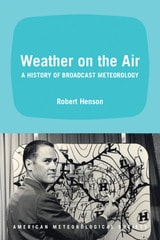
Weather on the Air
A History of Broadcast MeteorologyRobert Henson
American Meteorological Society, 2010
From low humor to high drama, TV weather reporting has encompassed an enormous range of styles and approaches, triggering chuckles, infuriating the masses, and at times even saving lives. In Weather on the Air,meteorologist and science journalist Robert Henson covers it all—the people, technology, science, and show business that combine to deliver the weather to the public each day.
The first comprehensive history of its kind, Weather on the Air explores the many forces that have shaped weather broadcasts over the years, including the long-term drive to professionalize weathercasting, the complex relations between government and private forecasters, and the effects of climate-change science and the Internet on today’s broadcasts. Dozens of photos and anecdotes accompany Henson’s more than two decades of research to document the evolution of weathercasts, from their primitive beginnings on the radio to the high-gloss, graphics-laden segments we watch on television every morning.
This engaging study will be an invaluable tool for students of broadcast meteorology and mass communication and an entertaining read for anyone fascinated by the public face of weather.
Wisconsin's Weather and Climate
Joseph M. Moran
University of Wisconsin Press, 2003
Wisconsin's Weather and Climate is written for weather buffs, teachers, students, outdoor enthusiasts, and those working in fields, lakes, and forests for whom the weather is a daily force to be reckoned with. It examines the physical features of Wisconsin that shape the state’s climate—topography, mid-latitude location, and proximity to Lakes Superior and Michigan—and meteorological phenomena that affect climate, such as atmospheric circulation and air mass frequency. Authors Joseph M. Moran and Edward J. Hopkins trace the evolution of methods of weather observation and forecasting that are so important for agriculture and Great Lakes commerce, and they explain how Wisconsin scientists use weather balloons, radar, and satellites to improve forecasting and track climate changes. They take readers through the seasonal changes in weather in Wisconsin and give an overview of what past climate changes might tell us about the future.
Appendices provide climatic data for Wisconsin, including extremes of temperature, snowfall, and precipitation at selected stations in the state. The authors also list sources for further information.
Vignettes throughout the book provide fascinating weather lore:
o Why there are cacti in Wisconsin
o The famous Green Bay Packers–Dallas Cowboys "Ice Bowl" game of 1967
o The Army Signal Corps’ ban on the word tornado
o Advances in snow-making technology
o The decline of the Great Lakes ice industry