Results by title
27 books match the query 'Presence'
A Gift of Presence
The Theology and Poetry of the Eucharist in Thomas AquinasJan Heiner Tück
Catholic University of America Press, 2018

A Ministry of Presence
Chaplaincy, Spiritual Care, and the LawWinnifred Fallers Sullivan
University of Chicago Press, 2014
In A Ministry of Presence, Winnifred Fallers Sullivan explores how chaplaincy works in the United States—and in particular how it sits uneasily at the intersection of law and religion, spiritual care, and government regulation. Responsible for ministering to the wandering souls of the globalized economy, the chaplain works with a clientele often unmarked by a specific religious identity, and does so on behalf of a secular institution, like a hospital. Sullivan's examination of the sometimes heroic but often deeply ambiguous work yields fascinating insights into contemporary spiritual life, the politics of religious freedom, and the never-ending negotiation of religion's place in American institutional life.
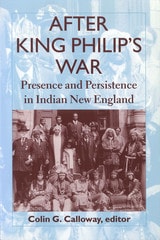
After King Philip’s War
Presence and Persistence in Indian New EnglandEdited by Colin G. Calloway
Dartmouth College Press, 1997
Capturing the Beat Moment
Cultural Politics and the Poetics of PresenceErik Mortenson
Southern Illinois University Press, 2010
CHOICE Outstanding Academic Title
Examining “the moment” as one of the primary motifs of Beat writing, Erik Mortenson offers the first book to investigate immediacy and its presence and importance in Beat writing. Capturing the Beat Moment: Cultural Politics and the Poetics of Presence places an expanded canon of Beat writers in an early postmodern context that highlights their importance in American poetics and provides an account of Beat practices that reveal how gender and race affect Beat politics of the moment.
Mortenson argues that Beat writers focused on action, desire, and spontaneity to establish an authentic connection to the world around them and believed that “living in the moment” was the only way in which they might establish the kind of life that led to good writing. With this in mind, he explores the possibility that, far from being the antithesis of their times, the Beats actually were a product of them. Mortenson outlines the effects of gender and race on Beat writing in the postwar years, as well as the Beats’ attempts to break free of the constrictive notions of time and space prevalent during the 1950s.
Mortenson discusses such topics as the importance of personal visionary experiences; the embodiment of sexuality and the moment of ecstasy in Beat writing; how the Beats used photographs to evoke the past; and the ways that Beat culture was designed to offer alternatives to existing political and social structures. Throughout the volume, Mortenson moves beyond the Kerouac-Ginsberg-Burroughs triumvirate commonly associated with Beat literature, discussing women—such as Diane di Prima, Janine Pommy Vega, and Joyce Johnson—and African American writers, including Bob Kaufman and Amiri Baraka. With the inclusion of these authors comes a richer understanding of the Beat writers’ value and influence in American literary history.
Chaucer on Screen
Absence, Presence, and Adapting the Canterbury TalesEdited by Kathleen Coyne Kelly and Tison Pugh
The Ohio State University Press, 2016

China’s Foreign Places
The Foreign Presence in China in the Treaty Port Era, 1840–1943Robert Nield
Hong Kong University Press, 2015
Contested Memoryscapes in Bosnia and Herzegovina
Presence of Absence in Everyday PeaceJohanna Mannergren
Central European University Press, 2027
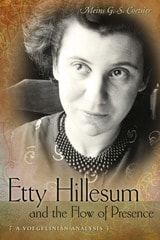
Etty Hillesum and the Flow of Presence
A Voegelinian AnalysisMeins G. S. Coetsier
University of Missouri Press, 2008
Although she died cruelly at Auschwitz at the age of twenty-nine, Etty Hillesum left a lasting legacy of mystical thought in her letters and diaries. Hillesum was a complex and powerful witness to the openness of the human spirit to the call of God, even under the most harrowing circumstances. Her life was as much shaped by Hitler’s regime as was that of philosopher Eric Voegelin, and as Meins Coetsier reveals, her thought lends itself to interpretation from a uniquely Voegelinian perspective.
Etty Hillesum and the Flow of Presence analyzes the life and writings of Hillesum from the standpoint of Voegelin’s views on consciousness—especially his philosophy of luminous participation in the transcendent ground of being. Through a careful reading of her letters and diaries, Coetsier reveals the inner development of Hillesum’s mystically grounded resistance to Nazism as he guides readers through the symbolism of her spiritual journey, making effective use of Voegelin’s analytics of experience and symbolization to trace her path to spiritual truth.
Intertwining the lives, works, and visions of these two mystical thinkers, Coetsier demonstrates his mastery of both Voegelin’s philosophy and Hillesum’s Dutch-language materials. He shows how mystical attunement to the “flow of presence”—Voegelin’s designation for human responsiveness to the divine—is the key to the development of Hillesum’s life and writings. He displays a special affinity for the suffering and grace-filled transformation that she underwent as she approached the end of her life and gained insight into the ultimate purpose of each individual’s contribution to the well-being and maintenance of the human spirit.
Retrieving one of the lesser-known but most compelling figures of the Holocaust, Etty Hillesum and the Flow of Presence is an original contribution to both Voegelin and Hillesum scholarship that reflects these writers’ strong valuation of the human person. It presents Hillesum’s life and work in an original and provocative context, shedding new light on her experiences and their symbolizations while further broadening the application of Voegelin’s thought
IN THE PRESENCE OF AUDIENCE
THE SELF IN DIARIES AND FICTIONDeborah Martinson
The Ohio State University Press, 2003
As a diary writer imagines shadow readers rifling diary pages, she tweaks images of the self, creating multiple readings of herself, fixed and unfixed. When the readers and potential readers are husbands and publishers, the writer maneuvers carefully in a world of men who are quick to judge and to take offense. She fills the pages with reflections, anecdotes, codes, stories, biographies, and fictions. The diary acts as a site for the writer’s tension, rebellion, and remaking of herself.
In this book Martinson examines the diaries of Virginia Woolf, Katherine Mansfield, Violet Hunt, and Doris Lessing’s fictional character Anna Wulf, and shows that these diaries (and others like them) are not entirely private writings as has been previously assumed. Rather, their authors wrote them knowing they would be read. In these four cases, the audience is the author’s male lover or husband, and Martinson reveals how knowledge of this audience affects the language and content in each diary. Ultimately, she argues, this audience enforces a certain “male censorship” which changes the shape of the revelations, the shape of the writer herself, making it impossible for the female author to be honest in writing about her true self.
Even sophisticated readers often assume that diaries are primarily private. This study interrogates the myth of authenticity and self-revelation in diaries written under the gaze of particular peekers.

In the Presence of Gods and Spirits
Hirata Atsutane and His CollaboratorsAnne Walthall
University of Michigan Press, 2025

Jesus-Shock
Peter Kreeft
St. Augustine's Press, 2008
Jesus Shock is the second in a series of short works on seminal concerns of the impact that Jesus Christ made in the world. The first work, The Philosophy of Jesus (St. Augustine’s Press, 2007), explored philosophy in light of Jesus, rather than the other way around. The present work investigates the reception Jesus received both in His lifetime and continuously to the present time, not only from His enemies, but from His friends, a reception of shock, astonishment, even disgust.
Perhaps a few remarks from the book best explains it:
The point of the book:
The point of the title: Imagine a storm has downed a telephone wire so that everyone who touches it is shocked in every cell of his body. Well, the storm of God’s crazy love has “downed” (incarnated) Jesus, and everyone who touches this “live wire” is shocked in every cell of his soul.
The question of the book: Why is “Jesus” the most non-neutral, the most controversial, the most embarrassing name in the world? Why is talking about Jesus like talking about sex?
This whole book is really about a single movie line, the greatest line in the greatest movie in history. Bet you know what it is.
Jesus-Shock is about the Real Presence of Christ in the Gospels and in the Eucharist. It
is not about the theology of the Real Presence, but about the experience of Him there, and about the experience of everyone in the Gospels who met Him.
What was the bitterest controversy of the Protestant Reformation, both between Protestants and Catholics and between different Protestant denominations, the one that had both sides calling the other not just heretics but devils?
Answer: It was not Justification by Faith, the hallmark of the Reformation, even though that question is about nothing less momentous than how to be saved, how to get to Heaven. It was not the relation between religion and politics, even though that was a matter of life or death (literally, on battlefields and at guillotines and hangings) and not just a matter of truth or falsity, or of good or evil. It was not about the sufficiency of the Bible, or the corruption in the Church, or the relation between the Bible and the Church. It was not about the Pope, and the governance of the Church. It was not about Mary or saints or angels or Purgatory. It was not about the Incarnation or the Trinity or the Atonement.
It was about the Real Presence of Christ in the Eucharist.
Jesus-Shock, in addressing this controversy forcefully and faithfully, shows the reasons why to this day the name of “Jesus” stirs up controversy, even revulsion, in polite society. In the true spirit of ecumenism, it also points the way toward a true rapprochement among His modern-day disciples.
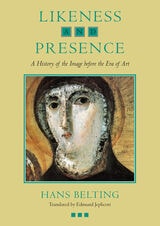
Likeness and Presence
A History of the Image before the Era of ArtHans Belting
University of Chicago Press, 1993
Likeness and Presence looks at the beliefs, superstitions, hopes, and fears that come into play as people handle and respond to sacred
images, and presents a compelling interpretation of the place of the image in Western history.
"A rarity within its genre—an art-historical analysis of iconography which is itself iconoclastic. . . . One of the most intellectually exciting and historically grounded interpretations of Christian iconography." —Graham Howes, Times Literary Supplement
"Likeness and Presence offers the best source to survey the facts of what European Christians put in their churches. . . . An impressively detailed contextual analysis of medieval objects." —Robin Cormack, New York Times Book Review
"I cannot begin to describe the richness or the imaginative grandeur of Hans Belting's book. . . . It is a work that anyone interested in art, or in the history of thought about art, should regard as urgent reading. It is a tremendous achievement."—Arthur C. Danto, New Republic
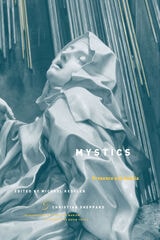
Mystics
Presence and AporiaEdited by Michael Kessler and Christian Sheppard
University of Chicago Press, 2003
Mystics presents a collection of previously unpublished essays by prominent scholars that consider both the idea of mystics and mysticism. The contributors offer detailed discussions of a variety of mystics from history, including Dionysius the Areopagite, Thomas Aquinas, Joan of Arc, Nicholas of Cusa, Saint Teresa of Avila, Martin Luther, and George Herbert. Essays on mysticism in George Bataille, Maurice Blanchot, and contemporary technology bring the volume into the twenty-first century.
For anyone interested in the state of current thinking about mysticism, this collection will be an essential touchstone.
Contributors:
Thomas A. Carlson, Alexander Golitzin, Kevin Hart, Amy Hollywood, Michael Kessler, Jean-Luc Marion, Bernard McGinn, Françoise Meltzer, Susan Schreiner, Regina M. Schwartz, Christian Sheppard, David Tracy
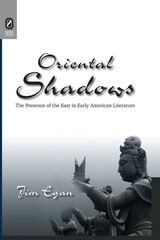
Oriental Shadows
The Presence of the East in Early American LiteratureJim Egan
The Ohio State University Press, 2011
Through the use of several iconic early American authors (Anne Bradstreet, James Kirkpatrick, Benjamin Franklin, and Edgar Allan Poe), Jim Egan’s Oriental Shadows: The Presence of the East in Early American Literature explores the presence of “the East” in American writing.
In bringing to light this largely overlooked archive of images within the American literary canon, Oriental Shadows suggests that the East played a key role in the emergence of a distinctively American literary tradition and, further, that early American identity was born as much from figures of the East as it was from the colonists’ encounters with the frontier.
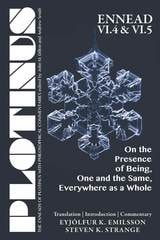
PLOTINUS Ennead VI.4 and VI.5
On the Presence of Being, One and the Same, Everywhere as a Whole: Translation with an Introduction and CommentaryEyjólfur K. Emilsson
Parmenides Publishing, 2015
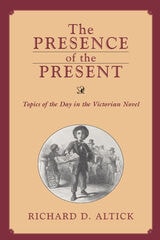
PRESENCE OF THE PRESENT
TOPICS OF THE DAY IN THE VICTORIAN NOVELRichard D. Altick
The Ohio State University Press, 1991
Philosophical Witnessing
The Holocaust as PresenceBerel Lang
Brandeis University Press, 2012
Presence and Absence
A Philosophical Investigation of Language and BeingRobert Sokolowski
Catholic University of America Press, 2017
“A splendid, provocative and profound work, this book explores the manifold ways in which the contrast of presence and absence operate to establish the possibility of human discourse and truthfulness…belongs in every philosophy collection.” – Choice
“Quite simply a superb book, which deserves more than one careful reading. A fresh, unified treatment of a grand philosophical theme, the theme of the connections between thought, truth, and being.” – Man and World
“A thoughtful book about thoughtfulness and truthfulness and their ontological conditions. Simply put, this is a book that will reward its careful reader a hundredfold, for Sokolowski is a speaker who says things in ways that are provocative, exciting, and invariably insightful.” – Journal of the British Society for Phenomenology
“Has few peers in phenomenological literature.” – International Philosophical Quarterly
“[Sokolowski is] an original thinker of the first rank, who has significantly furthered the path of phenomenological philosophy. As well as being an exciting synthesis, a thinking of the previously unthought in predecessors, and a ground-breaking movement, this work is written with a sensitivity to language and its graceful use that one would hope for from one exploring its richness and power.” – Human Studies
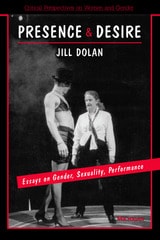
Presence and Desire
Essays on Gender, Sexuality, PerformanceJill Dolan
University of Michigan Press, 1993
This book critically bridges feminist theory and theatrical practice. Dolan examines how performance can subvert normative constructs of gender and sexuality. The collection evaluates mainstream theater, academic stages, subcultural venues, and performance in daily life. It centers sexuality as a primary analytical framework to explore queer visibility and cultural representation. It bridges contemporary feminist theory, poststructuralism, and theatrical practice and places sexuality at the center of its analytical framework to explore how theatrical representation can subvert normative constructs of gender and desire. Dolan evaluates a vast spectrum of performance spaces—ranging from mainstream professional and academic stages to subcultural venues, pornography, and everyday social interactions—to champion queer visibility and claim recognition for women's bodies. Ultimately, the volume functions as a foundational text in performance studies and LGBTQ+ cultural criticism, demonstrating how deliberate theatrical strategies can provoke American culture to actively dismantle and reimagine its traditional social relations
Presence and Resistance
Postmodernism and Cultural Politics in Contemporary American PerformancePhilip Auslander
University of Michigan Press, 1994
Presence and Social Obligation
An Essay on the ShareJames Ferguson
Prickly Paradigm Press, 2021
Recognizing Reality
German Realism and the Mediation of PresenceJessica C. Resvick
Northwestern University Press, 2026
Reveals how literary scenes of recognition stage the process of coming to know reality
In this deeply researched and thought-provoking study, Jessica C. Resvick traces nineteenth-century German realist writing’s paradoxical investment in mediated accounts of the world and the direct, unfiltered experience of reality. Focusing on the motif and operation of recognition in its Aristotelean sense, Resvick examines self-reflexive narratives in which the authors struggle to resolve this tension between the media they choose and the immediacy they hope to create.
Through close readings of key works by canonical authors such as E. T. A. Hoffmann, Annette von Droste-Hülshoff, Adalbert Stifter, Gottfried Keller, and Wilhelm Raabe, Resvick demonstrates the medially influenced and historically contingent ways in which they represent reality. Each chapter focuses on a different form of recognition, reconstructing the techniques that allow these authors to generate an effect of presence. Exploring the history and poetics of knowledge exchange, Recognizing Reality: German Realism and the Mediation of Presence expands on recent media histories of realism, examining the material bases for realist aesthetics while also investigating media’s epistemological accomplishments, and astutely elaborates the role of recognition as a medium-specific tool.

The Mass
The Presence of the Sacrifice of the CrossCharles Cardinal Journet
St. Augustine's Press, 2008

The Presence of God and Union with God
Creation, Divine Indwelling Through Grace, Incarnation and the Blessed Vision According to Saint Thomas AquinasGilles Emery, OP
Catholic University of America Press, 2027
The Presence of Light
Divine Radiance and Religious ExperienceEdited by Matthew T. Kapstein
University of Chicago Press, 2004
The essays in this volume make an important contribution to religious studies by proposing that it is misleading to conceive of religious experience in terms of an irreconcilable dichotomy between universality and cultural construction. An esteemed group of contributors, representing the study of Asian and Western religious traditions from a range of disciplinary perspectives, suggests that attention to various forms of divine radiance shows that there is indeed a range of principles that, if not universal, are nevertheless very widely occurring and amenable to fruitful comparative inquiry. What results is a work of enormous scope, demonstrating compelling cross-connections that will be of value to scholars of comparative religions, mysticism, and the relationship between art and the sacred.
Contributors:
* Catherine B. Asher
* Raoul Birnbaum
* Sarah Iles Johnston
* Matthew T. Kapstein
* Andrew Louth
* Paul E. Muller-Ortega
* Elliot R. Wolfson
* Mimi Hall Yiengpruksawan
* Hossein Ziai
The Presence of Myth
Leszek Kolakowski
University of Chicago Press, 1989
With The Presence of Myth, Kolakowski demonstrates that no matter how hard man strives for purely rational thought, there has always been-and always will be-a reservoir of mythical images that lend "being" and "consciousness" a specifically human meaning.
"Kolakowski undertakes a philosophy of culture which extends to all realms of human intercourse—intellectual, artistic, scientific, and emotional. . . . [His] book has real significance for today, and may well become a classic in the philosophy of culture."—Anglican Theological Review
¡Presente!
The Politics of PresenceDiana Taylor
Duke University Press, 2020