Results by title
355 books match the query 'Middle Atlantic (DC, DE, MD, NJ, NY, PA)' and 12 start with w
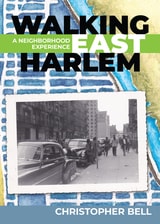
Walking East Harlem
A Neighborhood ExperienceChristopher Bell
Rutgers University Press, 2025
Now East Harlem native Christopher Bell takes you on a tour of his beloved neighborhood. He takes you on three separate walking tours, each visiting a different part of East Harlem and each full of stories about its theaters, museums, art spaces, schools, community centers, churches, mosques, and synagogues. You’ll also learn about the famous people who lived in El Barrio, such as actress Cecily Tyson, opera singer Marian Anderson, portrait artist Alice Neel, incomparable poet Julia De Burgos, and King of Latin Music Tito Puente.
Lavishly illustrated with over fifty photos, Walking East Harlem points out not only the many architectural and cultural landmarks in the neighborhood but also the historical buildings that have since been demolished. Whether you are a tourist or a resident, this guide will give you a new appreciation for El Barrio’s exciting history, cultural diversity, and continued artistic vibrancy.
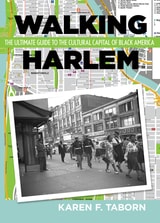
Walking Harlem
The Ultimate Guide to the Cultural Capital of Black AmericaTaborn, Karen
Rutgers University Press, 2018
This illustrated guide takes readers on five separate walking tours of Harlem, covering ninety-one different historical sites. Alongside major tourist destinations like the Apollo Theater and the Abyssinian Baptist Church, longtime Harlem resident Karen Taborn includes little-known local secrets like Jazz Age speakeasies, literati, political and arts community locales. Drawing from rare historical archives, she also provides plenty of interesting background information on each location.
This guide was designed with the needs of walkers in mind. Each tour consists of eight to twenty-nine nearby sites, and at the start of each section, readers will find detailed maps of the tour sites, as well as an estimated time for each walk. In case individuals would like to take a more leisurely tour, it provides recommendations for restaurants and cafes where they can stop along the way.
Walking Harlem gives readers all the tools they need to thoroughly explore over a century’s worth of this vital neighborhood’s cultural, political, religious, and artistic heritage. With its informative text and nearly seventy stunning photographs, this is the most comprehensive, engaging, and educational walking tour guidebook on one of New York’s historic neighborhoods.
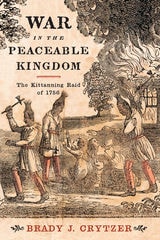
War in the Peaceable Kingdom
The Kittanning Raid of 1756Brady J. Crytzer
Westholme Publishing, 2016
On the morning of September 8, 1756, a band of about three hundred volunteers of a newly created Pennsylvania militia led by Lt. Col. John Armstrong crept slowly through the western Pennsylvania brush. The night before they had reviewed a plan to quietly surround and attack the Lenape, or Delaware, Indian village of Kittanning. The Pennsylvanians had learned that several prominent Delaware who had led recent attacks on frontier settlements as well as a number of white prisoners were at the village. Seeking reprisal, Armstrong’s force successfully assaulted Kittanning, killing one of the Delaware they sought, but causing most to flee—along with their prisoners. Armstrong then ordered the village burned. The raid did not achieve all of its goals, but it did lead to the Indians relocating their villages further away from the frontier settlements. However, it was a major victory for those Pennsylvanians—including some Quaker legislators—who believed the colony must be able to defend itself from outside attack, whether from the French, Indians, or another colony.
In War in the Peaceable Kingdom: The Kittanning Raid of 1756, historian Brady J. Crytzer follows the two major threads that intertwined at Kittanning: the French and Indian War that began in the Pennsylvania frontier, and the bitter struggle between pacifist Quakers and those Quakers and others—most notably, Benjamin Franklin—who supported the need to take up arms. It was a transformational moment for the American colonies. Rather than having a large, pacifist Pennsylvania in the heart of British North America, the colony now joined the others in training soldiers for defense. Ironically, it would be Pennsylvania soldiers who, in the early days of the American Revolution, would be crucial to the survival of George Washington’s army.
Waste is a Terrible Thing to Mind
Risk, Radiation, and Distrust of GovernmentWeingart, John
Rutgers University Press, 2007
It is an unenviable task, but one that all state governments face: finding a final “resting place” for low-level nuclear waste from power plants, hospitals, university laboratories, and other industries. John Weingart was the official in New Jersey who for many years led this onerous charge. This book is the story of how he and a commission appointed by the governor, instead of imposing a top-down solution, designed an approach that would confront public fears by seeking a community that would volunteer to host a disposal facility. Initially, this novel approach was surprisingly successful, as leaders in a dozen municipalities stepped forward to say they might be interested. Once their interest became known, however, the process in each town derailed. Residents demanded assurances of zero-percent risk and expressed profound distrust of government assertions and promises.
Waste Is a Terrible Thing to Mind is a compelling, suspenseful, and amusing insider’s account of New Jersey policy and politics, but it is also a larger saga of the challenges facing society in the post–9/11 era when the public’s distrust of government is increasing at the same time that its sensitivity to health and safety threats is heightened.
For more information, see: http://wasteisaterriblethingtomind.com/
"Written with a wry sense of humor, it is a pleasure to read and could provide the blueprint for future efforts to find locations for controversial land uses."
- Marie Curtis, Executive Director, New Jersey Environmental Lobby
"A penetrating look at one state's struggle with radioactive waste ... offering some tantalizing reflections on the public understanding of science and how we, in a democratic society, deal with complexity and uncertainty."
- Jay Kaufman, State Senator, Massachusetts State Legislature
"A provocative story, laced with humor, demonstrates how public distrust of government can make it impotent. It should be read by anyone working on public policy issues, especially planning, growth, and the environment."
- Harriet Keyserling, Former Energy Committee Chair, South Carolina State Legislature
"Readers interested in environmental policy, land use and how governments make decisions will learn much from this fine reflective insider's account. It's also a primer on how to survive and thrive in state government."
- David N. Kinsey, Visiting Professor, Woodrow Wilson School Princeton University
"... a fascinating case study of how a government agency creatively tried to solve an intractable public issue. Although the agency failed in its quest to recruit a town to host a low-level radioactive waste site, Weingart's detailed and often humorous narrative of the agency's efforts is a clear winner."
- Jack Sabatino, Judge, New Jersey Superior Court
"... a very engaging and sometimes discouraging case study about the pitfalls and perils of trying to site a controversial facility the right way."
- Gregg Larson, Administrator, Center for Biometric Research, University of Minnesota
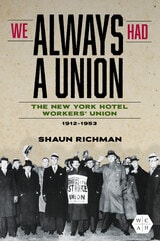
We Always Had a Union
The New York Hotel Workers' Union, 1912-1953Shaun Richman
University of Illinois Press, 2025
From the start, New York’s organized hotel workers experimented with and adapted how they organized and governed members and related to other labor unions. Richman follows union fortunes from early IWW activity through the Communist-led affiliates of the American Federation of Labor in the 1920s and 1930s, the shaping of breakthrough negotiating strategies, and the postwar era. As Richman shows, workers adopted a radicalism and militancy seldom associated with an AFL organization while openly negotiating the Communist Party’s power and influence within the union, until the Party’s eclipse in the 1950s.
An inspiring story of action and perseverance, We Always Had a Union profiles a foundational American labor union and offers lessons for today’s workers and organizers.
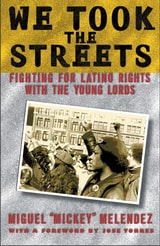
We Took the Streets
Fighting for Latino Rights with the Young LordsMiguel "Mickey" Melendez
Rutgers University Press, 0
In this memoir, Melendez describes with the unsparing eye of an insider the idealism, anger, and vitality of the Lords as they rose to become the most respected and powerful voice of Puerto Rican empowerment in the country. He also traces the internal ideological disputes that led the group, but not the mission, to fracture in 1972. Written with passion and compelling detail, We Took the Streets tells the story of how one group took on the establishment—and won.
In 1968 Miguel “Mickey” Melendez was a college student, developing pride in his Cuban and Puerto Rican cultural identity and becoming increasingly aware of the effects of social inequality on Latino Americans. Joining with other like-minded student activists, Melendez helped form the central committee of the New York branch of the Young Lords, one of the most provocative and misunderstood radical groups to emerge during the 1960s. Incorporating techniques of direct action and community empowerment, the Young Lords became a prominent force in the urban northeast. From their storefront offices in East Harlem, they defiantly took back the streets of El Barrio. In addition to running clothing drives, day-care centers, and food and health programs, they became known for their media-savvy tactics and bold actions, like the takeovers of the First People’s Church and Lincoln Hospital.
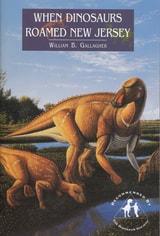
When Dinosaurs Roamed New Jersey
William B. Gallagher
Rutgers University Press, 1997
Did you know that Benjamin Franklin examined the first dinosaur bone in America from Woodbury, Gloucester County, in 1787--decades before the word dinosaur was even coined? Or that when the first reasonably complete dinosaur skeleton in the world was unearthed in Haddonfield, Camden County, in 1858, it was a major scientific breakthrough which forced paleontologists to completely revise their picture of dinosaur anatomy? Few people know that New Jersey is the nursery of American vertebrate paleontology!
When Dinosaurs Roamed New Jersey provides a succinct and readable history of the geology and paleontology of New Jersey from the time the region was covered by Cambrian seas, 543 million years ago, to the Pleistocene Ice Age only 10-15,000 years ago. William Gallagher tells the stories of professional and amateur fossil hunters, their discoveries, and their impact on the history of paleontological thought. He points out places in New Jersey and nearby where specimens characteristic of each era were found. He shows how fossil evidence found in the state is helping paleontologists uncover the ecological interactions and behavior of dinosaurs, and discusses such ongoing scientific controversies as the reason for the extinction of the dinosaurs.
From tracking dinosaur footprints across the Newark basin, to digging for the last dinosaurs in the greensands of South Jersey, to finding a mushroom in ancient amber in East Brunswick, this book is the ideal introduction to the Garden State's fossils and prehistory.
While Waiting for Rain
Community, Economy, and Law in a Time of ChangeJohn Henry Schlegel
University of Michigan Press, 2022
What might a sensible community choose to do if its economy has fallen apart and becoming a ghost town is not an acceptable option? Unfortunately, answers to this question have long been measured against an implicit standard: the postwar economy of the 1950s. After showing why that economy provides an implausible standard—made possible by the lack of economic competition from the European and Asian countries, winners or losers, touched by the war—John Henry Schlegel attempts to answer the question of what to do.
While Waiting for Rain first examines the economic history of the United States as well as that of Buffalo, New York: an appropriate stand-in for any city that may have seen its economy start to fall apart in the 1960s, 70s, and 80s. It makes clear that neither Buffalo nor the United States as a whole has had an economy in the sense of “a persistent market structure that is the fusion of an understanding of economic life with the patterns of behavior within the economic, political, and social institutions that enact that understanding” since both economies collapsed. Next, this book builds a plausible theory of how economic growth might take place by examining the work of the famous urbanist, Jane Jacobs, especially her book Cities and the Wealth of Nations. Her work, like that of many others, emphasizes the importance of innovation for economic growth, but is singular in its insistence that such innovation has to come from local resources. It can neither be bought nor given, even by well-intentioned political actors. As a result Americans generally, as well as locally, are like farmers in the midst of a drought, left to review their resources and wait. Finally, it returns to both the local Buffalo and the national economies to consider what these political units might plausibly do while waiting for an economy to emerge.
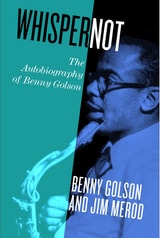
Whisper Not
The Autobiography of Benny GolsonBenny Golson
Temple University Press, 2016
“One of the greatest artists our country has is Benny Golson. He is not only a great musician, but an original and fabulous composer. He is inventive and creative and his work is loved the world over. Benny is a rare, creative genius. All I would like to say is THREE CHEERS for Benny Golson!”—Tony Bennett
“Composer supreme, tenor man supreme, jazz man supreme, good guy supreme: that’s BENNY GOLSON!"—Sonny Rollins
Born during the de facto inaugural era of jazz, saxophonist Benny Golson learned his instrument and the vocabulary of jazz alongside John Coltrane while Golson was still in high school in Philadelphia. Quickly establishing himself as an iconic fixture on the jazz landscape, Golson performed with dozens of jazz greats, from Sonny Rollins, Coleman Hawkins, and Jimmy Heath to Dizzy Gillespie, Freddie Hubbard, and many others. An acclaimed composer, Golson also wrote music for Hollywood films and television and composed such memorable jazz standards as “Stablemates,” “Killer Joe,” and “Whisper Not.”
An eloquent account of Golson’s exceptional life—presented episodically rather than chronologically—Whisper Not includes a dazzling collection of anecdotes, memories, experiences, and photographs that recount the successes, the inevitable failures, and the rewards of a life eternally dedicated to jazz.

Words That Make New Jersey History
A Primary Source Reader, revised and expanded editionEdited by Howard L. Green
Rutgers University Press, 2006
New to this expanded edition is the text of James McGreevey's "I am a Gay American" speech, as well as entries about the Abbott v. Burke court ruling mandating that New Jersey equalize funding of urban and suburban schools districts, sprawl and its effects on water supply, and the state's economic boom in the 1990s.
A balanced survey of New Jersey's history presented in the context of a changing nation, this volume is well suited to general readers who want to explore the primary sources of the state's past, and to U.S. history students at the high school and college levels.
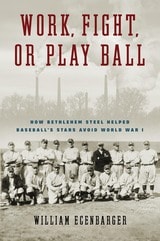
Work, Fight, or Play Ball
How Bethlehem Steel Helped Baseball's Stars Avoid World War IEcenbarger, William
Temple University Press, 2024
Some players used the steel mill and shipyard leagues to avoid wartime military duty, irking Major League owners, who saw their rosters dwindling. Bethlehem Steel President Charles Schwab (no relation to the financier) saw the league as a means to stave off employee and union organizing. Most fans loudly criticized the ballplayers, but nevertheless showed up to watch the action on the diamond.
Ecenbarger traces the 1918 Steel League’s season and compares the fates of the players who defected to industry or continued to play stateside with the travails of the Major Leaguers, such as Christy Mathewson, Ty Cobb, and Grover Cleveland Alexander, who served during the war.
Work, Fight, or Play Ball reveals the home field advantage brought on by the war, which allowed companies to profit from Major League players.
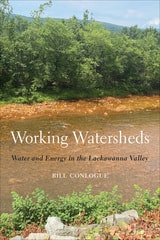
Working Watersheds
Water and Energy in the Lackawanna ValleyWilliam Conlogue
Temple University Press, 2025
Offering a fresh way to think about the Anthropocene, this distinctive history of water and coal in the Lackawanna Valley discusses how both water abundance and scarcity might play out as global temperatures rise. Working Watersheds is designed to trigger debates about the nature of history, the significance of literature, and the importance of linking person, place, and planet in an era of climate change.