Results by title
138 books match the query 'Minority Studies' and 8 start with w
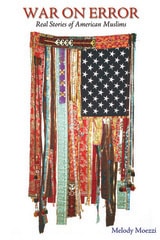
War on Error
Real Stories of American MuslimsMelody Moezzi
University of Arkansas Press, 2007
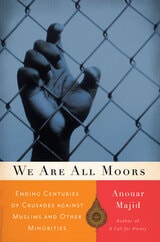
We Are All Moors
Ending Centuries of Crusades against Muslims and Other MinoritiesAnouar Majid
University of Minnesota Press, 2012
In 1609 King Philip III ordered the expulsion of all Moriscos—Spaniards of Muslim descent—from Spain in an ongoing attempt to establish a homogeneous state and remove the last vestiges of Islam from his nation. Four centuries later, Spain and Europe are once again outraged by the presence of Islam within their borders, and, for many, the millions of Muslim immigrants now living there pose a fundamental challenge to European identity. Across the Atlantic Ocean, the vast Hispanic community in the United States, both legal and illegal, has raised similar fears. Exacerbated by globalization and 9/11, these nativist, anti-Islamic, and broadly anti-immigrant attitudes fatally undermine meaningful dialogue and progress essential to creating a more peaceful and just world.
In We Are All Moors, Anouar Majid contends that the acrimonious debates about immigration and Islam in the West are the cultural legacy of the conflict between Christians and Moors. Offering a groundbreaking new history of the West’s perception and treatment of minority cultures, Majid explores how “the Moor” emerged as the archetypal Other against which Europe would define itself. The characteristics attributed to this quintessential minority—racial inferiority, religious impurity, cultural incompatibility—would be reapplied to other non-European and non-Christian peoples: Native Americans, black Africans, Jews, and minority immigrant communities, among others.
The Moor, Majid reveals, has served as an unacknowledged but potent metaphor for all minority peoples in the West, endlessly reincarnated by the majority. Only by recognizing the connections between current fears about immigration and Islam and medieval Christianity’s crusade against the Moor, he argues, can we begin to redress centuries of oppression, learn from the tragedies of the past, and find common ground in a globalized world.

Whatever Happened to Antisemitism?
Redefinition and the Myth of the 'Collective Jew'Antony Lerman
Pluto Press, 2020
'This elegantly written, erudite book is essential reading for all of us, whatever our identifications' - Lynne Segal
Antisemitism is one of the most controversial topics of our time. The public, academics, journalists, activists and Jewish people themselves are divided over its meaning. Antony Lerman shows that this is a result of a 30-year process of redefinition of the phenomenon, casting Israel, problematically defined as the ‘persecuted collective Jew’, as one of its main targets.
This political project has taken the notion of the ‘new antisemitism’ and codified it in the flawed International Holocaust Remembrance Alliance’s ‘working definition’ of antisemitism. This text is the glue holding together an international network comprising the Israeli government, pro-Israel advocacy groups, Zionist organizations, Jewish communal defence bodies and sympathetic governments fighting a war against those who would criticize Israel.
The consequences of this redefinition have been alarming, supressing free speech on Palestine/Israel, legitimizing Islamophobic right-wing forces, and politicizing principled opposition to antisemitism.
White Innocence
Paradoxes of Colonialism and RaceGloria Wekker
Duke University Press, 2016
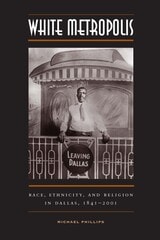
White Metropolis
Race, Ethnicity, and Religion in Dallas, 1841-2001By Michael Phillips
University of Texas Press, 2006
Winner, T. R. Fehrenbach Award, Texas Historical Commission, 2007
From the nineteenth century until today, the power brokers of Dallas have always portrayed their city as a progressive, pro-business, racially harmonious community that has avoided the racial, ethnic, and class strife that roiled other Southern cities. But does this image of Dallas match the historical reality? In this book, Michael Phillips delves deeply into Dallas's racial and religious past and uncovers a complicated history of resistance, collaboration, and assimilation between the city's African American, Mexican American, and Jewish communities and its white power elite.
Exploring more than 150 years of Dallas history, Phillips reveals how white business leaders created both a white racial identity and a Southwestern regional identity that excluded African Americans from power and required Mexican Americans and Jews to adopt Anglo-Saxon norms to achieve what limited positions of power they held. He also demonstrates how the concept of whiteness kept these groups from allying with each other, and with working- and middle-class whites, to build a greater power base and end elite control of the city. Comparing the Dallas racial experience with that of Houston and Atlanta, Phillips identifies how Dallas fits into regional patterns of race relations and illuminates the unique forces that have kept its racial history hidden until the publication of this book.
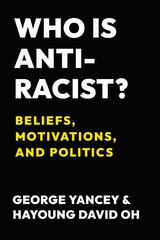
Who Is Antiracist?
Beliefs, Motivations, and PoliticsGeorge Yancey and Hayoung Oh
Temple University Press, 2025
Who Is Antiracist? provides a systematic approach to understanding the motivations and intentions of racial progressives as well as the impact of political ideology on antiracism. The authors discuss the theoretical origins of contemporary antiracism and review key works of antiracism to piece together the characteristics that define it. They also create the Antiracism Attitude Scale to explore the demographic makeup and social views of those who support the type of antiracism popularized in the United States.
Acknowledging that antiracism faces powerful challenges in fully obtaining the goals articulated by its proponents, Who Is Antiracist? enlightens us about the continuing racial conflict in our society and warns against the risk of antiracism becoming just a proxy for ordinary party politics.
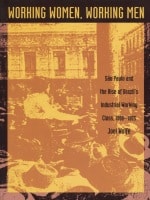
Working Women, Working Men
Sao Paulo & the Rise of Brazil’s Industrial Working Class, 1900–1955Joel Wolfe
Duke University Press, 1993
Drawing on a diverse range of sources—oral histories along with union, industry, and government archival materials—Wolfe's account focuses not only on labor leaders and formal Left groups, but considers the impact of grassroots workers' movements as well. He pays particular attention to the role of gender in the often-contested relations between leadership groups and thee rank and file. Wolfe's analysis illuminates how various class and gender ideologies influenced the development of unions, industrialists' strategies, and rank-and-file organizing and protest activities.
This study reveals how workers in Sào Paulo maintained a local grassroots social movement that, by the mid–1950s, succeeded in seizing control of Brazil's state-run official unions. By examining the actions of these workers in their rise to political prominence in the 1940s and 1950s, this book provides a new understanding of the sources and development of populist politics in Brazil.
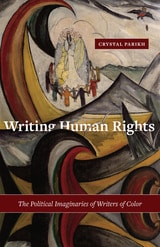
Writing Human Rights
The Political Imaginaries of Writers of ColorCrystal Parikh
University of Minnesota Press, 2017
The legal texts and aspirational ideals of human rights are usually understood and applied in a global context with little bearing on the legal discourse, domestic political struggles, or social justice concerns within the United States. In Writing Human Rights, Crystal Parikh uses the international human rights regime to read works by contemporary American writers of color—Toni Morrison, Chang-rae Lee, Ana Castillo, Aimee Phan, and others—to explore the conditions under which new norms, more capacious formulations of rights, and alternative kinds of political communities emerge.
Parikh contends that unlike humanitarianism, which views its objects as victims, human rights provide avenues for the creation of political subjects. Pairing the ethical deliberations in such works as Beloved and A Gesture Life with human rights texts like the United Nations Convention Against Torture, she considers why principles articulated as rights in international conventions and treaties—such as the right to self-determination or the right to family—are too often disregarded at home. Human rights concepts instead provide writers of color with a deeply meaningful method for political and moral imagining in their literature.
Affiliating transnational works of American literature with decolonization, socialist, and other political struggles in the global south, this book illuminates a human rights critique of idealized American rights and freedoms that have been globalized in the twenty-first century. In the absence of domestic human rights enforcement, these literatures provide a considerable repository for those ways of life and subjects of rights made otherwise impossible in the present antidemocratic moment.