Results by title
100 books match the query 'Monographs' and 4 start with w
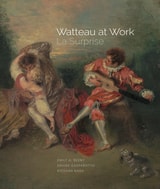
Watteau at Work
La SurpriseEmily A. Beeny
J. Paul Getty Trust, The, 2022
The painting La Surprise by Jean Antoine Watteau (1684–1721) belongs to a new genre of painting invented by the artist himself—the fête galante. These works, which show graceful open-air gatherings filled with scenes of courtship, music and dance, strolling lovers, and actors, do not so much tell a story as set a mood: one of playful, wistful, nostalgic reverie. Esteemed by collectors in Watteau’s day as a work that showed the artist at the height of his skill and success, La Surprise vanished from public view in 1848, not to reemerge for more than a century and a half. Acquired by the Getty Museum in 2017, it has never before been the subject of a dedicated publication. Marking the three hundredth anniversary of Watteau’s death, this book considers La Surprise within the context of the artist’s oeuvre and discusses the surprising history of collecting Watteau in Los Angeles.
This volume is published to accompany an exhibition on view at the J. Paul Getty Museum at the Getty Center from November 23, 2021, to February 20, 2022.
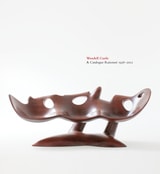
Wendell Castle
A Catalogue Raisonné, 1958–2012Wendell Castle
The Artist Book Foundation, 2014
Sculptor and furniture designer Wendell Castle (1932–2018) carved a distinct path in furniture making over nearly six decades of a distinguished career, and this long-awaited recording of his oeuvre, Wendell Castle: A Catalogue Raisonné, 1958–2012, beautifully presents the extraordinary scope of his artistry and craftsmanship. The voluminous accounting of his works, beginning with Castle's earliest, mid-century works through to his unabashed experiments with unconventional materials (gel-coated fiberglass and metallic automobile paint) and his latest signature wood laminations, is comprehensive and detailed. Three essays of varying perpectives introduce the catalogue raisonné followed by an extensive accounting of his enormous oeuvre, his exhibitions, numerous awards, and the collections of his works, as well as a substantive bibliography.
With his organic and whimsical approach to his various mediums, Castle seamlessly merged sculpture and design into one discipline, obscuring the distinction between the two. He invented the technique of carving stacked laminations of wood, and his later explorations into the qualities of fiberglass as a sculptural medium are unparalleled.

What Music Did
The Story of Numerocracy in the WestTony Conrad. Edited by Patrick Nickleson
University of Michigan Press, 2026
Throughout the book, readers encounter scenes from over two thousand years of history, mathematics, and music: Pythagoras using pebbles to articulate didactic number games to his disciples; Galileo fretting a hill and listening with a musician’s ear to calculate the rate of acceleration under gravity; Rameau trapping Western music in a five-limit tuning system, and what could have been if he were more adept with numbers. Even when drawing on classical sources to explore canonical figures like Saint Augustine, What Music Did offers idiosyncratic critical insights that highlight our ongoing cultural reverence when answers result in simple whole number ratios like 3:2, 4:3, or 5:4. What Music Did is Tony Conrad’s extended indictment of music’s role, from the Pythagoreans to the twentieth century, in upholding the use of number as a clandestine and circumscribed armature of power.
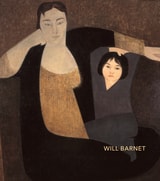
Will Barnet
Will Barnet
The Artist Book Foundation, 2024
The first monograph on Will Barnet in nearly 40 years, this title reflect's the artist's unique interpretation of the world's evolving genres.
Will Barnet’s artistic career as a painter and printmaker spanned nearly eight decades of continuous creativity. Few artists, other than perhaps Picasso or Monet, can claim such an extended period of uninterrupted and innovative art making. From the darkness of the Great Depression to the opening decade of the twenty-first century, his oeuvre reflects his unique interpretation of the art world’s evolving genres: Social Realism, Modernism, Abstract Expressionism, and ultimately representational Minimalism with the human figure as his primary subject.
This book is the first comprehensive monograph on Will Barnet in nearly 40 years. With scholarly essays by the four distinguished authors, an extensive plate section, a comprehensive chronology, lists of awards and exhibitions, and a detailed bibliography, this monograph is a thorough presentation of Barnet's iconic images and consistently evolving style while celebrating his unquenchable joie de vivre.
Barnet was devoted to making art every day and worked diligently even at the very end of his life. "The Old Masters are still alive after 400 years, and that's what I want to be," he once said. "At the age of 10 or 12, I discovered that being an artist would give me an ability to create something which would live on after death." Live on it does; in addition to his acclaimed body of work, he influenced a broad spectrum of artists such as Jackson Pollock, Mark Rothko, James Rosenquist, Cy Twombly, and Ethel Fisher.