Results by title
405 books match the query 'Natural history' and 25 start with w
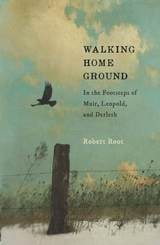
Walking Home Ground
In the Footsteps of Muir, Leopold, and DerlethRobert Root
Wisconsin Historical Society Press, 2017
When longtime author Robert Root moves to a small town in southeast Wisconsin, he gets to know his new home by walking the same terrain traveled by three Wisconsin luminaries who were deeply rooted in place—John Muir, Aldo Leopold, and August Derleth. Root walks with Muir at John Muir State Natural Area, with Leopold at the Shack, and with Derleth in Sac Prairie; closer to home, he traverses the Ice Age Trail, often guided by such figures as pioneering scientist Increase Lapham. Along the way, Root investigates the changes to the natural landscape over nearly two centuries, and he chronicles his own transition from someone on unfamiliar terrain to someone secure on his home ground.In prose that is at turns introspective and haunting, Walking Home Ground inspires us to see history’s echo all around us: the parking lot that once was forest; the city that once was glacier. "Perhaps this book is an invitation to walk home ground," Root tells us. "Perhaps, too, it’s a time capsule, a message in a bottle from someone given to looking over his shoulder even as he tries to examine the ground beneath his feet."
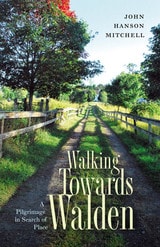
Walking Towards Walden
A Pilgrimage in Search of PlaceJohn Hanson Mitchell
University Press of New England, 2015
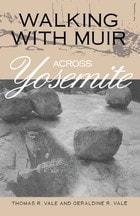
Walking with Muir across Yosemite
Thomas R. Vale
University of Wisconsin Press, 1998
Illustrated with drawings by John Muir and drawings and photos by the Vales, Walking with Muir across Yosemite emphasizes that current visitors to Yosemite—indeed to any national park—can still experience the solitude, wildness, and romanticism of nature. They believe, however, that this modern exploration would benefit from a national parks policy that actively promotes nature study and encourages a more profound interaction between humans and the natural world.
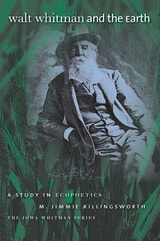
Walt Whitman and the Earth
A Study of EcopoeticsM. Jimmie Killingsworth
University of Iowa Press, 2005
It grows such sweet things out of such corruptions,
It turns harmless and stainless on its axis, with such endless successions of diseas’d corpses,
It distills such exquisite winds out of such infused fetor,
It renews with such unwitting looks its prodigal, annual, sumptuous crops,
It gives such divine materials to men, and accepts such leavings from them at last.
—Walt Whitman, from “This Compost”
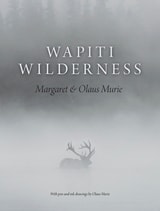
Wapiti Wilderness
Margaret Murie
University Press of Colorado, 1987
For over 37 years, Margaret and Olaus Murie made their home in the mountainous wilderness of the Tetons, where Olaus Murie conducted his famous studies of the American elk: the wapiti. Through these years their home was almost a nature-conservation shrine to thousands of Americans interested in outdoors, animals, and nature. Wapiti Wilderness, begun by Mrs. Murie as a sequel to her book Two in the Far North, which told of the Muries' life and expeditions in Alaska, became a collaborative effort by both the Muries.
In alternate chapters, Olaus tells of his work as a field biologist for the old U.S. Bureau of Biological Survey and recounts stories of his studies of not only elk but also other great animals. And Mrs. Murie, from her side, describes their life together on the trail and in the various camps and nature adventures in that wilderness during all four seasons. The book is replete with stories of Jackson Hole residents, “pioneer poets,” and the wild creatures that made their way into the Murie household. Olaus Murie's evocative pen-and-ink drawings illuminate each chapter, and four pages of photographs help complete the picture of what life was like in the wapiti wilderness.

We Came Naked and Barefoot
The Journey of Cabeza de Vaca across North AmericaBy Alex D. Krieger
University of Texas Press, 2002
Second place, Presidio La Bahia Award, Sons of the Republic of Texas, 2003
Perhaps no one has ever been such a survivor as álvar Núñez Cabeza de Vaca. Member of a 600-man expedition sent out from Spain to colonize "La Florida" in 1527, he survived a failed exploration of the west coast of Florida, an open-boat crossing of the Gulf of Mexico, shipwreck on the Texas coast, six years of captivity among native peoples, and an arduous, overland journey in which he and the three other remaining survivors of the original expedition walked some 1,500 miles from the central Texas coast to the Gulf of California, then another 1,300 miles to Mexico City.
The story of Cabeza de Vaca has been told many times, beginning with his own account, Relación de los naufragios, which was included and amplified in Gonzalo Fernando de Oviedo y Váldez's Historia general de las Indias. Yet the route taken by Cabeza de Vaca and his companions remains the subject of enduring controversy. In this book, Alex D. Krieger correlates the accounts in these two primary sources with his own extensive knowledge of the geography, archaeology, and anthropology of southern Texas and northern Mexico to plot out stage by stage the most probable route of the 2,800-mile journey of Cabeza de Vaca.
This book consists of several parts, foremost of which is the original English version of Alex Krieger's dissertation (edited by Margery Krieger), in which he traces the route of Cabeza de Vaca and his companions from the coast of Texas to Spanish settlements in western Mexico. This document is rich in information about the native groups, vegetation, geography, and material culture that the companions encountered. Thomas R. Hester's foreword and afterword set the 1955 dissertation in the context of more recent scholarship and archaeological discoveries, some of which have supported Krieger's plot of the journey. Margery Krieger's preface explains how she prepared her late husband's work for publication. Alex Krieger's original translations of the Cabeza de Vaca and Oviedo accounts round out the volume.

Wellsprings
A Natural History of Bottled Spring WatersChapelle, Francis H.
Rutgers University Press, 2005
As Francis H. Chapelle reveals in this delightful and informative volume, a complex story of geology, hydrology, and history lies behind every bottle of spring water. The book chronicles the history of the bottled water industry in America from its beginnings in Europe hundreds of years ago to the present day. Subsequent chapters describe the chemical characteristics that make some waters desirable, and provide an overview of the geologic circumstances that produce them. Wellsprings explains how these geologic conditions vary throughout the country, and how this affects the kinds and quality of bottled water that are available. Finally, Chapelle shows how the bottled water industry uses this natural history, together with the perceived health benefits of spring waters, to market their products.
Accessibly written and well illustrated, Wellsprings is both a revealing account and a user’s guide to natural spring waters. Regardless of your drinking preference, this timely exploration will make your next drink of water refreshingly informed.

What's Nature Worth
Terre Satterfield
University of Utah Press, 2004
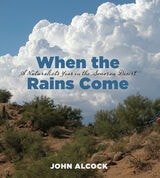
When the Rains Come
A Naturalist’s Year in the Sonoran DesertJohn Alcock
University of Arizona Press, 2009
John Alcock knows the Sonoran Desert better than just about anyone else, and in this book he tracks the changes he observes in plant and animal life over the course of a drought year. Combining scientific knowledge with years of exploring the desert, he describes the variety of ways in which the wait for rain takes place—and what happens when it finally comes.
The desert is a land of five seasons, featuring two summers—hot, dry months followed by monsoon—and Alcock looks at the changes that take place in an entire desert community over the course of all five. He describes what he finds on hikes in the Usery Mountains near Phoenix, where he has studied desert life over three decades and where frequent visits have enabled him to notice effects of seasonal variation that might escape a casual glance.
Blending a personal perspective with field observation, Alcock shows how desert ecology depends entirely on rainfall. He touches on a wide range of topics concerning the desert’s natural history, noting the response of saguaro flowers to heat and the habits of predators, whether soaring red-tailed hawk or tiny horned lizard. He also describes unusual aspects of insects that few desert hikers will have noticed, such as the disruptive color pattern of certain grasshoppers that is more effective than most camouflage.
When the Rains Come is brimming with new insights into the desert, from the mating behaviors of insects to urban sprawl, and features photographs that document changes in the landscape as drought years come and go. It brings us the desert in the harshest of times—and shows that it is still teeming with life.
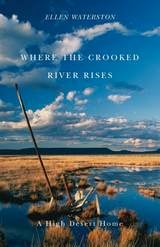
Where the Crooked River Rises
A High Desert HomeEllen Waterston
Oregon State University Press, 2010

Where the Wild Animals Is Plentiful
Diary of an Alabama Fur Trader's Daughter, 1912-1914May Jordan
University of Alabama Press, 2006
This rare find--a journal of a young backwoods woman--provides a unique picture of rural life in southwestern Alabama early in the 20th century.
"I am a little Alabama girl living on the frontier where the wild animals is plentiful," wrote May Jordan in 1912. During the hunting season her father traveled Washington County buying furs, and May--already 23--accompanied him on two of these trips, cooking meals, helping out with the business, and recording their experiences.
May's diary of these trips from December 1912 to March 1914 describes the routine of the fur trade and provides a vivid portrait of wilderness travel and social customs. Through May's eyes, readers can experience the sights and sounds of pine forests and swamps, the difficulty of wading through waist-deep mud, and the neighborliness of the people living in this isolated area. May also shares both the solace of religious faith and her love of laughter as reflected in the jokes she records.
Elisa Moore Baldwin provides an introduction that traces Jordan family history and describes economic, social, and political conditions during the period. Baldwin also includes annotations based on court records, census rolls, and other primary sources and photographs of many of the characters in May's narrative to provide a vivid picture of the times. Because few first-person accounts exist of the life of poor whites, this diary will be invaluable to students of southern and women's history; no comparable work exists for this part of Alabama during this era. May's journal takes us to another world and teaches us about the lively human spirit in the face of hardship and loneliness.

Whispers and Shadows
A Naturalist’s MemoirJerry Apps
Wisconsin Historical Society Press, 2015
Combining his signature lively storytelling and careful observations of nature, Apps draws on a lifetime of experiences, from his earliest years growing up on a central Wisconsin farm to his current ventures as gardener, tree farmer, and steward of wetlands, prairies, and endangered Karner blue butterflies. He also takes inspiration from the writings of Aldo Leopold, Annie Dillard, Henry David Thoreau, Sigurd Olson, Ralph Waldo Emerson, John Muir, Barbara Kingsolver, Wendell Berry, Richard Louv, and Rachel Carson. With these eloquent essays, Jerry Apps reminds us to slow down, turn off technology, and allow our senses to reconnect us to the natural world. For it is there, he writes, that “I am able to return to a feeling I had when I was a child, a feeling of having room to stretch my arms without interfering with another person, a feeling of being a small part of something much larger than I was, and I marvel at the idea.”

Whispers in the Pines
A Naturalist in the NortheastBurger, Joanna
Rutgers University Press, 2006
In this book, naturalist Joanna Burger takes us on a series of delightful trips through the Pine Barrens. From the Albany Pine Bush, the Long Island Barrens, and the New Jersey Pine Barrens in the Northeast, to the pinelands of South Carolina and Florida, Burger describes in lively detail how these habitats have come to harbor such a unique assemblage of species.
She introduces us to amphibians and reptiles, neotropical migrants and other birds, and a range of common and unusual mammals. Burger also traces the regions’ historic and geologic backgrounds, and the impact of human occupation from the time of the paleo-Indians to the present. She revisits the tension between development and preservation, reminding us that a healthy pine barren region requires uninterrupted land and rejuvenating fires, both of which are increasingly jeopardized.
Whispers in the Pines is essential reading for everyone concerned with the history and preservation of these unique landscapes and their wildlife.
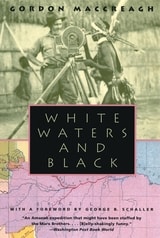
White Waters and Black
Gordon MacCreagh
University of Chicago Press, 2001

Wide Rivers Crossed
The South Platte and the Illinois of the American PrairieEllen E. Wohl
University Press of Colorado, 2013
During the past two centuries, these rivers changed dramatically, mostly due to human interaction. Crops replaced native vegetation; excess snowmelt and rainfall carried fertilizers and pesticides into streams; and levees, dams, and drainage altered distribution. These changes cascaded through networks, starting in small headwater tributaries, and reduced the ability of rivers to supply the clean water, fertile soil, and natural habitats they had provided for centuries. Understanding how these rivers, and rivers in general, function and how these functions have been altered over time will allow us to find innovative approaches to restoring river ecosystems.
The environmental changes in the South Platte and the Illinois reflect the relentless efforts by humans to control the distribution of water: to enhance surface water in the arid western prairie and to limit the spread of floods and drain the wetlands along the rivers in the water-abundant east. Wide Rivers Crossed looks at these historical changes and discusses opportunities for much-needed protection and restoration for the future.
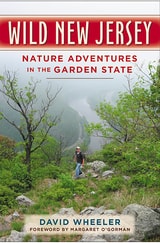
Wild New Jersey
Nature Adventures in the Garden StateDavid Wheeler
Rutgers University Press, 2011
Wild New Jersey invites readers along Wheeler’s whirlwind year-long tour of the most ecologically diverse state for its size in America. Along with the expert guidance of charismatic wildlife biologists and local conservationists, he explores mountains, valleys, beaches, pine barrens, caves, rivers, marshlands, and more—breathtaking landscapes and the state’s Noah’s Ark of fascinating creatures.
This isn’t your ordinary ride on the Jersey Turnpike. Fasten your seatbelts and join Wheeler as he . . .
- Kayaks through the Meadowlands under the watchful eye of the Empire State Building,
- Pans for cretaceous fossils in a hidden brook once home to mastodons and giant sloths,
- Rides a fishing boat in the frigid snows of winter on a high-seas quest for Atlantic puffins,
- Trudges through the eerie darkness of a bog on a mysterious night hike,
- Dogsleds across the windswept alpine slopes in the haunts of the porcupine and bobcat.
With Wheeler’s compelling narrative, in-depth background details, and eye for revealing the offbeat, you can count this as the first nature book to paint the extraordinary picture of New Jersey’s unlikely wilderness in all its glory. Come along for all the adventure and insight in Wild New Jersey!
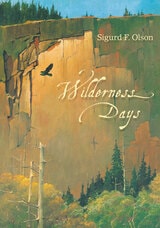
Wilderness Days
Sigurd F. Olson
University of Minnesota Press, 2012
In the evocative words of one of America’s best-loved nature writers, Wilderness Days brings together the essence of the magnificent wilderness with which he so deeply identifies. Sigurd F. Olson collects from his writings those moments that most vividly depict the turn of the seasons in the great woodlands and waters of the legendary Quetico–Superior region overlapping the Ontario–Minnesota border.

Wind in the Rock
The Canyonlands of Southeastern UtahAnn Zwinger
University of Arizona Press, 1978
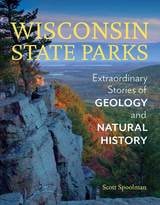
Wisconsin State Parks
Extraordinary Stories of Geology and Natural HistoryScott Spoolman
Wisconsin Historical Society Press, 2018
The impressive bluffs, valleys, waterfalls, and lakes of Wisconsin’s state parks provide more than beautiful scenery and recreational opportunities. They are windows into the distant past, offering clues to the dramatic events that have shaped the land over billions of years.
Author and former DNR journalist Scott Spoolman takes readers with him to twenty-eight parks, forests, and natural areas where evidence of the state’s striking geologic and natural history are on display. In an accessible storytelling style, Spoolman sheds light on the volcanoes that poured deep layers of lava rock over a vast area in the northwest, the glacial masses that flattened and molded the landscape of northern and eastern Wisconsin, mountain ranges that rose up and wore away over hundreds of millions of years, and many other bedrock-shaping phenomena. These stories connect geologic processes to the current landscape, as well as to the evolution of flora and fauna and development of human settlement and activities, for a deeper understanding of our state’s natural history.
The book includes a selection of detailed trail guides for each park, which hikers can take with them on the trail to view evidence of Wisconsin’s geologic and natural history for themselves.
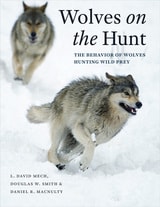
Wolves on the Hunt
The Behavior of Wolves Hunting Wild PreyL. David Mech, Douglas W. Smith, and Daniel R. MacNulty
University of Chicago Press, 2015
Combining behavioral data, thousands of hours of original field observations, research in the literature, a wealth of illustrations, and—in the e-book edition and online—video segments from cinematographer Robert K. Landis, the authors create a compelling and complex picture of these hunters. The wolf is indeed an adept killer, able to take down prey much larger than itself. While adapted to hunt primarily hoofed animals, a wolf—or especially a pack of wolves—can kill individuals of just about any species. But even as wolves help drive the underlying rhythms of the ecosystems they inhabit, their evolutionary prowess comes at a cost: wolves spend one-third of their time hunting—the most time consuming of all wolf activities—and success at the hunt only comes through traveling long distances, persisting in the face of regular failure, detecting and taking advantage of deficiencies in the physical condition of individual prey, and through ceaseless trial and error, all while risking injury or death.
By describing and analyzing the behaviors wolves use to hunt and kill various wild prey—including deer, moose, caribou, elk, Dall sheep, mountain goats, bison, musk oxen, arctic hares, beavers, and others—Wolves on the Hunt provides a revelatory portrait of one of nature’s greatest hunters.

Woman Of The Boundary Waters
Canoeing, Guiding, Mushing, and SurvivingJustine Kerfoot
University of Minnesota Press, 1994

Wordsworth and the Green Romantics
Affect and Ecology in the Nineteenth CenturyLisa Ottum
University of New Hampshire Press, 2016

Woven Shades of Green
An Anthology of Irish Nature LiteratureTim Wenzell
Bucknell University Press, 2019
Published by Bucknell University Press. Distributed worldwide by Rutgers University Press.
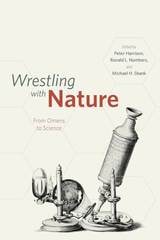
Wrestling with Nature
From Omens to ScienceEdited by Peter Harrison, Ronald L. Numbers, and Michael H. Shank
University of Chicago Press, 2011
When and where did science begin? Historians have offered different answers to these questions, some pointing to Babylonian observational astronomy, some to the speculations of natural philosophers of ancient Greece. Others have opted for early modern Europe, which saw the triumph of Copernicanism and the birth of experimental science, while yet another view is that the appearance of science was postponed until the nineteenth century.
Rather than posit a modern definition of science and search for evidence of it in the past, the contributors to Wrestling with Nature examine how students of nature themselves, in various cultures and periods of history, have understood and represented their work. The aim of each chapter is to explain the content, goals, methods, practices, and institutions associated with the investigation of nature and to articulate the strengths, limitations, and boundaries of these efforts from the perspective of the researchers themselves. With contributions from experts representing different historical periods and different disciplinary specializations, this volume offers a fresh perspective on the history of science and on what it meant, in other times and places, to wrestle with nature.

Writing Natural History
Dialogue with AuthorsEdward Lueders
University of Utah Press, 1989
Writing Natural History is the edited record of four public dialogues held at the University of Utah in 1988 between eminent writers in the fields of natural history. In these interchanges the writers discussed their traditions, perspectives, values, purposes, techniques, and personal insights. Their conversations, like their work, link the sciences with the humanities in surprising ways, enhancing our understanding and appreciation of both. This volume maintains the vitality of the spoken dialogues and conveys a lively sense of each speaker’s concern with the processes of the natural world and our human position in it.
Half of the authors began as professionals in the natural sciences before becoming recognized for their literary skills; the other half are established writers whose works reflect their vital human affinity with and respect for nature. Writing Natural History will appeal to all readers involved in conservation, nature study, creative writing, environmental issues, the natural sciences, the outdoors, and the ecological politics of Earth.
Authors dialogues feature Barry Lopez and Edward O. Wilson, Robert Finch and Terry Tempest Williams, Gary Paul Nabhan and Ann Zwinger, Paul Brooks and Edward Lueders.