55 books match the query 'Northwest, Pacific' and 3 start with w
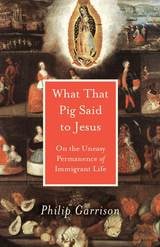
cover of What That Pig Said to Jesus: On the Uneasy Permanence of Immigrant Life

What That Pig Said to Jesus

On the Uneasy Permanence of Immigrant Life

Philip Garrison

University of Utah Press, 2017

Philip Garrison says his book of essays is “in praise of mixed feelings,” particularly the mixed feelings he and his neighbors have toward the places they came from. His neighborhood is the Columbia Plateau, one of many North American nodes of immigration. Following a meandering, though purposeful trail, Garrison catches hillbillies and newer Mexican arrivals in ambiguous, wary encounters on a set four hundred years in the making, built on a foundation of Native American displacement. Garrison is the product of the earlier surge of new arrivals: from the 1930s to the 1970s, those he calls hillbillies left such mid-nation states as Arkansas, Missouri, Oklahoma, Kansas, and the Dakotas for the West. The more recent wave, from 1990 to 2010, came mostly from the central plateau of Mexico. These are folks with whom Garrison communes in multiple ways. Anecdotes from sources as varied as pioneer diaries, railroad promotions, family Bibles, Wikipedia, and local gossip “portray the region's immigration as a kind of identity makeover, one that takes the form first of breakdown, then of reassembly, and finally of renewal.” Garrison’s mix of slangy memoir and anthropological field notes shines light on the human condition in today’s West. 
[more]
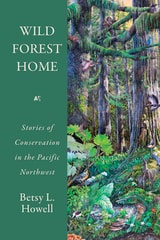
cover of Wild Forest Home: Stories of Conservation in the Pacific Northwest

Wild Forest Home

Stories of Conservation in the Pacific Northwest

Betsy L. Howell

University of Utah Press, 2024

Growing up in the Pacific Northwest, Betsy L. Howell spent her childhood exploring and thriving in old-growth coniferous forests. In the summer of 1986, she volunteered in Mt. Hood National Forest, surveying northern spotted owls. That summer position turned into three decades as a wildlife biologist with the U.S. Forest Service during a time of tremendous change within the agency.

The twenty-five essays in Wild Forest Home chronicle Howell’s career and personal experiences studying the wildlife of the Pacific Northwest during the litigious listing of the northern spotted owl and marbled murrelet under the Endangered Species Act and the Clinton administration’s adoption of the seminal 1994 Northwest Forest Plan. Meanwhile, Howell toiled on fire crews, searched for rare species, helped to monitor fishers reintroduced to the Olympic Peninsula, tested amphibians for deadly diseases, became a writer, and mourned the deaths of her parents. This captivating memoir seamlessly blends story and science to reveal a unique portrait of the struggles and joys of one wildlife biologist.
[more]
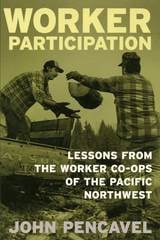
cover of Worker Participation: Lessons from Worker Co-ops of the Pacific Northwest

Worker Participation

Lessons from Worker Co-ops of the Pacific Northwest

John Pencavel

Russell Sage Foundation, 2001

Once they accept a job, most Americans have little control over their work environments. In Worker Participation, John Pencavel examines some of those rare workplaces where employees both own and manage the companies they work for: the plywood cooperatives and forest worker cooperatives of the Pacific Northwest. Rather than relying on abstract theories, Pencavel reviews the actual experiences of these two groups of worker co-ops. He focuses on how worker-owned companies perform when compared to more traditional firms and whether companies operate more efficiently when workers determine how they are run. He also looks at the long-term viability of these enterprises and why they are so unusual. Most businesses are constantly caught in the battle over whether to use the firm's profits to pay labor or to increase capital. Worker cooperatives provide an appealing case study because the interests of labor and capital are aligned. If individuals have a role in setting goals, they should have an added incentive to help meet those goals, and productivity should benefit. On the other hand, observers have long argued that, since any single employee in a co-op reaps only a small benefit from working hard, workers may shirk work, and productivity can flag. Furthermore, co-ops often have difficulty raising capital, since they are constrained by how much money the workers have, and banks are often reluctant to lend them money. Using some fifteen years of data on forty mills in Washington State, Pencavel examines how worker co-ops really function. He assesses the practical problems of running a workplace where every employee is a boss. He looks at worker productivity, on-the-job injuries and financial risks facing owner-workers. He considers whether co-ops are inherently unstable and if they are plagued by infighting among the many worker-owners. Although many of the co-ops he studied have closed or been replaced by conventional businesses, Pencavel judges them to have been a success. Despite the risks inherent in such operations, allowing workers to make the decisions that profoundly affect them produces many benefits, including workplace efficiency and increased job security. However, Pencavel concludes, if more Americans are to enjoy such a working arrangement, labor laws will have to be changed, participation encouraged, and a more vigorous public debate about worker participation must take place. This book provides an excellent place to start the discussion.
[more]