Results by title
242 books match the query 'Old Testament' and 10 start with w
Warfare, Ritual, and Symbol in Biblical and Modern Contexts
Brad E. Kelle
SBL Press, 2014
New perspectives on Israelite warfare for biblical studies, military studies, and social theory
Contributors investigate what constituted a symbol in war, what rituals were performed and their purpose, how symbols and rituals functioned in and between wars and battles, what effects symbols and rituals had on insiders and outsiders, what ways symbols and rituals functioned as instruments of war, and what roles rituals and symbols played in the production and use of texts.
Features:
- Thirteen essays examine war in textual, historical, and social contexts
- Texts from the Hebrew Bible are read in light of ancient Near Eastern texts and archaeology
- Interdisciplinary studies make use of contemporary ritual and social theory
Was There a Wisdom Tradition
New Prospects in Israelite Wisdom StudiesMark R. Sneed
SBL Press, 2015
Essential reading for scholars and students in wisdom studies
This collection of essays explores questions that challenge the traditional notion of a wisdom tradition among the Israelite literati, such as: Is the wisdom literature a genre or mode of literature or do we need new terminology? Who were the tradents? Is there such a thing as a “wisdom scribe” and what would that look like? Did the scribes who composed wisdom literature also have a hand in producing the other “traditions,” such as the priestly, prophetic, and apocalyptic, as well as other non-sapiential works? Were Israelite sages open to non-sapiential forms of knowledge in their conceptualization of wisdom?
Features:
- Recent genre theory in distinction from traditional form criticism
- Ancient Near Eastern comparative material
- A balanced collection that includes essays that seriously challenge and affirm the consensus view, as well as those that reconfigure it
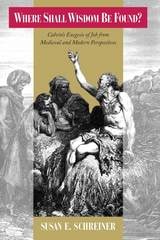
Where Shall Wisdom be Found?
Calvin's Exegesis of Job from Medieval and Modern PerspectivesSusan E. Schreiner
University of Chicago Press, 1994
For Calvin and his predecessors, Schreiner argues, the concept of intellectual perception is the key to an understanding of Job. The texts she examines constantly raise questions about the human capacity for knowledge: What can the sufferer who stands within history perceive about the self, God, and reality? Can humans truly perceive the workings of providence in their personal lives or in the tumult of history? Are evil and injustice a reality that we must confront before finding wisdom?
In her final chapter, Schreiner turns to the wide array of twentieth-century interpretations of Job, including modern biblical commentaries, the work of Carl Jung, and literary transfigurations by Wells, MacLeish, Wiesel, and Kafka. The result is a compelling demonstration of how the history of exegesis can yield vital insights for contemporary culture.
Wisdom Discourse and Torah in Second Temple Judaism
Challenging the Integration ParadigmJiseong James Kwon
SBL Press, 2025
Did wisdom literature in the Hebrew Bible develop over time from secular to religious, as many early modern scholars believed? Did it develop in reaction to historical events or out of conflict with other traditions, including Torah? In Wisdom Discourse and Torah in Second Temple Judaism, JiSeong James Kwon moves beyond this impasse by applying a discourse-critical method to intertextual readings of Proverbs, Ben Sira, the Wisdom of Solomon, Baruch, the Dead Sea Scrolls, and Deuteronomy. Kwon’s study reveals that wisdom literature maintained an independent identity and theological orientation distinct from the legal traditions of the Torah. Rather than wisdom being subsumed into legal material, Jewish intellectual production remained pluralistic in form, genre, and theological orientation throughout the Persian and Hellenistic periods.
Wisdom from the Late Bronze Age
Yoram Cohen
SBL Press, 2013
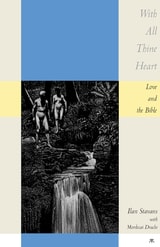
With All Thine Heart
Love and the BibleStavans, Ilan
Rutgers University Press, 2010
Presented in an engaging, conversational format and touched with striking artwork, the textured dialogue between Stavans and Drache is meant to show how the Bible is a multidimensional text and one that, when considered over the course of history, still has the power to shape our world. The theme of love provides the connective tissue that binds this work.
Addressing a wide range of topics, from biblical archaeology and fundamentalism to Hollywood movies, lexicography, and the act of praying, With All Thine Heart suggests that the Hebrew Bible is a novel worth decoding patiently, such as one does with classics like Don Quixote de la Mancha, In Search of Lost Time, and Anna Karenina. Similar to the protagonists in these tales, biblical characters, although not shaped with the artistic nuance of modern literature, allow for astonishing insight. This exploration of love through the pages of the Bible—organized chronologically from Genesis to Exodus and followed by insightful meditations on the Song of Songs and the Book of Job—is a delightful intellectual and spiritual treat . . . Shema Ysrael!
With the Loyal You Show Yourself Loyal
Essays on Relationships in the Hebrew Bible in Honor of Saul M. OlyanT. M. Lemos
SBL Press, 2021
Contributors to this volume come together to honor the lifetime of work of Saul M. Olyan, Samuel Ungerleider Jr. Professor of Judaic Studies and Professor of Religious Studies at Brown University. Essays by his students, colleagues, and friends focus on and engage with his work on relationships in the Hebrew Bible, from the marking of status in relationships of inequality, to human family, friend, and sexual relationships, to relationships between divine beings. Contributors include Susan Ackerman, Klaus-Peter Adam, Rainer Albertz, Andrea Allgood, Debra Scoggins Ballentine, Bob Becking, John J. Collins, Stephen L. Cook, Ronald Hendel, T. M. Lemos, Nathaniel B. Levtow, Carol Meyers, Susan Niditch, Brian Rainey, Thomas Römer, Jordan D. Rosenblum, Rüdiger Schmitt, Jennifer Elizabeth Singletary, Kerry M. Sonia, Karen B. Stern, Stanley Stowers, Andrew Tobolowsky, Karel van der Toorn, Emma Wasserman, and Steven Weitzman.

Women at Work in the Deuteronomistic History
Mercedes L. García Bachmann
SBL Press, 2013
A thorough study of the socio-economic and literary contexts of women in the Deuteronomistic History
Mercedes L. García Bachmann examines the key texts in the Deuteronomistic History that mention women in service occupations: slaves and dependents, cooks, wet nurses, childcare givers, prostitutes, and scribes. The mostly anonymous women who performed this work for others are sometimes mentioned only in a single verse. Consequently, they often are as unrecognized in modern scholarship as they seem in the biblical text. García Bachmann shows that these women were honored not in relation to matters such as sexual purity or marital faithfulness but on account of the valuable service that they provided.
- A close examination of unnamed women
- A review of previous work in feminist, ancient Near Eastern, biblical, and social-scientific studies
- Extensive coverage of Hebrew terms used for women workers
Worship, Women and War
Essays in Honor of Susan NiditchJohn J. Collins
SBL Press, 2015
Celebrate the career of an inspirational scholar and teacher concerned with revealing voices from the margins
This volume of essays honors Susan Niditch, author of War in the Hebrew Bible: A Study in the Ethics of Violence (1993), “My Brother Esau Is a Hairy Man”: Hair and Identity in Ancient Israel (2008), and most recently, The Responsive Self: Personal Religion in Biblical Literature of the Neo-Babylonian and Persian Periods (forthcoming), among other influential publications. Essays touch on topics such as folklore, mythology, and oral history, Israelite religion, ancient Judaism, warfare, violence, and gender.
Features:
- Essays from nineteen scholars, all experts in their fields
- Exploration of texts from Mesopotamia, the Hebrew Bible, and the New Testament
- Bibliography of Niditch's scholarly contributions
Writing and Literacy in the World of Ancient Israel
Epigraphic Evidence from the Iron AgeChristopher A. Rollston
SBL Press, 2010