Results by title
96 books match the query 'Penology' and 8 start with w
Way Down in the Hole
Race, Intimacy, and the Reproduction of Racial Ideologies in Solitary ConfinementAngela J. Hattery
Rutgers University Press, 2023
Way Down the Hole Video 1 (https://youtu.be/UuAB63fhge0)
Way Down the Hole Video 2 (https://youtu.be/TwEuw1cTrcQ)
Way Down the Hole Video 3 (https://youtu.be/bOcBv_UnHIs)
Way Down the Hole Video 4 (https://youtu.be/cx_l1S8D77c)
Weeping in the Playtime of Others
America’s Incarcerated Children. 2nd edition.Written by Kenneth Wooden with a foreword by Kathleen M. Heide
The Ohio State University Press, 2000
Kenneth Wooden’s Weeping in the Playtime of Others—first published in 1976 and an enduring work of investigative journalism and criminology that was nominated for a Pulitzer Prize—exposes the harsh realities faced by children in the American juvenile justice system. Wooden’s extensive research and firsthand accounts highlight the systemic abuse, neglect, and violence that incarcerated youth endure. Investigative reporter Wooden journeyed across thirty states to document brutal conditions in juvenile detention centers and training schools. His work revealed in stark detail how these institutions regularly failed to provide the rehabilitation they promised, perpetuating cycles of violence and criminality, and presented a devastating picture of the detrimental effects on of solitary confinement, physical punishment, and inadequate educational and psychological support.
Wooden’s many case studies include that of a young Charles Manson, illustrating how early institutionalization can presage lifelong criminal behavior. Wooden also critiques the political and economic forces that sustain these abusive systems, calling for comprehensive reforms.
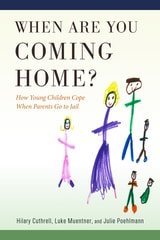
When Are You Coming Home?
How Young Children Cope When Parents Go to JailHilary Cuthrell
Rutgers University Press, 2023
Wisconsin Sentencing in the Tough-on-Crime Era
How Judges Retained Power and Why Mass Incarceration Happened AnywayMichael O'Hear
University of Wisconsin Press, 2021
O'Hear tracks the effects of sentencing laws and politics in Wisconsin from the eve of the imprisonment boom in 1970 up to the 2010s. Drawing on archival research, original public-opinion polling, and interviews with dozens of key policymakers, he reveals important dimensions that have been missed by others. He draws out lessons from the Wisconsin experience for the United States as a whole, where mass incarceration has cost taxpayers billions of dollars and caused untold misery to millions of inmates and their families.

Women Guarding Men
Lynn Zimmer
University of Chicago Press, 1986
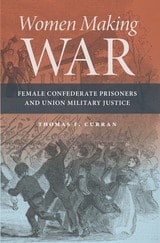
Women Making War
Female Confederate Prisoners and Union Military JusticeThomas F. Curran
Southern Illinois University Press, 2020
During the American Civil War, more than four hundred women were arrested and imprisoned by the Union Army in the St. Louis area. The majority of these women were fully aware of the political nature of their actions and had made conscious decisions to assist Confederate soldiers in armed rebellion against the U.S. government. Their crimes included offering aid to Confederate soldiers, smuggling, spying, sabotaging, and, rarely, serving in the Confederate army. Historian Thomas F. Curran’s extensive research highlights for the first time the female Confederate prisoners in the St. Louis area, and his thoughtful analysis shows how their activities affected Federal military policy.
Early in the war, Union officials felt reluctant to arrest women and waited to do so until their conduct could no longer be tolerated. The war progressed, the women’s disloyal activities escalated, and Federal response grew stronger. Some Confederate partisan women were banished to the South, while others were held at Alton Military Prison and other sites. The guerilla war in Missouri resulted in more arrests of women, and the task of incarcerating them became more complicated.
The women’s offenses were seen as treasonous by the Federal government. By determining that women—who were excluded from the politics of the male public sphere—were capable of treason, Federal authorities implicitly acknowledged that women acted in ways that had serious political meaning. Nearly six decades before U.S. women had the right to vote, Federal officials who dealt with Confederate partisan women routinely referred to them as citizens. Federal officials created a policy that conferred on female citizens the same obligations male citizens had during time of war and rebellion, and they prosecuted disloyal women in the same way they did disloyal men.
The women arrested in the St. Louis area are only a fraction of the total number of female southern partisans who found ways to advance the Confederate military cause. More significant than their numbers, however, is what the fragmentary records of these women reveal about the activities that led to their arrests, the reactions women partisans evoked from the Federal authorities who confronted them, the impact that women’s partisan activities had on Federal military policy and military prisons, and how these women’s experiences were subsumed to comport with a Lost Cause myth—the need for valorous men to safeguard the homes of defenseless women.
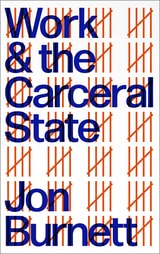
Work and the Carceral State
Jon Burnett
Pluto Press, 2022
During 2019-20 in England and Wales, over 17 million hours of labor were carried out by more than 12,500 people incarcerated in prisons, while many people in immigration detention centers were also put to work. These people constitute a sub-waged, captive workforce who are frequently discarded by the state when done with.
Work and the Carceral State examines these forms of work as part of a broader exploration of the relationship between criminalization, criminal justice, immigration policy and labor, tracing their lineage through the histories of transportation and banishment, of houses of correction and prisons, to the contemporary production of work.
Criminalization has been used to enforce work and to discipline labor throughout the history of England and Wales. This book demands that we recognise the carceral state as operating at the frontier of labor control in the 21st century.
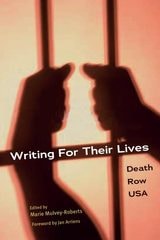
Writing for Their Lives
Death Row USAEdited by Marie Mulvey-Roberts. Foreword by Jan Arriens
University of Illinois Press, 2007
Exposing little-known facts about the five modes of execution practiced in the United States today, Writing for Their Lives documents the progress of life on death row from a capital trial to execution and beyond, through the testimony of the prisoners themselves as well as those who watch, listen, and write to them. What emerges are stories of the survival of the human spirit under even the most unimaginable circumstances, and the ways in which some prisoners find penitence and peace in the most unlikely surroundings. In spite of the uniformity of their prison life and its nearly inevitable conclusion, prisoners able to read and write letters are shown to retain and develop their individuality and humanity as their letters become poems and stories.
Writing for Their Lives serves ultimately as an affirmation of the value of life and provides bountiful evidence that when a state executes a prisoner, it takes a life that still had something to give.
This edition features an introduction by the editor as well as a foreword by Jan Arriens. Dr. Mulvey-Roberts will be donating her profits from the sale of this volume to the legal charity Amicus, which assists in capital defense in the United States."