Results by title
221 books match the query 'Personal narratives' and 12 start with w
War Stories
Suffering and Sacrifice in the Civil War NorthFrances M. Clarke
University of Chicago Press, 2011
The American Civil War is often seen as the first modern war, not least because of its immense suffering. Yet unlike later conflicts, it did not produce an outpouring of disillusionment or cynicism, as most people continued to portray the war in highly sentimental and patriotic terms. While scholars typically dismiss this everyday writing as simplistic or naïve, Frances M. Clarke argues that we need to reconsider the letters, diaries, songs, and journalism penned by Union soldiers and their caregivers to fully understand the war’s impact and meaning.
In War Stories, Clarke revisits the most common stories that average Northerners told in hopes of redeeming their suffering and loss—stories that enabled people to make sense of their hardship, and to express their beliefs about religion, community, and personal character. From tales of Union soldiers who died heroically to stories of tireless volunteers who exemplified the Republic’s virtues, War Stories sheds new light on this transitional moment in the history of war, emotional culture, and American civic life.

Wartime Washington
The Civil War Letters of Elizabeth Blair LeeEdited by Virginia Jeans Laas
University of Illinois Press, 1991
We Are a People in This World
The Lakota Sioux and the Massacre at Wounded KneeConger Beasley Jr.
University of Arkansas Press, 1997
We Cannot Forget
Interviews with Survivors of the 1994 Genocide in RwandaTotten, Samuel
Rutgers University Press, 2011
During a one-hundred-day period in 1994, Hutus murdered between half a million and a million Tutsi in Rwanda. The numbers are staggering; the methods of killing were unspeakable. Utilizing personal interviews with trauma survivors living in Rwandan cities, towns, and dusty villages, We Cannot Forget relates what happened during this period and what their lives were like both prior to and following the genocide.
Through powerful stories that are at once memorable, disturbing, and informative, readers gain a critical sense of the tensions and violence that preceded the genocide, how it erupted and was carried out, and what these people faced in the first sixteen years following the genocide.
Welcome the Hour of Conflict
William Cowan McClellan and the 9th AlabamaWilliam Cowan McClellan, edited by John C. Carter
University of Alabama Press, 2007
In the Spring of 1861, a 22-year-old Alabamian did what many of his friends and colleagues were doing—he joined the Confederate Army as a volunteer. The first of his family to enlist, William Cowan McClellan, who served as a private in the 9th Alabama Infantry regiment, wrote hundreds of letters throughout the war, often penning for friends who could not write home for themselves. In the letters collected in John C. Carter’s volume, this young soldier comments on his feelings toward his commanding officers, his attitude toward military discipline and camp life, his disdain for the western Confederate armies, and his hopes and fears for the future of the Confederacy.
McClellan’s letters also contain vivid descriptions of camp life, battles, marches, picket duty, and sickness and disease in the army. The correspondence between McClellan and his family dealt with separation due to war as well as with other wartime difficulties such as food shortages, invasion, and occupation. The letters also show the rise and fall of morale on both the home front and on the battlefield, and how they were closely intertwined.
Remarkable for their humor, literacy, and matter-of-fact banter, the letters reveal the attitude a common soldier in the Army of Northern Virginia had toward the day-to-day activity and progression of the war. John C. Carter includes helpful appendixes that list the letters chronologically and offer the regimental roster, casualty/enlistment totals, assignments, and McClellan’s personal military record.
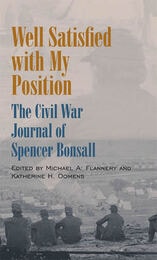
Well Satisfied with My Position
The Civil War Journal of Spencer BonsallEdited by Michael A. Flannery and Katherine H. Oomens
Southern Illinois University Press, 2007
Well Satisfied with My Position offers a first-person account of army life during the Civil War’s Peninsula Campaign and Battle of Fredericksburg. Spencer Bonsall, who joined the 81st Pennsylvania Infantry as a hospital steward, kept a journal from March 1862 until March 1863, when he abruptly ceased writing. Editors Michael A. Flannery and Katherine H. Oomens place his experiences in the context of the field of Civil War medicine and continue his story in an epilogue.
Trained as a druggist when he was in his early twenties, Bonsall traveled the world, spent eight years on a tea plantation in India, and settled in Philadelphia, where he worked in the city surveyor’s office. But in March 1862, when he was in his mid-forties, the lure of serving his country on the battlefield led Bonsall to join the 81st Pennsylvania Infantry as a hospital steward.
Bonsall enjoyed his life with the Union army at first, comparing bivouacking in the woods to merely picnicking on a grand scale. “We are about as jolly a set of old bachelors as can be found in Virginia,” Bonsall wrote. But his first taste of the aftermath of battle at Fair Oaks and the Seven Days’ Battles in Virginia changed his mind about the joys of soldiering—though he never lost his zeal for the Union cause.
Bonsall details the camp life of a soldier from firsthand experience, outlines the engagements of the 81st, and traces the Battle of Fredericksburg and the Peninsula Campaign. He records facts not available elsewhere about camp conditions, attitudes toward Union generals and Confederate soldiers, and troop movements.
From the end of June to late October 1862, Bonsall’s illness kept him from writing in his journal. He picked up the record again in December 1862, just before the Battle of Fredericksburg, Virginia, in which the Union suffered a staggering 10,200 casualties and the 81st Pennsylvania lost more than half its men. He vividly describes the bloody aftermath. Bonsall’s horse was shot out from underneath him at the battle of Gettysburg, injuring him seriously and ending his military career. Although he was listed as “sick in hospital” on the regiment’s muster rolls, he was labeled a deserter in the U.S. Army records. Indeed, after recovery from his injuries, Bonsall walked away from the army to resume life in Philadelphia with his wife and child.
Published for the first time, Bonsall’s journal offers an unusually personal glimpse into the circumstances and motives of a man physically ruined by the war. Seventeen illustrations, including some drawn by Bonsall himself, help bring this narrative to life.

Widows by the Thousand
The Civil War Correspondence of Theophilus and Harriet Perry, 1862–1864M. Jane Johansson
University of Arkansas Press, 2000

William & Rosalie
A Holocaust TestimonyWilliam Schiff
University of North Texas Press, 2007
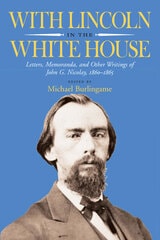
With Lincoln in the White House
Letters, Memoranda, and other Writings of John G. Nicolay, 1860-1865Edited by Michael Burlingame
Southern Illinois University Press, 2000
From the time of Lincoln’s nomination for the presidency until his assassination, John G. Nicolay served as the Civil War president’s chief personal secretary. Nicolay became an intimate of Lincoln and probably knew him as well as anyone outside his own family. Unlike John Hay, his subordinate, Nicolay kept no diary, but he did write several memoranda recording his chief’s conversation that shed direct light on Lincoln. In his many letters to Hay, to his fiancée, Therena Bates, and to others, Nicolay often describes the mood at the White House as well as events there. He also expresses opinions that were almost certainly shaped by the president
For this volume, Michael Burlingame includes all of Nicolay’s memoranda of conversations, all of the journal entries describing Lincoln’s activities, and excerpts from most of the nearly three hundred letters Nicolay wrote to Therena Bates between 1860 and 1865. He includes letters and portions of letters that describe Lincoln or the mood at the White House or that give Nicolay’s personal opinions. He also includes letters written by Nicolay while on troubleshooting missions for the president.
An impoverished youth, Nicolay was an unlikely candidate for the important position he held during the Civil War. It was only over the strong objections of some powerful people that he became Lincoln’s private secretary after Lincoln’s nomination for the presidency in 1860. Prominent Chicago Republican Herman Kreismann found the appointment of a man so lacking in savoir faire
Lacking charm, Nicolay became known at the White House as the “bulldog in the ante-room” with a disposition “sour and crusty.” California journalist Noah Brooks deemed Nicolay a “grim Cerberus of Teutonic descent who guards the last door which opens into the awful presence.” Yet in some ways he was perfectly suited for the difficult job. William O. Stoddard, noting that Nicolay was not popular and could “say 'no'about as disagreeably as any man I ever knew,” still granted that Nicolay served Lincoln well because he was devoted and incorruptible. Stoddard concluded that Nicolay “deserves the thanks of all who loved Mr. Lincoln.”
For his part, Nicolay said he derived his greatest satisfaction “from having enjoyed the privilege and honor of being Mr. Lincoln’s intimate and official private secretary, and of earning his cordial friendship and perfect trust.”
Women, Violence and War
Wartime Victimization of Refugees in the BalkansVesna Nikolic-Ristanovic
Central European University Press, 2000
Based on interviews with seventy women refugees, Women, Violence and War is a book about war as it is seen, lived and interpreted by women who were citizens of the former Yugoslavia.
Many of the accounts portray the horrific experiences the victims had to face and the book addresses issues of sexual, physical and psychological violence, as well as problems of confinement, upheaval and family separation. In a completely new insight the book dispels the myth that many of the women were peasants, and shows that in fact they were educated, middle-class women with independent careers. The study also depicts how some of the victims attempt to come to terms with the aftermath of wartime abuse.
This probing, accurate and unique investigation of victimization is an unparalleled volume that presents a completely new perspective maintaining that violence against women in war is not independent of peace-time victimization and the imbalance of power between sexes.
Worthy of the Cause for Which They Fight
The Civil War Diary of Brigadier General Harris Reynolds, 1861-1865Robert Patrick Bender
University of Arkansas Press, 2011
Writing That Breaks Stones
African Child Soldier NarrativesJoya Uraizee
Michigan State University Press, 2020