Results by title
4917 books match the query 'Philosophy' and 132 start with w
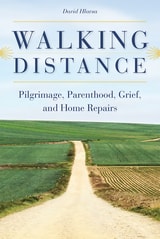
Walking Distance
Pilgrimage, Parenthood, Grief, and Home RepairsDavid Hlavsa
Michigan State University Press, 2015
Though walking more than 400 miles across the north of Spain turned out to be more difficult than they had anticipated, after a series of misadventures, including a brief stay in a Spanish hospital, they arrived in Santiago. Shortly after their return to Seattle, Lisa became pregnant, and the hardships of the Camino were no comparison to what followed: the stillbirth of their first son and Lisa’s harrowing second pregnancy.
Walking Distance is a moving and disarmingly funny book, a good story with a happy ending—the safe arrival of David and Lisa’s second son, Benjamin. David and Lisa get more than they bargained for, but they also get exactly what they wanted: a child, a solid marriage, and a richer life.
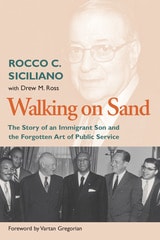
Walking On Sand
The Story of an Immigrant Son and the Forgotten Art of Public ServiceRocco C Siciliano
University of Utah Press, 2004
Rocco C. Siciliano broke new ground as the first Italian-American to serve in the White House as an assistant to the president, Dwight D. Eisenhower. At 31, "Ike’s Youngest" attained a prominence not suggested in his humble beginnings in Salt Lake City, Utah. But his upbringing in the Mormon-dominated community, where he balanced the heritage of his striving immigrant parents with his own aspirations for success, prepared him for a wide variety of service. This service includes leading a special weapons platoon in the 10th Mountain Division in World War II, bringing Martin Luther King Jr. to meet with President Eisenhower, and becoming a recognized business leader in California.
Siciliano used his expertise in labor, personnel management, and business to contribute substantively to the J. Paul Getty Center, the Los Angeles Philharmonic Association, the Committee for Economic Development, and the "Volcker" Commission on Public Service, among others.
The variety of Siciliano’s experiences reinvigorates our understanding of the forgotten art of public service. Walking on Sand emphasizes the role that public service can play for corporations, communities, states, and the nation. This story is a gift from the Greatest Generation to the many people who serve America today and will serve her tomorrow.
Walls
Enclosure and Ethics in the Modern LandscapeThomas Oles
University of Chicago Press, 2014
In Walls, Oles shows how our minds and our politics are shaped by–and shape–our divisions in the landscape. He traces the rich array of practices and meanings connected to the making and marking of boundaries across history and prehistory, and he describes how these practices have declined in recent centuries. The consequence, he argues, is all around us in the contemporary landscape, riven by walls shoddy in material and mean in spirit. Yet even today, Oles demonstrates, every wall remains potentially an opening, a stage, that critical place in the landscape where people present themselves and define their obligations to one another. In an evocative epilogue, Oles brings to life a society of productive, intentional, and ethical enclosure—one that will leave readers more hopeful about the divided landscapes of the future.
Walter Benjamin for Children
An Essay on His Radio YearsJeffrey Mehlman
University of Chicago Press, 1993
Now in paperback, an insightful analysis of the great theorist's most unusual work: a diverse collection of radio broadcasts for children.
In light of the legendary difficulty of Walter Benjamin's works, it is a strange and intriguing fact that from 1929 to 1933, the great critic and cultural theorist wrote—and broadcast—numerous scripts, on the order of fireside chats, for children. Invited to speak on whatever subject he considered appropriate, Benjamin talked to the children of Frankfurt and Berlin about the destruction of Pompeii, an earthquake in Lisbon, and a railroad disaster at the Firth of Tay. He spoke about bootlegging and swindling, cataclysm and suicide, Faust and Cagliostro. In this first sustained analysis of the thirty surviving scripts, Jeffrey Mehlman demonstrates how Benjamin used the unlikely forum of children's radio to pursue some of his central philosophical and theological concerns.
In Walter Benjamin for Children, readers will encounter a host of intertextual surprises: an evocation of the flooding of the Mississippi informed by the argument of "The Task of the Translator;" a discussion of scams in stamp-collecting that turns into "The Work of Art in the Age of Mechanical Reproduction;" a tale of bootlegging in the American South that converges with the best of Benjamin's essays on fiction. Mehlman superimposes a dual series of texts dealing with catastrophe, on the one hand, and fraud, on the other, that resonate with the false-messianic theology of Sabbatianism as it came to focus the attention and enthusiasm of Benjamin's friend Gershom Scholem during the same years. The radio scripts for children, that is, offer an unexpected byway, on the eve of the apocalypse, into Benjamin's messianic preoccupations.
A child's garden of deconstruction, these twenty-minute talks—from the perspective of childhood, before an invisible audience, on whatever happened to cross the critic's mind—are also by their very nature the closest we may ever come to a transcript of a psychoanalysis of Walter Benjamin. Particularly alive to that circumstance, Mehlman explores the themes of the radio broadcasts and brilliantly illuminates their hidden connections to Benjamin's life and work.
This lucid analysis brings to light some of the least researched and understood aspects of Walter Benjamin's thought. It will interest and provoke literary theorists and philosophers of culture, as well as anyone who hopes to understand one of this century's most suggestive and perplexing critics.
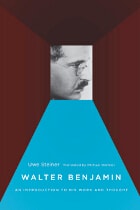
Walter Benjamin
An Introduction to His Work and ThoughtUwe Steiner
University of Chicago Press, 2010
Acknowledged only by a small circle of intellectuals during his lifetime, Benjamin is now a major figure whose work is essential to an understanding of modernity. Steiner traces the development of Benjamin’s thought chronologically through his writings on philosophy, literature, history, politics, the media, art, photography, cinema, technology, and theology. Walter Benjamin reveals the essential coherence of its subject’s thinking while also analyzing the controversial or puzzling facets of Benjamin’s work. That coherence, Steiner contends, can best be appreciated by placing Benjamin in his proper context as a member of the German philosophical tradition and a participant in contemporary intellectual debates.
As Benjamin’s writing attracts more and more readers in the English-speaking world, Walter Benjamin will be a valuable guide to this fascinating body of work.
Wandering
Philosophical Performances of Racial and Sexual FreedomSarah Jane Cervenak
Duke University Press, 2014
War and the State
The Theory of International PoliticsR. Harrison Wagner
University of Michigan Press, 2010
War and the State exposes the invalid arguments employed in the unproductive debate about Realism among international relations scholars, as well as the common fallacy of sharply distinguishing between conflict among states and conflict within them. As R. Harrison Wagner demonstrates, any understanding of international politics must be part of a more general study of the relationship between political order and organized violence everywhere--as it was in the intellectual tradition from which modern-day Realism was derived. War and the State draws on the insights from Wagner's distinguished career to create an elegantly crafted essay accessible to both students and scholars.
"Possibly the most important book on international relations theory since Kenneth Waltz's Theory of International Politics."
---James Fearon, Stanford University
"This is one of the best books on international relations theory I have read in a very long time. It is required reading for any student of modern IR theory. Once again, Wagner has shown himself to be one of the clearest thinkers in the field today."
---Robert Powell, Robson Professor of Political Science, University of California, Berkeley
"Painting on a vast canvas, and tackling and integrating topics such as state formation, domestic politics, and international conflict, R. Harrison Wagner's War and the State offers many brilliant insights into the nature of international relations and international conflict. War and the State compellingly highlights the importance of constructing rigorous and valid theorizing and sets a high standard for all students of international relations. The field has much to gain if scholars follow the trail blazed by Wagner in this book."
---Hein Goemans, University of Rochester
R. Harrison Wagner is Professor of Government at the University of Texas.
Warping Time
How Contending Political Forces Manipulate the Past, Present, and FutureBenjamin Ginsberg and Jennifer Bachner
University of Michigan Press, 2023
Warping Time shows how narratives of the past influence what people believe about the present and future state of the world. In Benjamin Ginsberg and Jennifer Bachner’s simple experiments, in which the authors measured the impact of different stories their subjects heard about the past, these “history lessons” moved contemporary policy preferences by an average of 16 percentage points; forecasts of the future moved contemporary policy preferences by an average of 12 percentage points; the two together moved preferences an average of 21 percentage points. And, in an Orwellian twist, the authors estimate that the “history lessons” had an average “erasure effect” of 8.5 percentage points—the difference between those with long-held preferences and those who did not recall that they previously held other opinions before participating in the experiment. The fact that the past, present, and future are subject to human manipulation suggests that history is not simply the product of impersonal forces, material conditions, or past choices. Humans are the architects of history, not its captives. Political reality is tenuous. Changes in our understanding of the past or future can substantially alter perceptions of and action in the present. Finally, the manipulation of time, especially the relationship between past and future, is a powerful political tool.
Watsuji on Nature
Japanese Philosophy in the Wake of HeideggerDavid W. Johnson
Northwestern University Press, 2019
In an engagingly lucid and deft analysis, Watsuji on Nature radically expands our appreciation of twentieth-century Japanese philosophy and shows what it has to offer to a global philosophical conversation.
Ways of Making and Knowing
The Material Culture of Empirical KnowledgeEdited by Pamela H. Smith, Amy R. W. Meyers, and Harold J. Cook
Bard Graduate Center, 2017
Ways of Releasement
Writings on God, Eckhart, and ZenReiner Schürmann
Diaphanes, 2023
In 1962, Reiner Schürmann began studying at the Dominican school of theology Le Saulchoir, outside Paris. That experience radically shaped his life and work, enabling him to begin to develop many of the ideas for which he would later be known: letting be, life without why, ontological anarchy, and the tragic double bind.
Ways of Releasement contains never-before-published material from Schürmann’s early period as well as a report Schürmann wrote about his encounter with Heidegger; a précis of his autobiographical novel, Origins; and translations and new editions of later groundbreaking essays. Ways of Releasement concludes with an extensive afterword setting Schürmann’s writings in the context of his thinking and life.
Ways of Seeing After Dark
Kyle Parry
University of Minnesota Press, 2026
Rethinking darkness through the politics and possibilities of vision
Darkness is widely misunderstood, argues Kyle Parry. We take darkness as the enemy of sight, yet we can’t see without it. We call the worst parts of our lives dark, yet we wouldn’t be here without wombs, skulls, oceans, the moon, and other shadowed places. Ways of Seeing After Dark contends that darkness is not absence but presence, shaping how worlds are sensed, inhabited, and understood. Darkness brings peril, but it is also a fundamental, if increasingly threatened, condition of living together on this planet.
Tracing links between John Berger’s influential Ways of Seeing and his more poetic later writings, Parry recasts contemporary conditions defined by light pollution, digital mediation, and racialized regimes of seeing. In dialogue with artists, critics, and astronomers, Ways of Seeing After Dark examines how fear of darkness is built rather than universal and how such training intersects with broader social structures, including racism and capitalism. Showing how “felt darkness displaces physical darkness” and “brighter nights bring darker days,” Parry reveals the dark as a multifaceted phenomenon with political and perceptual significance, calling for new ways of seeing with and through the night.
Retail e-book files for this title are screen-reader friendly.
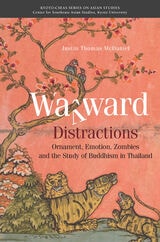
Wayward Distractions
Ornament, Emotion, Zombies and the Study of Buddhism in ThailandJustin Thomas McDaniel
National University of Singapore Press, 2021
In Thailand, Buddhism is deeply integrated into national institutions and ideologies, making it tempting to think of Buddhism in Thailand as a textual, institutional, cultural, and conceptual whole. At the same time, religious expression in the country reflects anything but a single order. Often gaudy, cacophonous, variegated, and jumbled, diversity and apparent contradiction abound. A more open engagement with Buddhism in Thailand requires a willingness to be distracted, to step away from received hierarchies and follow the intriguing detail in the ornate design, the odd textual reference, and to prefer "thin description" over a search for meaning. Justin McDaniel's well-known book-length writings in Buddhist and Theravada studies cannot be fully understood without taking into account his shorter writings, what he calls his wayward distractions. Collected together for the first time, these essays cover subjects ranging from ornamental art to marriage and emotion, the role of Hinduism, neglected gender and ethnic diversity, Buddhist inflections in contemporary art practice, and the boundaries between the living, dead, and undead. These writings will be of importance to students of Theravada and Thailand, of religion in Southeast Asia and more generally, of the materialist turn in studies of religion.
Wayward Reproductions
Genealogies of Race and Nation in Transatlantic Modern ThoughtAlys Eve Weinbaum
Duke University Press, 2004
Gracefully traversing a wide range of discourses––including literature, evolutionary theory, early anthropology, Marxism, feminism, and psychoanalysis––Weinbaum traces a genealogy of the race/reproduction bind within key intellectual formations of the late nineteenth and twentieth centuries. She examines two major theorists of genealogical thinking—Friedrich Nietzsche and Michel Foucault—and unearths the unacknowledged ways their formulations link race and reproduction. She explores notions of kinship and the replication of racial difference that run through Charlotte Perkins Gilman’s work; Marxist thinking based on Friedrich Engel’s The Origin of the Family; Charles Darwin’s theory of sexual selection; and Sigmund Freud’s early studies on hysteria. She also describes W. E. B. Du Bois’s efforts to transcend ideas about the reproduction of race that underwrite citizenship and belonging within the United States. In a coda, Weinbaum brings the foregoing analysis to bear on recent genomic and biotechnological innovations.
We Decide!
Theories and Cases in Participatory DemocracyMichael Menser
Temple University Press, 2017
Participatory democracy calls for the creation and proliferation of practices and institutions that enable individuals and groups to better determine the conditions in which they act and relate to others. Michael Menser’s timely book We Decide! is arguably the most comprehensive treatment of participatory democracy. He explains the three waves of participatory democracy theory to show that this movement is attentive to the mechanics of contemporary political practices. Menser also outlines “maximal democracy,” his own view of participatory democracy that expands people’s abilities to shape their own lives, reduce inequality, and promote solidarity.
We Decide! draws on liberal, feminist, anarchist, and environmental justice philosophies as well as in-depth case studies of Spanish factory workers, Japanese housewives, and Brazilian socialists to show that participatory democracy actually works. Menser concludes his study by presenting a reconstructed version of the state that is shaped not by corporations but by inclusive communities driven by municipal workers, elected officials, and ordinary citizens working together. In this era of Bernie Sanders and Donald Trump, the participatory democracy proposed in We Decide! is more significant than ever.
We Make the Road by Walking
Conversations on Education and Social ChangeMyles Horton
Temple University Press, 1990
We
Reviving Social HopeRonald Aronson
University of Chicago Press, 2017
Beneath today’s crisis Aronson examines our heartbreaking story: a century of catastrophic violence and the bewildering ambiguity of progress—all of which have contributed to the evaporation of social hope. As he shows, we are now in a time when hope is increasingly privatized, when—despite all the ways we are connected to each other—we are desperately alone, struggling to weather the maelstrom around us, demoralized by the cynicism that permeates our culture and politics, and burdened with finding personal solutions to social problems.
Yet, Aronson argues, even at a time when false hopes are rife, social hope still persists. Carefully exploring what we mean when we say we “hope” and teasing hope apart from its dangerously misconstrued sibling, “progress,” he locates seeds of real change. He argues that always underlying our experience—even if we completely ignore it—is the fact of our social belonging, and that this can be reactivated into a powerful collective force, an active we. He looks to various political movements, from the massive collective force of environmentalists to the movements around Sanders and Jeremy Corbyn, as powerful examples of socially energized, politically determined, and actionably engaged forms of hope. Even in this age of Donald Trump, the result is an illuminating and inspiring call that anyone can clearly hear: we can still create a better future for everyone, but only if we resist false hopes and act together.
Weakness of Will from Plato to the Present (Studies in Philosophy and the History of Philosophy, Volume 49)
Tobias Hoffmann
Catholic University of America Press, 2008
Wealth, Commerce, and Philosophy
Foundational Thinkers and Business EthicsEdited by Eugene Heath and Byron Kaldis
University of Chicago Press, 2017
Spanning the history of western philosophy as well as looking toward classical Chinese thought and medieval Islamic philosophy, this volume provides business ethicists a unified source of clear, accurate, and compelling accounts of how the ideas of foundational thinkers—from Aristotle to Friedrich Hayek to Amartya Sen—relate to wealth, commerce, and markets. The essays illuminate perspectives that have often been ignored or forgotten, informing discussion in fresh and often unexpected ways. In doing so, the authors not only throw into relief common misunderstandings and misappropriations often endemic to business ethics but also set forth rich moments of contention as well as novel ways of approaching complex ethical problems. Ultimately, this volume provides a bedrock of moral thought that will move business ethics beyond the ever-changing opinions of headline-driven debate.
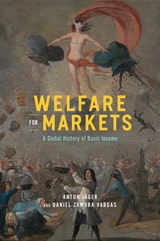
Welfare for Markets
A Global History of Basic IncomeAnton Jäger and Daniel Zamora Vargas
University of Chicago Press, 2023
A sweeping intellectual history of the welfare state’s policy-in-waiting.
The idea of a government paying its citizens to keep them out of poverty—now known as basic income—is hardly new. Often dated as far back as ancient Rome, basic income’s modern conception truly emerged in the late nineteenth century. Yet as one of today’s most controversial proposals, it draws supporters from across the political spectrum.
In this eye-opening work, Anton Jäger and Daniel Zamora Vargas trace basic income from its rise in American and British policy debates following periods of economic tumult to its modern relationship with technopopulist figures in Silicon Valley. They chronicle how the idea first arose in the United States and Europe as a market-friendly alternative to the postwar welfare state and how interest in the policy has grown in the wake of the 2008 credit crisis and COVID-19 crash.
An incisive, comprehensive history, Welfare for Markets tells the story of how a fringe idea conceived in economics seminars went global, revealing the most significant shift in political culture since the end of the Cold War.
Welfare in America
How Social Science Fails the PoorWilliam M. Epstein
University of Wisconsin Press, 1997
William M. Epstein charges that most current social welfare programs are not held to credible standards in their design or their results. Rather than spending less on such research and programs, however, Epstein suggests we should spend much more, and do the job right.
The American public and policymakers need to rely on social science research for objective, credible information when trying to solve problems of employment, affordable housing, effective health care, and family integrity. But, Epstein contends, politicians treat welfare issues as ideological battlegrounds; they demand immediate results from questionable data and implement policies long before social researchers can complete their analyses. Social scientists often play into the political agenda, supporting poorly conceived programs and doing little to test and revise them. Analyzing Aid to Families with Dependent Children (AFDC) and the recent welfare reform act, Food Stamps, Medicaid, job training, social services, and other programs, Epstein systematically challenges the conservative’s vain hope that neglect is therapeutic for the poor, as well as the liberal’s conceit that a little bit of assistance is sufficient.
Western Creed, Western Identity
Essays in Legal and Social PhilosophyJude P. Dougherty
Catholic University of America Press, 2000
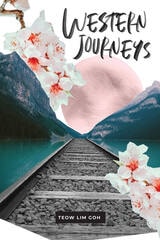
Western Journeys
Teow Lim Goh
University of Utah Press, 2022
In Western Journeys, Teow Lim Goh charts her journeys immigrating from Singapore and spending the last fifteen years living in and exploring the American West. Goh chronicles her lived experiences while building on the longer history of immigrants from Asia during the nineteenth and twentieth centuries, bringing new insights to places, the historical record, and memory. These vital essays consider how we access truth in the face of erasure. In exploring history, nature, politics, and art, Goh asks, “What does it mean for an immigrant to be at home?”
Looking beyond the captivating landscapes of the American West, Goh uncovers stories of the Chinese people who came to America during the era of Chinese Exclusion Act, as well as the stories of the Indigenous peoples who have been written out of popular narratives, and various others. She examines the links between the transcontinental railroad, the cowboy myth, and the anti-Chinese prejudice that persists today. These essays explore the early efforts to climb Colorado’s highest peaks, the massacre of Chinese miners in Rock Springs, Wyoming, and the increasingly destructive fire seasons in the West. Goh’s essays create a complex, varied, and sometimes contradictory story of people and landscapes, a tapestry of answers and questions.
Whale
K.L. Evans
University of Minnesota Press, 2003
An entirely fresh approach to Moby Dick, by way of Ludwig Wittgenstein
The aim of this thoroughly unconventional work is to demonstrate that Herman Melville’s Moby Dick and Ludwig Wittgenstein’s Philosophical Investigations share the same projects and are, in effect, one and the same book. Confounding and improbable as such an enterprise might seem, Whale! not only successfully reveals the vital intersections between Melville and Wittgenstein but also, more important, makes a compelling argument for why such intersections are essential to understanding common political projects in literature and philosophy.
Written with grace, passion, and wit, Whale! manages to produce a startling and remarkably original reading of one of the most written-about and interpreted books in the American canon. K. L. Evans explores Melville’s vast work as a tale not of vengeance but of affection, and Ahab’s near-pathological agitation as indicative of his refusal to accept the world as unknowable. Between Ahab and the whale, Evans traces a longing for connection and meaning and finds a forceful response to the skeptical view that language is bankrupt and knowledge is uncertain. In Ahab’s hunt for Moby Dick, Whale! discovers a way to reconnect matter with meaning, object with knowledge.
What Animals Teach Us about Politics
Brian Massumi
Duke University Press, 2014
What Did the Romans Know?
An Inquiry into Science and WorldmakingDaryn Lehoux
University of Chicago Press, 2012
What Do You Think, Mr. Ramirez?
The American Revolution in EducationGeoffrey Galt Harpham
University of Chicago Press, 2017
That, says Harpham, was the midcentury promise of American education, the deep current of commitment and aspiration that undergirded the educational system that was built in the postwar years, and is under extended assault today. The United States was founded, he argues, on the idea that interpreting its foundational documents was the highest calling of opinion, and for a brief moment at midcentury, the country turned to English teachers as the people best positioned to train students to thrive as interpreters—which is to say as citizens of a democracy. Tracing the roots of that belief in the humanities through American history, Harpham builds a strong case that, even in very different contemporary circumstances, the emphasis on social and cultural knowledge that animated the midcentury university is a resource that we can, and should, draw on today.

What Does It Mean to Be Human?
Elizabeth Minnich
Temple University Press, 2027
What does it mean to be human? It has long been a tantalizing question for religious figures, scientists, political leaders, artists, and autocrats, among others. Noted philosopher Elizabeth Minnich claims, “There are no answers to such a question (although we all have favored responses).”
In What Does It Mean to Be Human?, Minnich invites us to reclaim our freedom from the dangerously distorted rationales for supremacism. She explores how the simplest mistakes in responses to “what does it mean to be human?” have enabled deadly historical errors, totalizing regimes, colonialisms, genocides, and enslavement. Paying close attention to the languages, logics, and nonsense of authoritative pronouncements, Minnich considers ways of thinking that affect and reflect meaning. She offers a fresh understanding of how mistakenly limited definitions of “human being” can be.
What Does It Mean to Be Human? emerges from Minnich’s ongoing effort to find, think through, and dissolve past mistakes that keep resurfacing to disastrous effect.
What Gardens Mean
Stephanie Ross
University of Chicago Press, 1998
In What Gardens Mean, Stephanie Ross draws on philosophy as well as the histories of art, gardens, culture, and ideas to explore the magical lure of gardens. Paying special attention to the amazing landscape gardens of eighteenth-century England, she situates gardening among the other fine arts, documenting the complex messages gardens can convey and tracing various connections between gardens and the art of painting.
What Gardens Mean offers a distinctive blend of historical and contemporary material, ranging from extensive accounts of famous eighteenth-century gardens to incisive connections with present-day philosophical debates. And while Ross examines aesthetic writings from the seventeenth and eighteenth centuries, including Joseph Addison's Spectator essays on the pleasures of imagination, the book's opening chapter surveys more recent theories about the nature and boundaries of art. She also considers gardens on their own terms, following changes in garden style, analyzing the phenomenal experience of viewing or strolling through a garden, and challenging the claim that the art of gardening is now a dead one.
Showing that an artistic lineage can be traced from gardens in the Age of Satire to current environmental installations, this book is a sophisticated account of the myriad pleasures that gardens offer and a testimony to their enduring sensory and cognitive appeal. Beautifully illustrated and elegantly written, What Gardens Mean will delight all those interested in the history of gardens and the aesthetic and philosophical issues that they invite.
"Replete with provocative musings, Ross delineates links that should prove interesting to readers engaged in pondering our capacity to relate to the natural world through the gardens we create."—Booklist
"[A]n innovative and absorbing study of the garden as an object of aesthetic interest."—Allen Carlson, Journal of Aesthetics and Art Criticism
"[P]leasantly readable. . . . A thought-provoking book for all who reflect as they dig."—Noel Kingsbury, Country Life
"[A] refreshing view of the subject. . . . Ross's book is continually illuminating in unexpected ways."—Gillian Darley, Architects' Journal
"What Gardens Mean is a wonderful intellectual combination of discussions on the interdisciplinary histories of art, gardening, and philosophy."—Choice
What Gender Is, What Gender Does
Judith Roof
University of Minnesota Press, 2016
What Gender Is, What Gender Does provides a forceful new paradigm for considering genders. With depth and insight, Judith Roof argues that genders are much more than binary. And they are constantly morphing: they are conscious and unconscious, simultaneously conventional and idiosyncratic. At any moment, more than one gender dynamic is at work in any individual.
Roof’s interpretation of genders isn’t content with either biological duality or endlessly open performativity, and what results is a nuanced and surprising representation of gender—an account that captures the complexities of lived experience as well as lived ideology. For Roof, genders are interacting sets of operations that link individual desires to multiple, shifting manifestations of sociocultural positioning and self-presentation. Thus, “to gender” is to signal, mask, suggest, mislead, and simplify the uncontainable chaos of desires characteristic of subjects but roundly contained by society.
Drawing illustrative material from contemporary popular culture productions, including My Big Fat Greek Wedding, Spider-Man, Shrek, Shallow Hal, Sex and the City, Bridesmaids, Bond films, and “bromance” movies, What Gender Is, What Gender Does demonstrates how the persistent conflation of gender and sexual difference is, on the one hand, a simple taxonomic urge and, on the other, a cover that offers the security of identity in place of the frustrations and fears of the real asymmetries of personal power dynamics.
What I Saw, Heard, Learned . . .
Giorgio Agamben
Seagull Books, 2023
What can the senses of an attentive philosopher see, hear, and learn that can, in turn, teach us about living better lives? Perhaps it’s less a matter of asking what and more a matter of asking how. These latest reflections from Italy’s foremost philosopher form a sort of travelogue that chronicles Giorgio Agamben’s profound interior journey. Here, with unprecedented immediacy, Agamben shares his final remarks, late-life observations, and reflections about his life that flashed before his eyes. What did he see in that brief flash? What did he stay faithful to? What remains of all those places, friends, and teachers?
What If?
Twenty-Two Scenarios in Search of ImagesVilém Flusser
University of Minnesota Press, 2022
An imagination of possibilities, of miscalculations, of futures off-kilter
“Probability is a chimera, its head is true, its tail a suggestion. Futurologists attempt to compel the head to eat the tail (ouroboros). Here, though, we will try to wag the tail.” —Vilém Flusser
Two years after his Vampyroteuthis Infernalis, the philosopher Vilém Flusser engaged in another thought experiment: a collection of twenty-two “scenarios for the future” to be produced as computer-generated media, or technical images, that would break the imaginative logjam in conceiving the social, political, and economic future of the universe. What If? is not just an “impossible journey” to which Flusser invites us in the first scenario; it functions also as a distorting mirror held up to humanity.
Flusser’s disarming scenarios of an Anthropocene fraught with nightmares offer new visions that range from the scientific to the fantastic to the playful and whimsical. Each essay reflects our present sense of understanding the world, considering the exploitation of nature and the dangers of global warming, overpopulation, and blind reliance on the promises of scientific knowledge and invention. What If? offers insight into the radical futures of a slipstream Anthropocene that have much to do with speculative fiction, with Flusser’s concept of design as “crafty” or slippery, and with art and the immense creative potential of failure versus reasonable, “good” computing or calculability. As such, the book is both a warning and a nudge to imagine what we may yet become and be.
What Is Biodiversity?
James Maclaurin and Kim Sterelny
University of Chicago Press, 2008
Here, Maclaurin and Sterelny explore not only the origins of the concept of biodiversity, but also how that concept has been shaped by ecology and more recently by conservation biology. They explain the different types of biodiversity important in evolutionary theory, developmental biology, ecology, morphology and taxonomy and conclude that biological heritage is rich in not just one biodiversity but many. Maclaurin and Sterelny also explore the case for the conservation of these biodiversities using option value theory, a tool borrowed from economics.
An erudite, provocative, timely, and creative attempt to answer a fundamental question, What Is Biodiversity? will become a foundational text in the life sciences and studies thereof.
What Is Education?
Philip W. Jackson
University of Chicago Press, 2011
What Is History? And Other Late Unpublished Writings (CW28)
Eric Voegelin & Edited & Intro by Thomas A. Hollweck and Paul Caringella
University of Missouri Press, 0
What Is Nietzsche's Zarathustra?
A Philosophical ConfrontationHeinrich Meier
University of Chicago Press, 2021
A masterful, nuanced, and novel examination of Nietzsche’s Zarathustra.
Thus Spoke Zarathustra is Nietzsche’s most famous and most puzzling work, one in which he makes the greatest use of poetry to explore the questions posed by philosophy. But in order to understand the movement of this drama, we must first understand the character of its protagonist: we must ask, What Is Nietzsche’s Zarathustra?
Heinrich Meier attempts to penetrate the core of the drama, following as a guiding thread the question of whether Zarathustra is a philosopher or a prophet, or, if he is meant to be both, whether Zarathustra is able to unite philosopher and prophet in himself. Via a close reading that uncovers the book’s hidden structure, Meier develops a highly stimulating and original interpretation of this much-discussed but still ill-understood masterwork of German poetic prose. In the process, he carefully overturns long-established canons in the academic discourse of Nietzsche interpretation. The result is a fresh and surprising grasp of Nietzsche’s well-known teachings of the overman, the will to power, and the eternal return.

What Is Research?
Edited by Peter Miller
Bard Graduate Center, 2021
What is Research? includes conversations with theater director Annie Dorsen, biomedical researcher Elodie Ghedin, sculptor Tom Joyce, physicist Hideo Mabuchi, poet Campbell McGrath, photographer and filmmaker An-My Lê, neuroscientist Sheila Nirenberg, geochemist Terry Plank, and historian Marina Rustow, all of whom grapple with questions about the nature of research from their varied perspectives.
What Is Taoism?
and Other Studies in Chinese Cultural HistoryHerrlee Glessner Creel
University of Chicago Press, 1982
What Is Transcendental Phenomenology?
Foundations of a Phenomenological Speculative IdealismAlexander Schnell; Leonard Ip
Northwestern University Press, 2027
Offering a systematic introduction to a vital discipline
Phenomenology is a now century-old school of philosophy, to which Alexander Schnell offers here a threefold introduction that explores its diversity of approaches. In What Is Transcendental Phenomenology?, Schnell provides an in-depth overview of the Husserlian phenomenological method and its fundamental concepts (epoché and reduction, eidetic variation, phenomenological description, and phenomenological construction). He then examines that method’s limits, stressing the necessity of overcoming them in order to achieve a constructive approach while staying true to its fundamental disciplinary frameworks. Finally, he outlines a theory of understanding that expands the phenomenological method and highlights its speculative grounding before turning to speculative realists’ criticisms of the field. Schnell’s work shows that phenomenology can face the challenge of speculative thinking from an idealist standpoint, making a vital contribution to current debates about new, or speculative, realism. This important volume not only answers its titular question but, in its mode of discussing its subject, is itself phenomenology.

What Is a Person?
AN ETHICAL EXPLORATIONJames W. Walters
University of Illinois Press, 1997
important to understand what constitutes a person. What are the medical,
ethical, moral, mental, legal, and philosophical criteria that determine
protectable human life?
Following immediately on the publication of his highly praised book Choosing
Who's to Live, James Walters addresses with depth and wisdom another
ambitious and complicated matter: determining the nature of personhood.
By providing a much-needed religious/philosophical context for the discussion--examining
contemporary thinking on just what constitutes valuable life--Walters
broadens his inquiry beyond the human to include other animals and deals
with the phenomenon of anencephalic infants, those who are born without
higher brains.
Searching for a measurable and humane standard of personhood, Walters
looks at the current definition of it and declares it inadequate--offering
instead the idea of proximate personhood, with criteria for helping to
determine which individuals possess a unique claim to life.
What Is a Person?
Rethinking Humanity, Social Life, and the Moral Good from the Person UpChristian Smith
University of Chicago Press, 2010
What is a person? This fundamental question is a perennial concern of philosophers and theologians. But, Christian Smith here argues, it also lies at the center of the social scientist’s quest to interpret and explain social life. In this ambitious book, Smith presents a new model for social theory that does justice to the best of our humanistic visions of people, life, and society.
Finding much current thinking on personhood to be confusing or misleading, Smith finds inspiration in critical realism and personalism. Drawing on these ideas, he constructs a theory of personhood that forges a middle path between the extremes of positivist science and relativism. Smith then builds on the work of Pierre Bourdieu, Anthony Giddens, and William Sewell to demonstrate the importance of personhood to our understanding of social structures. From there he broadens his scope to consider how we can know what is good in personal and social life and what sociology can tell us about human rights and dignity.
Innovative, critical, and constructive, What Is a Person? offers an inspiring vision of a social science committed to pursuing causal explanations, interpretive understanding, and general knowledge in the service of truth and the moral good.
What Is an Event?
Robin Wagner-Pacifici
University of Chicago Press, 2017
What Is an Event? ranges across several disciplines, systematically analyzing the ways that events emerge, take shape, gain momentum, flow, and even get bogged down. As an exploration of how events are constructed out of ruptures, it provides a mechanism for understanding eventful forms and flows, from the micro-level of individual life events to the macro-level of historical revolutions, contemporary terrorist attacks, and financial crises. Wagner-Pacifici takes a close look at a number of cases, both real and imagined, through the reports, personal narratives, paintings, iconic images, political posters, sculptures, and novels they generate and through which they live on. What is ultimately at stake for individuals and societies in events, Wagner-Pacifici argues, are identities, loyalties, social relationships, and our very experiences of time and space. What Is an Event? provides a way for us all—as social and political beings living through events, and as analysts reflecting upon them—to better understand what is at stake in the formations and flows of the events that mark and shape our lives.
What Is the Good Life?
Luc Ferry
University of Chicago Press, 2005
In What Is the Good Life? Ferry argues that the question of the meaning of life, on which much philosophical debate throughout the centuries has rested, has not vanished, but at the very least the question is posed differently today. Ferry points out the pressures in our secularized world that tend to reduce the idea of a successful life or "good life" to one of wealth, career satisfaction, and prestige. Without deserting the secular presuppositions of our world, he shows that we can give ourselves a richer sense of life's possibilities. The "good life" consists of harmonizing life's different forces in a way that enables one to achieve a sense of personal satisfaction in the realization of one's creative abilities.
What Philosophy Is For
Michael Hampe
University of Chicago Press, 2018
Philosophers generally develop systematic theories that lay out the basic structures of human experience, in order to teach the rest of humanity how to rightly understand our place in the world. This “scientific” approach to philosophy, Hampe argues, is too one-sided. In this magnum opus of an essay, Hampe aims to rescue philosophy from its current narrow claims of doctrine and to remind us what it is really for—to productively disillusion us into clearer thinking. Hampe takes us through twenty-five hundred years of intellectual history, starting with Socrates. That archetype of the philosophical teacher did not develop strict doctrines and rules, but rather criticized and refuted doctrines. With the Socratic method, we see the power of narration at work. Narrative and analytical disillusionment, Hampe argues, are the most helpful long-term enterprises of thought, the ones most worth preserving and developing again.
What Philosophy Is For is simultaneously an introduction, a critique, and a call to action. Hampe shows how and why philosophy became what it is today, and, crucially, shows what it could be once more, if it would only turn its back on its pretensions to dogma: a privileged space for reflecting on the human condition.
What Philosophy Wants from Images
D. N. Rodowick
University of Chicago Press, 2017
Rodowick here explores work by artists such as Ken Jacobs, Ernie Gehr, Victor Burgin, Harun Farocki, and others—artists who are creating forms that express a new historical consciousness of images. These forms acknowledge a complex relationship to the disappearing past even as they point toward new media that will challenge viewers’ confidence in what the images they see are or are becoming. What philosophy wants from images, Rodowick shows, is to renew itself conceptually through deep engagement with new forms of aesthetic experience.
What a Philosopher Is
Becoming NietzscheLaurence Lampert
University of Chicago Press, 2018
With this book, Laurence Lampert answers that question. He does so through his trademark technique of close readings of key works in Nietzsche’s journey to philosophy: The Birth of Tragedy, Schopenhauer as Educator, Richard Wagner in Bayreuth, Human All Too Human, and “Sanctus Januarius,” the final book of the 1882 Gay Science. Relying partly on how Nietzsche himself characterized his books in his many autobiographical guides to the trajectory of his thought, Lampert sets each in the context of Nietzsche’s writings as a whole, and looks at how they individually treat the question of what a philosopher is. Indispensable to his conclusions are the workbooks in which Nietzsche first recorded his advances, especially the 1881 workbook which shows him gradually gaining insights into the two foundations of his mature thinking. The result is the most complete picture we’ve had yet of the philosopher’s development, one that gives us a Promethean Nietzsche, gaining knowledge even as he was expanding his thought to create new worlds.
What is Political Philosophy? And Other Studies
Leo Strauss
University of Chicago Press, 1988
What Is Political Philosophy?—a collection of ten essays and lectures and sixteen book reviews written between 1943 and 1957—contains some of Leo Strauss's most famous writings and some of his most explicit statements of the themes that made him famous. The title essay records Strauss's sole extended articulation of the meaning of political philosophy itself. Other essays discuss the relation of political philosophy to history, give an account of the political philosophy of the non-Christian Middle Ages and of classic European modernity, and present his theory of esoteric writing.

What's Next?
Eco Materialism and Contemporary ArtLinda Weintraub
Intellect Books, 2019
In this highly original book, Linda Weintraub surveys the work of forty international artists who present materiality as a strategy to convert society’s environmental neglect into responsible stewardship. These bold art initiatives, enriched by their associations with philosophy, ecology, and cultural critique, bear the hallmark of a significant new art movement. This accessible text, augmented with visuals, charts, and questionnaires, invites students and a wider readership to engage in this timely arena of contemporary art.
What's the Use?
On the Uses of UseSara Ahmed
Duke University Press, 2019
When Conscience Calls
Moral Courage in Times of Confusion and DespairKristen Renwick Monroe
University of Chicago Press, 2023
What is moral courage? Why is it important and what drives it? An argument for why we should care about moral courage and how it shapes the world around us.
War, totalitarianism, pandemics, and political repression are among the many challenges and crises that force us to consider what humane people can do when the world falls apart. When tolerance disappears, truth becomes rare, and civilized discourse is a distant ideal, why do certain individuals find the courage to speak out when most do not?
When Conscience Calls offers powerful portraits of ordinary people performing extraordinary acts—be it confronting presidents and racist mobs or simply caring for and protecting the vulnerable. Uniting these portraits is the idea that moral courage stems not from choice but from one’s identity. Ultimately, Kristen Renwick Monroe argues bravery derives from who we are, our core values, and our capacity to believe we must change the world. When Conscience Calls is a rich examination of why some citizens embrace anger, bitterness, and fearmongering while others seek common ground, fight against dogma, and stand up to hate.