Results by title
168 books match the query 'Poland' and 6 start with w
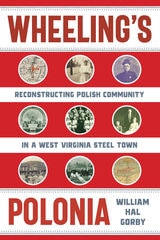
Wheeling's Polonia
Reconstructing Polish Community in a West Virginia Steel TownWilliam Hal Gorby
West Virginia University Press, 2020
William Hal Gorby’s study of Wheeling’s Polish community weaves together stories of immigrating, working, and creating a distinctly Polish American community, or Polonia, in the heart of the upper Ohio Valley steel industry. It addresses major topics in the history of the United States in the first half of the twentieth century, while shifting from urban historians’ traditional focus on large cities to a case study in a smaller Appalachian setting.
Wheeling was a center of West Virginia’s labor movement, and Polish immigrants became a crucial element within the city’s active working-class culture. Arriving at what was also the center of the state’s Roman Catholic Diocese, Poles built religious and fraternal institutions to support new arrivals and to seek solace in times of economic strain and family hardship. The city’s history of crime and organized vice also affected new immigrants, who often lived in neighborhoods targeted for selective enforcement of Prohibition.
At once a deeply textured evocation of the city’s ethnic institutions and an engagement with larger questions about belonging, change, and justice, Wheeling’s Polonia is an inspiring account of a diverse working-class culture and the immigrants who built it.
[more]
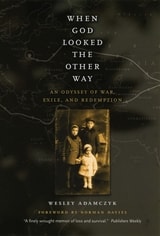
When God Looked the Other Way
An Odyssey of War, Exile, and RedemptionWesley Adamczyk
University of Chicago Press, 2004
Often overlooked in accounts of World War II is the Soviet Union's quiet yet brutal campaign against Polish citizens, a campaign that included, we now know, war crimes for which the Soviet and Russian governments only recently admitted culpability. Standing in the shadow of the Holocaust, this episode of European history is often overlooked. Wesley Adamczyk's gripping memoir, When God Looked the Other Way, now gives voice to the hundreds of thousands of victims of Soviet barbarism.
Adamczyk was a young Polish boy when he was deported with his mother and siblings from their comfortable home in Luck to Soviet Siberia in May of 1940. His father, a Polish Army officer, was taken prisoner by the Red Army and eventually became one of the victims of the Katyn massacre, in which tens of thousands of Polish officers were slain at the hands of the Soviet secret police. The family's separation and deportation in 1940 marked the beginning of a ten-year odyssey in which the family endured fierce living conditions, meager food rations, chronic displacement, and rampant disease, first in the Soviet Union and then in Iran, where Adamczyk's mother succumbed to exhaustion after mounting a harrowing escape from the Soviets. Wandering from country to country and living in refugee camps and the homes of strangers, Adamczyk struggled to survive and maintain his dignity amid the horrors of war.
When God Looked the Other Way is a memoir of a boyhood lived in unspeakable circumstances, a book that not only illuminates one of the darkest periods of European history but also traces the loss of innocence and the fight against despair that took root in one young boy. It is also a book that offers a stark picture of the unforgiving nature of Communism and its champions. Unflinching and poignant, When God Looked the Other Way will stand as a testament to the trials of a family during wartime and an intimate chronicle of episodes yet to receive their historical due.
“Adamczyk recounts the story of his own wartime childhood with exemplary precision and immense emotional sensitivity, presenting the ordeal of one family with the clarity and insight of a skilled novelist. . . . I have read many descriptions of the Siberian odyssey and of other forgotten wartime episodes. But none of them is more informative, more moving, or more beautifully written than When God Looked the Other Way.”—From the Foreword by Norman Davies, author of Europe: A History and Rising ’44: The Battle for Warsaw
“A finely wrought memoir of loss and survival.”—Publishers Weekly
“Adamczyk’s unpretentious prose is well-suited to capture that truly awful reality.” —Andrew Wachtel, Chicago Tribune Books
“Mr. Adamczyk writes heartfelt, straightforward prose. . . . This book sheds light on more than one forgotten episode of history.”—Gordon Haber, New York Sun
“One of the most remarkable World War II sagas I have ever read. It is history with a human face.”—Andrew Beichman, Washington Times
[more]

Whitman in Poland
The Reception and Role of the American Poet in Polish National CultureMarta A. Skwara
University of Iowa Press, 2020
Whitman in Poland examines the reception of Walt Whitman in Poland from 1872 to the present day. The many ways in which Whitman was read, translated, and constructed in Polish culture are analyzed using a unique interdisciplinary approach that melds reception, communication, translation, and comparative studies. Marta Skwara shows how Whitman’s biography was portrayed in
Poland; how and why the mid-1950s saw the greatest flourish of interest in Whitman as he was read in terms of “socialist realism” in accordance with the political indoctrination of the era; how Whitman’s image in Poland evolved from his first Polish translators and enthusiasts on through modernist poets’ responses; and how reading multiple Polish translations of the same Whitman poem by different translators allows us to see changing cultural and comparative contexts. Readers will get a full picture of how Whitman has functioned as a presence in Polish prose and poetry, and even in cinema and television.
Poland; how and why the mid-1950s saw the greatest flourish of interest in Whitman as he was read in terms of “socialist realism” in accordance with the political indoctrination of the era; how Whitman’s image in Poland evolved from his first Polish translators and enthusiasts on through modernist poets’ responses; and how reading multiple Polish translations of the same Whitman poem by different translators allows us to see changing cultural and comparative contexts. Readers will get a full picture of how Whitman has functioned as a presence in Polish prose and poetry, and even in cinema and television.
[more]

William & Rosalie
A Holocaust TestimonyWilliam Schiff
University of North Texas Press, 2007
[more]
Women in Poland, 1945–1989
Modernity, Equality, CommunismKatarzyna Stanczak-Wislicz
Central European University Press, 2026
Women in Poland 1945–1989: Modernity, Equality, Communism offers a compelling and deeply researched exploration of women’s lives under state socialism in Poland. The book reveals how communist promises of emancipation intersected with everyday reality – shaping work, family life, political participation, and personal identity. It examines women’s political engagement, experiences of work in both urban factories and rural fields, the management of household and family life, childhood and education, as well as biopolitics and the evolving culture of beauty. Juxtaposing the Polish experience with developments across Europe in the second half of the twentieth century, this insightful study uncovers the ambitions, contradictions, and lived realities of communist projects directed at women.
[more]
Women on the Polish Labor Market
Henryk Domanski
Central European University Press, 2001
Can women succeed? Is women's work appreciated equally to men's? Do women's salaries reflect the quality and quantity of work they do? Does gender make a difference? These questions, which often emerge even in democratic societies and free-market economies, are much more acute in the new democracies of Central and Eastern Europe. Gender has been an issue thus far neglected in transition economies. Drawing on official statistics, an international multidisciplinary team of sociologists, economists, demographers and geographers examines how women have been affected by the labor market reforms in Poland in the transition period of the 1990s. The issues discussed include occupational segregation, the social mobility of women, demographic change, the power and participation of women in public life, women's organizations, and labor market reform.
[more]