Results by title
1066 books match the query 'Political' and 31 start with w

W. E. B. Du Bois
Revolutionary Across the Color LineBill V. Mullen
Pluto Press, 2016
Du Bois was born in Massachusetts in 1868, just three years after formal emancipation of America’s slaves. In his extraordinarily long and active political life, he would emerge as the first black man to earn a PhD from Harvard; surpass Booker T. Washington as the leading advocate for African American rights; co-found the NAACP, and involve himself in anti-imperialist and anti-colonial struggles across Asia and Africa. Beyond his Civil Rights work, Mullen also examines Du Bois's attitudes towards socialism, the USSR, China’s Communist Revolution, and the intersectional relationship between capitalism, poverty and racism.
An accessible introduction to a towering figure of American Civil Rights, perfect for anyone wanting to engage with Du Bois’s life and work.
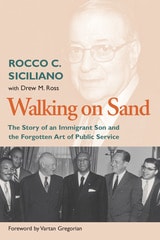
Walking On Sand
The Story of an Immigrant Son and the Forgotten Art of Public ServiceRocco C Siciliano
University of Utah Press, 2004
Rocco C. Siciliano broke new ground as the first Italian-American to serve in the White House as an assistant to the president, Dwight D. Eisenhower. At 31, "Ike’s Youngest" attained a prominence not suggested in his humble beginnings in Salt Lake City, Utah. But his upbringing in the Mormon-dominated community, where he balanced the heritage of his striving immigrant parents with his own aspirations for success, prepared him for a wide variety of service. This service includes leading a special weapons platoon in the 10th Mountain Division in World War II, bringing Martin Luther King Jr. to meet with President Eisenhower, and becoming a recognized business leader in California.
Siciliano used his expertise in labor, personnel management, and business to contribute substantively to the J. Paul Getty Center, the Los Angeles Philharmonic Association, the Committee for Economic Development, and the "Volcker" Commission on Public Service, among others.
The variety of Siciliano’s experiences reinvigorates our understanding of the forgotten art of public service. Walking on Sand emphasizes the role that public service can play for corporations, communities, states, and the nation. This story is a gift from the Greatest Generation to the many people who serve America today and will serve her tomorrow.
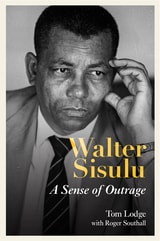
Walter Sisulu
A Sense of OutrageTom Lodge with Roger Southall
Ohio University Press, 0
Although hailed, alongside Nelson Mandela and Oliver Tambo, as one of the African National Congress’s holy trinity, Walter Sisulu has remained a relatively neglected figure in the historiography of the struggle for liberation in South Africa. Modest and unassuming, Sisulu was always content to stay in the background in a way that has long belied his importance. This nuanced and highly original biography, drafted by political historian Tom Lodge before his untimely death, provides a powerful corrective. Lodge describes Sisulu as an exceptional organizer, the most influential planner of the ANC’s mass campaigning during the 1950s, a principled but undoctrinaire communist, and like Mandela, an advocate of the necessity of armed struggle. He also served as the careful navigator of the ambiguous relationship between the ANC and Umkhonto we Sizwe, and Lodge details how Sisulu, with his exceptional grasp of the subtleties of fact and law, confounded the prosecution as he sat in the dock in the Rivonia trial. Sentenced to life imprisonment with his fellow defendants, Sisulu became a calming influence amid the divisive ideological debates that took place on Robben Island, as well as a constant source of strength and support to Mandela. After his 1989 release from jail—ahead of Mandela—he again demonstrated his prowess as the chief organizer of the ANC as it reestablished itself ahead of the 1994 elections. Sociologist Roger Southall stepped in to complete Lodge’s detailed analysis of Sisulu’s commitment and contribution to South African freedom, an encomium that Walter Sisulu richly deserves.
We Decide!
Theories and Cases in Participatory DemocracyMichael Menser
Temple University Press, 2017
Participatory democracy calls for the creation and proliferation of practices and institutions that enable individuals and groups to better determine the conditions in which they act and relate to others. Michael Menser’s timely book We Decide! is arguably the most comprehensive treatment of participatory democracy. He explains the three waves of participatory democracy theory to show that this movement is attentive to the mechanics of contemporary political practices. Menser also outlines “maximal democracy,” his own view of participatory democracy that expands people’s abilities to shape their own lives, reduce inequality, and promote solidarity.
We Decide! draws on liberal, feminist, anarchist, and environmental justice philosophies as well as in-depth case studies of Spanish factory workers, Japanese housewives, and Brazilian socialists to show that participatory democracy actually works. Menser concludes his study by presenting a reconstructed version of the state that is shaped not by corporations but by inclusive communities driven by municipal workers, elected officials, and ordinary citizens working together. In this era of Bernie Sanders and Donald Trump, the participatory democracy proposed in We Decide! is more significant than ever.
We
Reviving Social HopeRonald Aronson
University of Chicago Press, 2017
Beneath today’s crisis Aronson examines our heartbreaking story: a century of catastrophic violence and the bewildering ambiguity of progress—all of which have contributed to the evaporation of social hope. As he shows, we are now in a time when hope is increasingly privatized, when—despite all the ways we are connected to each other—we are desperately alone, struggling to weather the maelstrom around us, demoralized by the cynicism that permeates our culture and politics, and burdened with finding personal solutions to social problems.
Yet, Aronson argues, even at a time when false hopes are rife, social hope still persists. Carefully exploring what we mean when we say we “hope” and teasing hope apart from its dangerously misconstrued sibling, “progress,” he locates seeds of real change. He argues that always underlying our experience—even if we completely ignore it—is the fact of our social belonging, and that this can be reactivated into a powerful collective force, an active we. He looks to various political movements, from the massive collective force of environmentalists to the movements around Sanders and Jeremy Corbyn, as powerful examples of socially energized, politically determined, and actionably engaged forms of hope. Even in this age of Donald Trump, the result is an illuminating and inspiring call that anyone can clearly hear: we can still create a better future for everyone, but only if we resist false hopes and act together.
Western Creed, Western Identity
Essays in Legal and Social PhilosophyJude P. Dougherty
Catholic University of America Press, 2000
What Animals Teach Us about Politics
Brian Massumi
Duke University Press, 2014
What Is Nietzsche's Zarathustra?
A Philosophical ConfrontationHeinrich Meier
University of Chicago Press, 2021
A masterful, nuanced, and novel examination of Nietzsche’s Zarathustra.
Thus Spoke Zarathustra is Nietzsche’s most famous and most puzzling work, one in which he makes the greatest use of poetry to explore the questions posed by philosophy. But in order to understand the movement of this drama, we must first understand the character of its protagonist: we must ask, What Is Nietzsche’s Zarathustra?
Heinrich Meier attempts to penetrate the core of the drama, following as a guiding thread the question of whether Zarathustra is a philosopher or a prophet, or, if he is meant to be both, whether Zarathustra is able to unite philosopher and prophet in himself. Via a close reading that uncovers the book’s hidden structure, Meier develops a highly stimulating and original interpretation of this much-discussed but still ill-understood masterwork of German poetic prose. In the process, he carefully overturns long-established canons in the academic discourse of Nietzsche interpretation. The result is a fresh and surprising grasp of Nietzsche’s well-known teachings of the overman, the will to power, and the eternal return.
What is Political Philosophy? And Other Studies
Leo Strauss
University of Chicago Press, 1988
What Is Political Philosophy?—a collection of ten essays and lectures and sixteen book reviews written between 1943 and 1957—contains some of Leo Strauss's most famous writings and some of his most explicit statements of the themes that made him famous. The title essay records Strauss's sole extended articulation of the meaning of political philosophy itself. Other essays discuss the relation of political philosophy to history, give an account of the political philosophy of the non-Christian Middle Ages and of classic European modernity, and present his theory of esoteric writing.
When Conscience Calls
Moral Courage in Times of Confusion and DespairKristen Renwick Monroe
University of Chicago Press, 2023
What is moral courage? Why is it important and what drives it? An argument for why we should care about moral courage and how it shapes the world around us.
War, totalitarianism, pandemics, and political repression are among the many challenges and crises that force us to consider what humane people can do when the world falls apart. When tolerance disappears, truth becomes rare, and civilized discourse is a distant ideal, why do certain individuals find the courage to speak out when most do not?
When Conscience Calls offers powerful portraits of ordinary people performing extraordinary acts—be it confronting presidents and racist mobs or simply caring for and protecting the vulnerable. Uniting these portraits is the idea that moral courage stems not from choice but from one’s identity. Ultimately, Kristen Renwick Monroe argues bravery derives from who we are, our core values, and our capacity to believe we must change the world. When Conscience Calls is a rich examination of why some citizens embrace anger, bitterness, and fearmongering while others seek common ground, fight against dogma, and stand up to hate.
When Good Men Do Nothing
The Assassination Of Albert PattersonAlan Grady
University of Alabama Press, 2003
A true crime classic, the definitive account of the notorious 1954 assassination of Alabama Attorney General Albert Patterson
On June 18, 1954, just a few weeks after being elected Alabama's Attorney General, Albert Patterson was assassinated outside his law office in Phenix City, Alabama. His campaign promised hope and inspired reform to law-abiding citizens of Phenix City, which was notorious for organized crime, prostitution, gambling, bootlegging, and political corruption. Patterson's stance on cleaning up Phenix City had been met with threats and intimidation. With millions of dollars in illegal income and hundreds of political and professional careers at stake, the motive for his killing seemed apparent. The primary investigation surrounding Patterson's shooting focused on who pulled the trigger.
Alan Grady has exhaustively mined the state's original murder case files; the papers of John Patterson, Albert's son; records from the Office of Alabama Attorney General (who directed the murder investigation); the case files of the Alabama Department of Toxicology and Criminal Investigation; National Guard reports; and more than 30 interviews with eyewitnesses and interested parties.
Grady takes a complex story of multiple dimensions—a large cast of judicial, criminal, and political players; a web of alliances and allegiances; and a knotted sequence of investigative revelations and dead ends—and transforms it into a readable, incisive analysis of the powers and loyalties that governed, and corrupted to the core, the body politic of the state. Readers will be enthralled and educated by this authoritative account of the most compelling crime drama in Alabama during the 20th century.
When Spinoza Met Marx
Experiments in Nonhumanist ActivityTracie Matysik
University of Chicago Press, 2022
Karl Marx was a fiery revolutionary theorist who heralded the imminent demise of capitalism, while Spinoza was a contemplative philosopher who preached rational understanding and voiced skepticism about open rebellion. Spinoza criticized all teleological ideas as anthropomorphic fantasies, while Marxism came to be associated expressly with teleological historical development. Why, then, were socialists of the German nineteenth century consistently drawn to Spinoza as their philosophical guide? Tracie Matysik shows how the metaphorical meeting of Spinoza and Marx arose out of an intellectual conundrum around the meaning of activity. How is it, exactly, that humans can be fully determined creatures but also able to change their world? To address this paradox, many revolutionary theorists came to think of activity in the sense of Spinoza—as relating. Matysik follows these Spinozist-socialist intellectual experiments as they unfolded across the nineteenth century, drawing lessons from them that will be meaningful for the contemporary world.
When These Things Begin
Conversations with Michel TreguerRené Girard (Translated by Trevor Cribben Merrill)
Michigan State University Press, 2014
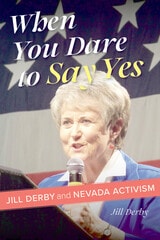
When You Dare to Say Yes
Jill Derby and Nevada ActivismJill Derby
University of Nevada Press, 2024
Derby’s account of the awakening of her post-college experience living abroad and stories of her global travels infuse this memoir with an international perspective and entertaining vignettes. Ultimately, Derby shares her personal understanding of the transformative power of living among different cultures.
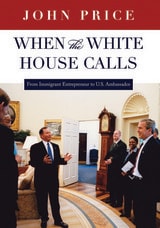
When the White House Calls
From Immigrant Entrepreneur to U.S. AmbassadorJohn Price
University of Utah Press, 2011
When the White House Calls tells the life story of John Price, one of Utah’s most prominent citizens, beginning with his birth in Germany through his years as a successful builder and real estate developer—with business interests in broadcasting, manufacturing, distribution, and banking—to his life as a diplomat. Born in Berlin on August 18, 1933, Hans Joachim Praiss was five years old when he and his family fled Nazi Germany in April 1939. The family found temporary refuge in Panama, finally arriving at Ellis Island in September 1940 and settling in New York City. Following the advice of a professor at CCNY, Price traveled west to fulfill a geology fieldwork course requirement, but upon seeing the snow-capped mountains surrounding Salt Lake City, knew he would stay. He earned his Bachelor of Science in Geological Engineering from the University of Utah in 1956. He practiced in that field before tiring of the often rigorous travel requirements and the desolate nature of the work. He soon turned to new opportunities.
Years later, after operating successful business enterprises throughout the Intermountain region and nationally, and serving on numerous local, state, and national boards, Price had become the consummate entrepreneur, businessman, and community leader. He was ready to serve his country when the White House called. In February 2002 he was sworn in as U.S. Ambassador to the Republic of Mauritius, the Republic of Seychelles, and the Union of the Comoros, three Indian Ocean island nations off the east coast of Africa, where he served until 2005.
In this telling autobiography, John Price focuses on his years as an ambassador and includes his thoughts on the future of sub-Saharan Africa. The account of his service as a diplomat offers readers a view of the daily life of an ambassador—the protocol for official meetings with heads of state, the routine of the office, the process of handling official communications, and the intricacies of diplomacy. More than that, in a world concerned with the global war on terror, he reflects on the three island nations where he served and on the region’s increasing strategic importance to the national security of the United States.
In the years since the 2001 attacks on the World Trade Center and the Pentagon, the al-Qaeda movement has grown and its members have dispersed throughout the world, including the region known as the Horn of Africa and East Africa. Price calls attention to the vulnerability of sub-Saharan Africa as a haven for terrorists, and the critical need for our engagement of this desperate continent with economic development, health care, and education to counter this threat. His concern for this region of Africa is carefully articulated in the text, as well as in interviews (included as appendixes) with notable country leaders. When the White House Calls is a compelling story of the American Dream realized, and the importance of service to country. This is a book that will both educate and inspire young people, their mentors, and others, as they work to make a difference in the world.

Whenever Two or More Are Gathered
Relationship as the Heart of Ethical DiscourseMichael M. Harmon and O. C. McSwite
University of Alabama Press, 2011
A Scholarly Exploration of How Relationships Shape Moral Understanding.
Whenever Two or More Are Gathered focuses on the critical role of ethics and moral responsibility in the field of public administration. Michael M. Harmon and O. C. McSwite posit that administrative ethics, as presently conceived and practiced, is largely a failure, incapable of delivering on its original promise of effectively regulating official conduct in order to promote the public interest. They argue that administrative ethics is compromised at its very foundations by two core assumptions: that human beings act rationally and that language is capable of conveying clear, stable, and unambiguous principles of ethical conduct.
The result is the illusion that values, principles, and rules of ethical conduct can be specified in workably clear ways, in particular, through their formalization in official codes of ethics; that people are capable of comprehending and responding to them as they are intended; and that the rewards and punishments attached to them will be effective in structuring daily behavior.
In a series of essays that draw on both fiction and film, as well as the disciplines of pragmatism, organizational theory, psychoanalysis, structural linguistics, and economics, Harmon and McSwite make their case for human relationship as the proper foundation of administrative ethics. “Exercising responsible ethical practice requires attaining a special kind of relationship with other people. Relationship is how the pure freedom that resides in the human psyche—for ethical choice, creativity, or original action of any type—can be brought into the structured world of human social relations without damaging or destroying it.” Furthermore, they make the case for dropping the term “ethics” in favor of the term “responsibility,” as “responsibility accentuates the social [relational] nature of moral action.”
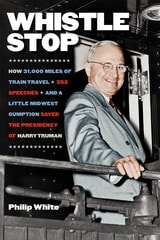
Whistle Stop
How 31,000 Miles of Train Travel, 352 Speeches, and a Little Midwest Gumption Saved the Presidency of Harry TrumanPhilip White
University Press of New England, 2015
Why Parties?
The Origin and Transformation of Political Parties in AmericaJohn H. Aldrich
University of Chicago Press, 1995
Surveying three critical episodes in the development of American political parties—from their formation in the 1790s to the Civil War—Aldrich shows how parties serve to combat three fundamental problems of democracy: how to regulate the number of people seeking public office; how to mobilize voters; and how to achieve and maintain the majorities needed to accomplish goals once in office. Overcoming these obstacles, argues Aldrich, is possible only with political parties.
Aldrich brings this innovative account up to date by looking at the profound changes in the character of political parties since World War II. In the 1960s, he shows, parties started to become candidate-centered organizations that are servants to their office seekers and officeholders. Aldrich argues that this development has revitalized parties, making them stronger, and more vital, with well-defined cleavages and highly effective governing ability.

Why They Die
Civilian Devastation in Violent ConflictDaniel Rothbart and Karina V. Korostelina
University of Michigan Press, 2013
Why do civilians suffer most during times of violent conflict? Why are civilian fatalities as much as eight times higher, calculated globally for current conflicts, than military fatalities? In Why They Die, Daniel Rothbart and Karina V. Korostelina address these questions through a systematic study of civilian devastation in violent conflicts. Pushing aside the simplistic definition of war as a guns-and-blood battle between two militant groups, the authors investigate the identity politics underlying conflicts of many types. During a conflict, all those on the opposite side are perceived as the enemy, with little distinction between soldiers and civilians. As a result, random atrocities and systematic violence against civilian populations become acceptable.
Rothbart and Korostelina devote the first half of the book to case studies: deportation of the Crimean Tatars from the Ukraine, genocide in Rwanda, the Lebanon War, and the war in Iraq. With the second half, they present new methodological tools for understanding different types of violent conflict and discuss the implications of these tools for conflict resolution.
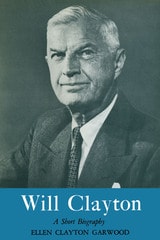
Will Clayton
A Short BiographyBy Ellen Clayton Garwood
University of Texas Press, 1959
Will Clayton left his mark on world commerce through the development of Anderson, Clayton & Co., the world's largest cotton marketing firm; he made an equally important impress on international economics and politics through special and vital service in the State Department during three crucial years of world history.
The politico-economic philosophy that Will Clayton developed as cotton merchant to the world provided the basis for his distinguished service as Assistant Secretary of State and as Undersecretary of State for Economic Affairs and influenced the course of international events far more than is generally realized.
"When the full story of the genesis of the Marshall Plan is told, it will become evident that the inspiration was Will Clayton's; which means he will have a firm niche in history, for this, if for nothing else," wrote John Dalgleish in Everybody's Weekly (London) in 1947. Dalgleish's opinion is supported by documentary evidence and the statements of others whose views are given in this short biography.
The principal events in Will Clayton's background that shaped his character and developed his personal philosophy are here portrayed by one who had a unique opportunity to view her subject at close range during the main periods of his careers in government and business. In this brief biography, his eldest daughter, Ellen Clayton Garwood, intimately but objectively traces the evolution of Clayton's realistic internationalism. The effectiveness of his governmental service in a fast-shrinking world had its roots in his early struggles in international cotton marketing. His marked ability to gain the support of Congress for government proposals—extension of the Reciprocal Trade Agreements Act, the British Loan, the Marshall Plan—is foreshadowed in his triumphant defense of his own business before a Senate investigating committee in the early twentieth century, and by his championship of Southern delivery on futures contracts on the New York Cotton Exchange.
But the story is not all one of success. Will Clayton wanted more than anything to see his country assume membership in an International Trade Organization, for the charter of which he had worked so hard. His disappointment here—partially offset by the success of the General Agreement on Tariffs and Trade—finds counterpart throughout these pages in the obstacles he had to overcome in his development as a human being.
And human being he emerges—son, husband, and father; businessman and statesman—whose measure, with its shadow and its highlights, should serve as strong encouragement for those who would serve their country and their world with equally intelligent devotion.
This book, therefore, brings a note of definite optimism. Will Clayton started out as a poor boy among the bewildered people of the reconstructed South. He emerged a statesman who drew out of still worse confusion in the world a program of hopeful and uplifting clarity. His own words, in a cable from Geneva, August 15, 1947, describe the challenge he met—a challenge that recurs in different form today: "A great opportunity to help Europe lift herself permanently out of a morass of bilateralism and restrictionism has floated in to us on a floodtide of destruction. If we fail to seize this opportunity now it will probably never return except possibly after a third World War."
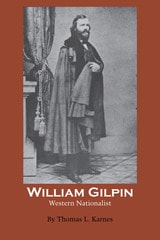
William Gilpin
Western NationalistBy Thomas L. Karnes
University of Texas Press, 1970
William Gilpin (1815–1894) has been called “America’s first geopolitician.” Regarded today as both scientist and quack, Gilpin was in his own time a recognized authority whose maps were accepted by Congress as the most accurate available, and his description of trails and land in the West were read by pioneer and scientist alike as inspiration and guide.
His writings first introduced to the American public the treasures of the Great Plains (to Gilpin probably belongs the credit for introducing this well-known term) and the mountain plateaus of the Rockies. He advertised the future of the lush valleys of Oregon and the mineral riches that, he was sure, the American West contained.
Gilpin was a cultured, educated man; his studies and his hours of lonely observation on many trips across the American prairies had resulted in the theory—in part true, in part fallacious—about the importance of the Mississippi Valley to world trade and world peace. To his contemporaries and a few later historians he was “a man of rare genius and advanced thought, a prophet and pioneer of civilization,” “one of the wonderful and gifted men of the age, and to him are the citizens of the Republic, in general, and the West, in particular, immeasurably indebted.”
In this biography Thomas L. Karnes traces the life of William Gilpin from the quiet comfort of his wealthy Quaker boyhood home through an exciting and turbulent career as Indian fighter, pioneer, newspaper editor, explorer, land promoter, and first governor of Colorado Territory. But throughout his varied career there was one task to which Gilpin was always devoted: he was a publicizer of the West, first in letters to family and friends; then in newspaper articles, books, and speeches; and finally in reports that became part of the Congressional Record and that influenced the actions of Presidents.
William Godwin
A Political LifeRichard Gough Thomas
Pluto Press, 2019
William Godwin was the first major anarchist thinker in the Anglophone world, and his thought rocked the establishment at the beginning of the nineteenth century. Famously married to Mary Wollstonecraft, father to Mary Shelley, and inspiration to Lord Byron, he lived a life and created a body of work that lie at the heart of British radicalism and romanticism.
In this biography, Richard Gough Thomas reads Godwin afresh, drawing on newly discovered letters and journals. He situates Godwin’s early life in the counterculture of eighteenth-century religious dissent, before moving on to exploring the ideas of the French Revolution. As Godwin's groundbreaking works propelled him from Whig party hack to celebrity philosopher, his love affair with Mary Wollstonecraft saw him ostracized in both liberal and conservative circles.
Godwin's anarchism always remained at the center of his work, Thomas shows, inspiring libertarians, both left- and right-wing. This biography places Godwin alongside the other members of his famous family as a major political, ethical, and educational writer and shows why a reappraisal of his ideas is pertinent today.
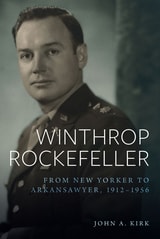
Winthrop Rockefeller
From New Yorker to Arkansawyer, 1912-1956John A. Kirk
University of Arkansas Press, 2022
Winner, 2024 J. G. Ragsdale Book Award, Arkansas Historical Association
Winner, 2024 Booker Worthen Literary Prize
Why did Winthrop Rockefeller, scion of one of the most powerful families in American history, leave New York for an Arkansas mountaintop in the 1950s? In this richly detailed biography of the former Arkansas governor, John A. Kirk delves into the historical record to fully unravel that mystery for the first time. Kirk pursues clues threaded throughout Rockefeller’s life, tracing his family background, childhood, and education; his rise in the oil industry from roustabout to junior executive; his military service in the Pacific during World War II, including his involvement in the battles of Guam, Leyte, and Okinawa; his postwar work in race relations, health, education, and philanthropy; his marriage to and divorce from Barbara “Bobo” Sears; and the birth of his only child, future Arkansas lieutenant governor Win Paul Rockefeller. This careful examination of Winthrop Rockefeller’s first forty-four years casts a powerful new light on his relationship with his adopted state, where his legacy continues to be felt more than half a century after his governorship.
Wisconsin Watershed
Tony Earl and the New Politics of the Democratic PartyDave Cieslewicz
Michigan State University Press, 2027
In 1982, Tony Earl stormed into the Wisconsin governorship with a sweeping victory, rallying blue-collar Democrats around a progressive political platform. Four years later, observers were stunned when he was soundly defeated by conservative Republican Tommy Thompson—not because of any failure as governor, but because, as Dave Cieslewicz notes, the Democratic Party and American politics had undergone a dramatic transformation.
Wisconsin Watershed traces Earl’s journey from Michigan’s Upper Peninsula and the U.S. Navy, through his years in Wisconsin politics and his single, controversial term as Wisconsin’s governor. Earl tackled acid rain, comparable worth, AIDS policy, and tax reform with equal force; he kept American Motors in the state and pulled Wisconsin from a fiscal crisis. Yet voters could not connect his name with his accomplishments. The progressivism that energized new constituencies also alienated the working-class Catholics who had formed the Democratic Party’s backbone. “It’s not the taxes,” one legislator explained. “It’s the desks”—the name for Earl’s symbolic offices to advocate for Native Americans, African Americans, and women.
Earl refused negative campaigning, and he believed that good policy would ultimately prove good politics. His defeat marked the beginning of the end of an era of civility. Through Earl’s story, we witness the Democratic Party’s evolution from New Deal coalition to the emergence of a modern campaign culture that values image and anger over good governance.
With Honor
Melvin Laird in War, Peace, and PoliticsVan Atta
University of Wisconsin Press, 2008
The first book ever to focus on Laird’s legacy, this authorized biography reveals his central and often unrecognized role in managing the crisis of national identity sparked by the Vietnam War—and the challenges, ethical and political, that confronted him along the way. Drawing on exclusive interviews with Laird, Henry Kissinger, Gerald Ford, and numerous others, author Dale Van Atta offers a sympathetic portrait of a man striving for open government in an atmosphere fraught with secrecy. Van Atta illuminates the inner workings of high politics: Laird’s behind-the-scenes sparring with Kissinger over policy, his decisions to ignore Nixon’s wilder directives, his formative impact on arms control and health care, his key role in the selection of Ford for vice president, his frustration with the country’s abandonment of Vietnamization, and, in later years, his unheeded warning to Donald Rumsfeld that “it’s a helluva lot easier to get into a war than to get out of one.”

Wizards
David Duke, America's Wildest Election, and the Rise of the Far RightBrian Fairbanks
Vanderbilt University Press, 2022
A surging Republican populist.
The Democrat, hounded by corruption allegations; the Republican, dogged by business failures and ties to white supremacists.
The Republican turned out thousands of screaming supporters for speeches blaming illegal immigrants and crime on the Democrats, and the Democrat plummeted in the polls.
Sound familiar?
The '91 Louisiana Governor's race was supposed to be forgettable. But when former KKK Grand Wizard David Duke shocked the nation by ousting incumbent Republican Governor Buddy Roemer in the primary, the world took notice. Democrat Edwin Edwards, a former three-term governor and two-time corruption defendant, was left alone to face Duke in the general election—and he was going to lose.
Then a little-known state committeewoman stepped in with evidence of Duke's nefarious past. Could her evidence be enough to sway the minds of fired-up voters, or would Louisiana welcome a far-right radical into the highest office in the state?
Journalist Brian Fairbanks explores how the final showdown between Duke and Edwards in November 1991 led to a major shift in our national politics, as well as the rise of the radical right and white supremacist groups, and how history repeated itself in the 2016 presidential election. The story of these political "wizards," almost forgotten by history, remains eerily prescient and disturbingly relevant, and a compulsive page-turner.
World War and World Peace in the Age of Digital Capitalism
By Christian Fuchs
University of Westminster Press, 2025
In World War and World Peace in the Age of Digital Capitalism, Christian Fuchs asks: how do violence and war manifest themselves in global digital capitalism? How do digital capitalism and digital technologies manifest themselves in violence and warfare? What are the prospects for world peace today?
To prevent world war and advance world peace we need a better understanding of war and violence and their contexts and causes. We need to ask what war is, what violence is, what war and peace look like today and how they have changed in the 21st century. This book addresses these urgent questions and provides possible answers.
Worldly Ethics
Democratic Politics and Care for the WorldElla Myers
Duke University Press, 2013
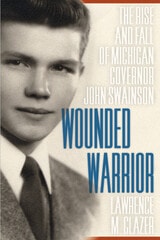
Wounded Warrior
The Rise and Fall of Michigan Governor John SwainsonLawrence M. Glazer
Michigan State University Press, 2010
Few people today remember John Swainson. As a teenage soldier he lost both legs in a WWII landmine explosion. Back in the United States, following a meteoric political rise in the Michigan State Senate, Swainson was elected as Michigan's youngest governor since Stevens T. Mason.
In 1970 Swainson was elected to the Michigan Supreme Court, becoming one of the few public officials to have served in the legislative, executive, and judicial branches of state government. Then, in 1957, he was indicted on federal charges of bribery and perjury, and convicted of lying to a federal grand jury. Forced to leave the state Supreme Court and disbarred from practicing law, he became a pariah, sinking into depression and alcoholism. He virtually disappeared from public view.
Lawrence M. Glazer re-examines the FBI's investigation of Swainson and delves into his 1975 trial in detail. He reveals new information from eye-witnesses who never testified and, in a poignant coda, relates the little-known story of Swainson's rehabilitation and return to public life as a historian.
Writing
The Political TestClaude Lefort
Duke University Press, 2000
In Writing: The Political Test, France’s leading political philosopher, Claude Lefort, illuminates the process by which writers negotiate difficult path to free themselves from the ideological and contextual traps that would doom their attempts to articulate a new vision. Lefort examines writers whose works provide special insights into this problem of risk, both literary artists and political philosophers. Among them are Salman Rushdie, Sade, Tocqueville,m Machiavelli, Leo Strauss, Orwell, Kant, Robespierre, Guizot, and Pierre Clastres. In Tocqueville, for example, Lefort finds that the author’s improvisatory and open-ended expression represents the character of the democratic experience. Orwell’s work on totalitarianism shows up the totalitarian subject’s complicity in this political regime. And Rushdie is remarkable for his solid attack on relativism. With the character and fate of the political forms of modernity, democracy, and totalitarianism a central theme, Lefort concludes with some reflections on the collapse of the Soviet Union.
This intriguing and accessible exploration of literature’s political aspects and political philosophy’s literary ones will be welcomed by those who have been stymied by current efforts to bridge these two fields. Taken together, the essays in this volume also stand as an intellectual autobiography of Lefort, making it an excellent introduction to his work for less experience students of political theory or philosophy.