Results by title
233 books match the query 'Political culture' and 4 start with w

Warped Narratives
Distortion in the Framing of Gun PolicyMelissa K. Merry
University of Michigan Press, 2020
The politics of gun policy in the United States are dramatic. Against the backdrop of daily gun violence—which claims more than 33,000 lives per year—gun control groups push for stronger regulations, while gun rights groups resist infringements upon their Second Amendment rights. To illuminate the dynamics of this polarized debate, Warped Narratives examines how and why interest groups frame the gun violence problem in particular ways, exploring the implication of groups’ framing choices for policymaking and politics. Melissa K. Merry argues that the gun policy arena is warped, and that both gun control and gun rights organizations contribute to the distortion of the issue by focusing on atypical characters and settings in their policy narratives. Gun control groups emphasize white victims, child victims, and mass shootings in suburban locales, while gun rights groups focus on self-defense shootings, highlighting threats to “law-abiding” gun owners. In reality, most gun deaths are the result of suicide. Homicides occur disproportionately in urban areas, mainly affecting racial minorities. While warping makes political sense in the short term, it may lead to negative, long-term consequences, including constraints on groups’ ability to build broad-based coalitions and to reduce prospects for compromise. To demonstrate warping, Merry analyzes nearly 67,000 communications by 15 national gun policy groups between 2000 and 2017 collected from blogs, emails, Facebook posts, and press releases. This book is the first to systematically assess the role of race in gun policy groups’ framing and offers the most comprehensive examination to date of interest groups’ presentation of this issue.

When Informal Institutions Change
Institutional Reforms and Informal Practices in the Former Soviet UnionHuseyn Aliyev
University of Michigan Press, 2017
When Informal Institutions Change engages with a growing body of literature on informal practices and institutions in political science, economics, sociology, and beyond. Aliyev proposes expanding the analysis of the impact of institutional reforms on informal institutions beyond disciplinary boundaries, and combines theoretical insights from comparative politics with economic and social theories on informal relations. In addition, Aliyev offers insights that are relevant to democratization, institutionalism, and human geography. Detailed case studies of three transitional post-Soviet regimes—Georgia, Moldova, and Ukraine—illustrate the contentious relationship between democratic institutional reforms and informality in the broader post-Soviet context.
Aliyev shows that in order for institutional reform to succeed in strengthening, democratizing, and formalizing institutions, it is important to approach informal practices and institutions as instrumental for its effectiveness. These findings have implications not only for hybrid regimes, but also for other post-Soviet or post-communist countries.

Written in Stone
Public Monuments in Changing SocietiesSanford Levinson
Duke University Press, 1998
In Written in Stone, legal scholar Sanford Levinson considers the tangled responses of ever-changing societies to the monuments and commemorations created by past regimes or outmoded cultural and political systems. Drawing on examples from Albania to Zimbabwe, from Moscow to Managua, and paying particular attention to examples throughout the American South, Levinson looks at social and legal arguments regarding the display, construction, modification, and destruction of public monuments. He asks what kinds of claims the past has on the present, particularly if the present is defined in dramatic opposition to its past values. In addition, he addresses the possibilities for responding to the use and abuse of public spaces and explores how a culture might memorialize its historical figures and events in ways that are beneficial to all its members.
Written in Stone is a meditation on how national cultures have been or may yet be defined through the deployment of public monuments. It adds a thoughtful and crucial voice into debates surrounding historical accuracy and representation, and will be welcomed by the many readers concerned with such issues.
Written in Stone
Public Monuments in Changing SocietiesSanford Levinson
Duke University Press, 1998
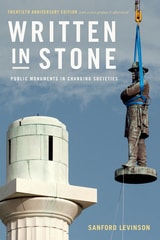
From the removal of Confederate monuments in New Orleans in the spring of 2017 to the violent aftermath of the white nationalist march on the Robert E. Lee monument in Charlottesville later that summer, debates and conflicts over the memorialization of Confederate “heroes” have stormed to the forefront of popular American political and cultural discourse. In Written in Stone Sanford Levinson considers the tangled responses to controversial monuments and commemorations while examining how those with political power configure public spaces in ways that shape public memory and politics. Paying particular attention to the American South, though drawing examples as well from elsewhere in the United States and throughout the world, Levinson shows how the social and legal arguments regarding the display, construction, modification, and destruction of public monuments mark the seemingly endless confrontation over the symbolism attached to public space.
This twentieth anniversary edition of Written in Stone includes a new preface and an extensive afterword that takes account of recent events in cities, schools and universities, and public spaces throughout the United States and elsewhere. Twenty years on, Levinson's work is more timely and relevant than ever.