70 books match the query 'Prisons' and 6 start with w

cover of Walking George: The Life of George John Beto and the Rise of the Modern Texas Prison System

Walking George

The Life of George John Beto and the Rise of the Modern Texas Prison System

David M. Horton

University of North Texas Press, 2005
[more]
cover of Warfare in the American Homeland: Policing and Prison in a Penal Democracy

Warfare in the American Homeland

Policing and Prison in a Penal Democracy

Joy James, ed.

Duke University Press, 2007

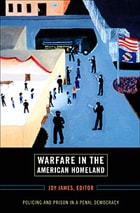
The United States has more than two million people locked away in federal, state, and local prisons. Although most of the U.S. population is non-Hispanic and white, the vast majority of the incarcerated—and policed—is not. In this compelling collection, scholars, activists, and current and former prisoners examine the sensibilities that enable a penal democracy to thrive. Some pieces are new to this volume; others are classic critiques of U.S. state power. Through biography, diary entries, and criticism, the contributors collectively assert that the United States wages war against enemies abroad and against its own people at home.

Contributors consider the interning or policing of citizens of color, the activism of radicals, structural racism, destruction and death in New Orleans following Hurricane Katrina, and the FBI Counterintelligence Program designed to quash domestic dissent. Among the first-person accounts are an interview with Dhoruba Bin Wahad, a Black Panther and former political prisoner; a portrayal of life in prison by a Plowshares nun jailed for her antinuclear and antiwar activism; a discussion of the Puerto Rican Independence Movement by one of its members, now serving a seventy-year prison sentence for sedition; and an excerpt from a 1970 letter by the Black Panther George Jackson chronicling the abuses of inmates in California’s Soledad Prison. Warfare in the American Homeland also includes the first English translation of an excerpt from a pamphlet by Michel Foucault and others. They argue that the 1971 shooting of George Jackson by prison guards was a murder premeditated in response to human-rights and justice organizing by black and brown prisoners and their supporters.

Contributors. Hishaam Aidi, Dhoruba Bin Wahad (Richard Moore), Marilyn Buck, Marshall Eddie Conway, Susie Day, Daniel Defert, Madeleine Dwertman, Michel Foucault, Carol Gilbert, Sirène Harb, Rose Heyer, George Jackson, Joy James, Manning Marable, William F. Pinar, Oscar Lòpez Rivera, Dylan Rodríguez, Jared Sexton, Catherine vön Bulow, Laura Whitehorn, Frank B. Wilderson III
[more]
cover of When the Smoke Cleared: Attica Prison Poems and Journal

When the Smoke Cleared

Attica Prison Poems and Journal

Celes Tisdale, editor

Duke University Press, 2022
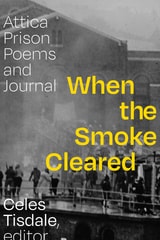
Following the Attica prison uprising in September 1971, Celes Tisdale—a poet and then professor at Buffalo State College—began leading poetry workshops with those incarcerated at Attica. Tisdale’s workshop created a space of radical Black creativity and solidarity, in which poets who lived through the uprising were able to turn their experiences into poetry. The poems written by Tisdale’s students were published as Betcha Ain’t: Poems from Attica in 1974. When the Smoke Cleared contains the entirety of Betcha Ain’t, Tisdale’s own poems and journal entries from the three years he taught at Attica, a previously unpublished collection of poems by Attica poets, and a critical introduction by poet Mark Nowak. In addition to the poetry, Tisdale’s journal entries give readers a unique opportunity to experience what it was like to enter Attica as an educator and return week after week to discuss poetry. When the Smoke Cleared showcases these poets’ achievements, their desire for self-determination, and their historical role as storytellers of Black life in a prison monitored exclusively by white guards and administrators.
[more]
cover of Whose Rights?: Counterterrorism and the Dark Side of American Public Opinion

Whose Rights?

Counterterrorism and the Dark Side of American Public Opinion

Clem Brooks

Russell Sage Foundation, 2013
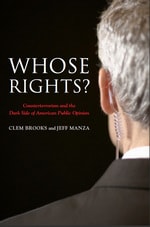
In the wake of the September 11 attacks, the U.S. government adopted a series of counterterrorism policies that radically altered the prevailing balance between civil liberties and security. These changes allowed for warrantless domestic surveillance, military commissions at Guantanamo Bay and even extralegal assassinations. Now, more than a decade after 9/11, these sharply contested measures appear poised to become lasting features of American government. What do Americans think about these policies? Where do they draw the line on what the government is allowed to do in the name of fighting terrorism? Drawing from a wealth of survey and experimental data, Whose Rights? explores the underlying sources of public attitudes toward the war on terror in a more detailed and comprehensive manner than has ever been attempted. In an analysis that deftly deploys the tools of political science and psychology, Whose Rights? addresses a vexing puzzle: Why does the counterterrorism agenda persist even as 9/11 recedes in time and the threat from Al Qaeda wanes? Authors Clem Brooks and Jeff Manza provocatively argue that American opinion, despite traditionally showing strong support for civil liberties, exhibits a “dark side” that tolerates illiberal policies in the face of a threat. Surveillance of American citizens, heightened airport security, the Patriot Act and targeted assassinations enjoy broad support among Americans, and these preferences have remained largely stable over the past decade. There are, however, important variations: Waterboarding and torture receive notably low levels of support, and counterterrorism activities sanctioned by formal legislation, as opposed to covert operations, tend to draw more favor. To better evaluate these trends, Whose Rights? examines the concept of “threat-priming” and finds that getting people to think about the specter of terrorism bolsters anew their willingness to support coercive measures. A series of experimental surveys also yields fascinating insight into the impact of national identity cues. When respondents are primed to think that American citizens would be targeted by harsh counterterrorism policies, support declines significantly. On the other hand, groups such as Muslims, foreigners, and people of Middle Eastern background elicit particularly negative attitudes and increase support for counterterrorism measures. Under the right conditions, Brooks and Manza show, American support for counterterrorism activities can be propelled upward by simple reminders of past terrorism plots and communication about disliked external groups. Whose Rights? convincingly argues that mass opinion plays a central role in the politics of contemporary counterterrorism policy. With their clarity and compelling evidence, Brooks and Manza offer much-needed insight into the policy responses to the defining conflict of our age and the psychological impact of terrorism.
[more]
cover of Why Are So Many Americans in Prison? 

Why Are So Many Americans in Prison? 

Steven Raphael

Russell Sage Foundation, 2013

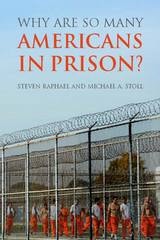
Between 1975 and 2007, the American incarceration rate increased nearly fivefold, a historic increase that puts the United States in a league of its own among advanced economies. We incarcerate more people today than we ever have, and we stand out as the nation that most frequently uses incarceration to punish those who break the law. What factors explain the dramatic rise in incarceration rates in such a short period of time? In Why Are So Many Americans in Prison? Steven Raphael and Michael A. Stoll analyze the shocking expansion of America’s prison system and illustrate the pressing need to rethink mass incarceration in this country. Raphael and Stoll carefully evaluate changes in crime patterns, enforcement practices and sentencing laws to reach a sobering conclusion: So many Americans are in prison today because we have chosen, through our public policies, to put them there. They dispel the notion that a rise in crime rates fueled the incarceration surge; in fact, crime rates have steadily declined to all-time lows. There is also little evidence for other factors commonly offered to explain the prison boom, such as the deinstitutionalization of the mentally ill since the 1950s, changing demographics, or the crack-cocaine epidemic. By contrast, Raphael and Stoll demonstrate that legislative changes to a relatively small set of sentencing policies explain nearly all prison growth since the 1980s. So-called tough on crime laws, including mandatory minimum penalties and repeat offender statutes, have increased the propensity to punish more offenders with lengthier prison sentences. Raphael and Stoll argue that the high-incarceration regime has inflicted broad social costs, particularly among minority communities, who form a disproportionate share of the incarcerated population. Why Are So Many Americans in Prison? ends with a powerful plea to consider alternative crime control strategies, such as expanded policing, drug court programs, and sentencing law reform, which together can end our addiction to incarceration and still preserve public safety. As states confront the budgetary and social costs of the incarceration boom, Why Are So Many Americans in Prison? provides a revealing and accessible guide to the policies that created the era of mass incarceration and what we can do now to end it.
[more]
cover of Women Guarding Men

Women Guarding Men

Lynn Zimmer

University of Chicago Press, 1986

The hiring of women as guards in men's prisons represents a major breakthrough in women's efforts to achieve full sexual equality in the workplace. This dramatic social change has required great flexibility on the part of the women guards as well as substantial adjustments by their male counterparts, prison administrators, and the inmates themselves. In the first comprehensive study of this phenomenon, Lynn Zimmer examines the experiences of the women and men involved in the painful process of transition from a segregated to an integrated prison environment. Women Guarding Men is significant not only for its vivid depiction of their trials, but for its contribution to a general theory of women's occupational and organizational behavior.
[more]