Results by title
156 books match the query 'Psychotherapy' and 2 start with w
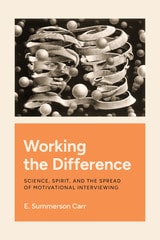
Working the Difference
Science, Spirit, and the Spread of Motivational InterviewingE. Summerson Carr
University of Chicago Press, 2023
Motivational interviewing (MI) is a professional practice, a behavioral therapy, and a self-professed conversation style that encourages clients to talk themselves into change. Originally developed to treat alcoholics, MI quickly spread into a variety of professional fields including corrections, medicine, and sanitation. In Working the Difference, E. Summerson Carr focuses on the training and dissemination of MI to explore how cultural forms—and particularly forms of expertise—emerge and spread. The result is a compelling analysis of the American preoccupations at MI’s core, from democratic autonomy and freedom of speech to Protestant ethics and American pragmatism.
Writing Against the Family
Gender in Lawrence and JoyceCynthia Lewiecki-Wilson
Southern Illinois University Press, 1994
This first feminist book-length comparison of D. H. Lawrence and James Joyce offers striking new readings of a number of the novelists’ most important works, including Lawrence’s Man Who Died and Joyce’s Finnegans Wake.
Cynthia Lewiecki-Wilson argues that a feminist reader must necessarily read with and against theories of psychoanalysis to examine the assumptions about gender embedded within family relations and psychologies of gender found in the two authors’ works. She challenges the belief that Lawrence and Joyce are opposites, inhabiting contrary modernist camps; instead they are on a continuum, with both engaged in a reimagination of gender relations.
Lewiecki-Wilson demonstrates that both Lawrence and Joyce write against a background of family material using family plots and family settings. While previous discussions of family relations in literature have not questioned assumptions about the family and about sex roles within it, Lewiecki-Wilson submits the systems of meaning by which gender is construed to a feminist analysis. She reexamines Lawrence and Joyce from the point of view of feminist psychoanalysis, which, she argues, is not a set of beliefs or a single theory but a feminist practice that analyzes how systems of meaning construe gender and produce a psychology of gender.
Lewiecki-Wilson argues against a theory of representation based on gender, however, concluding that Lawrence’s and Joyce’s texts, in different ways, test the idea of a female aesthetic. She analyzes Lawrence’s portrait of family relations in Sonsand Lovers, The Rainbow, and Women in Love and compares Joyce’s Portrait of the Artist as a Young Man with Lawrence’s autobiographical text. She then shows that Portrait begins a deconstruction of systems of meaning that continues and increases in Joyce’s later work, including Ulysses.
Lewiecki-Wilson concludes by showing that Lawrence, Joyce, and Freud relate family material to Egyptian myth in their writings. She identifies Freud’s essay "Leonardo da Vinci and a Memory of Childhood" as an important source for Joyce’s Finnegans Wake, which portrays beneath the gendered individual a root androgyny and asserts an unfixed, evolutionary view of family relations.